
I’ve eaten a lot of steak outside Korea.
Some had a stronger beef flavor. Some had an impressive aged aroma. Some were thick, beautifully seared steaks that I still remember.
But one thing has always stood out to me.
Very few were as soft and juicy as really good Hanwoo.
Hanwoo (한우, han-u), Korea’s native beef, is not cheap. Even Koreans consider a good Hanwoo dinner expensive.
But if you eat it the way Koreans do, there is more to the experience than simply ordering an expensive piece of beef.
The cuts change. The grill changes the flavor. The side dishes change the pace of the meal.
And the meal does not necessarily end when the meat is gone.
Different Cuts Really Do Taste Different
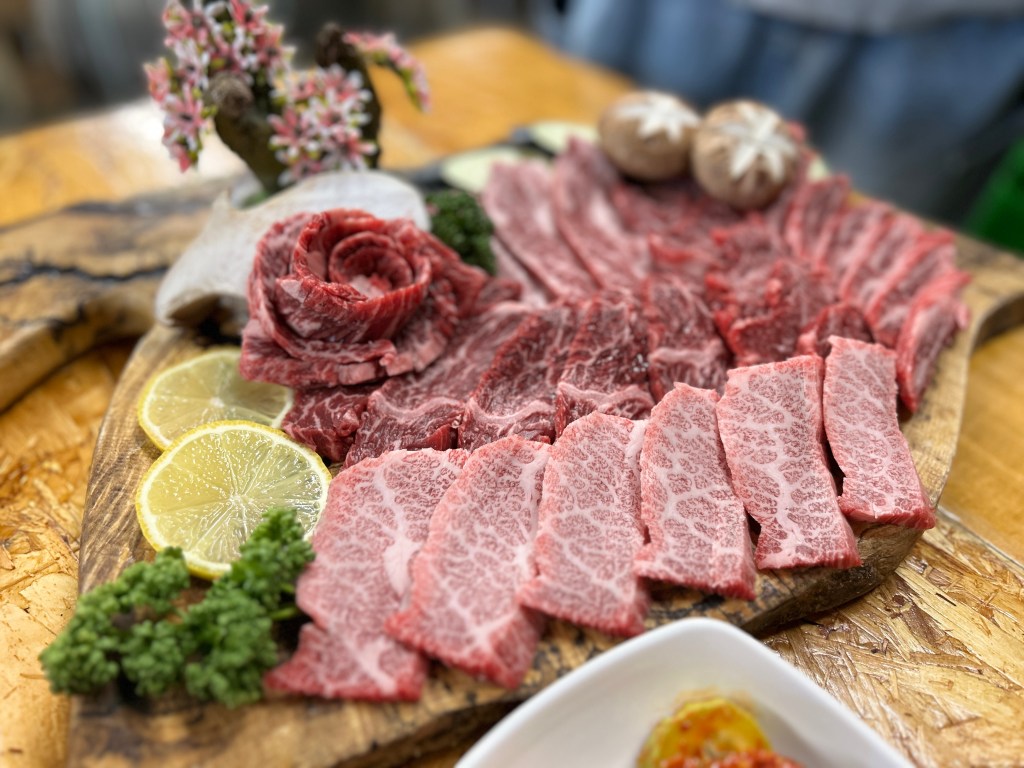
One of the first things you may notice at a Korean beef restaurant is the number of unfamiliar cut names.
There is sirloin and tenderloin, of course.
But then you start seeing cuts such as salchisal, anchangsal, tosisal, and jebichuri.
This is not simply a matter of giving more names to similar pieces of beef.
They can actually taste quite different.
Some are heavily marbled and extremely tender. Others have more texture.
And some have a noticeably different flavor.
A good example is inside skirt (안창살, anchangsal).
To me, anchangsal does not simply taste like a stronger or weaker version of sirloin. It has its own distinctive character.
That is why I would not recommend ordering a large amount of just one cut on your first Hanwoo meal.
If possible, try several cuts in smaller amounts and compare them.
Finding the cut you personally like is part of the fun.
The Way You Grill Hanwoo Changes the Experience
The same beef can taste surprisingly different depending on how it is cooked.
Over charcoal or direct flame, you get the aroma from the fire and the slightly charred edges that come with it.
A cast-iron plate gives you something different: a strongly seared surface and a richer, concentrated style of grilling.
I do not think one method is automatically better.
The same cut can feel like a different piece of beef depending on how it is grilled.
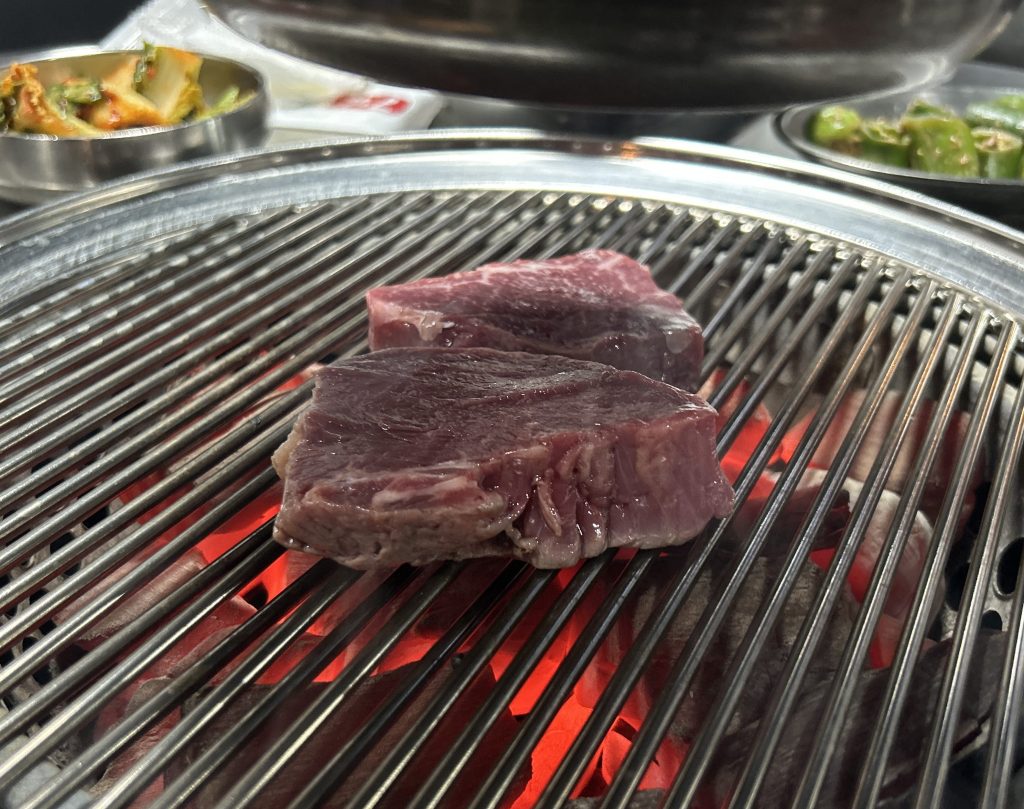
There is another point I would make to people who are used to ordering premium steak very rare.
With highly marbled Hanwoo, rarer is not always better.
Sometimes I prefer it cooked a little more so that the marbling has had enough heat to soften properly.
Premium beef does not automatically mean blue rare.
The best doneness depends on the cut and how heavily marbled it is.
Start Simple
When good Hanwoo arrives at the table, I do not immediately wrap it in vegetables or cover it with sauce.
For the first bite, salt is enough.
Then I might try a little wasabi.
That makes it easier to notice the texture, juiciness, and differences between the cuts.
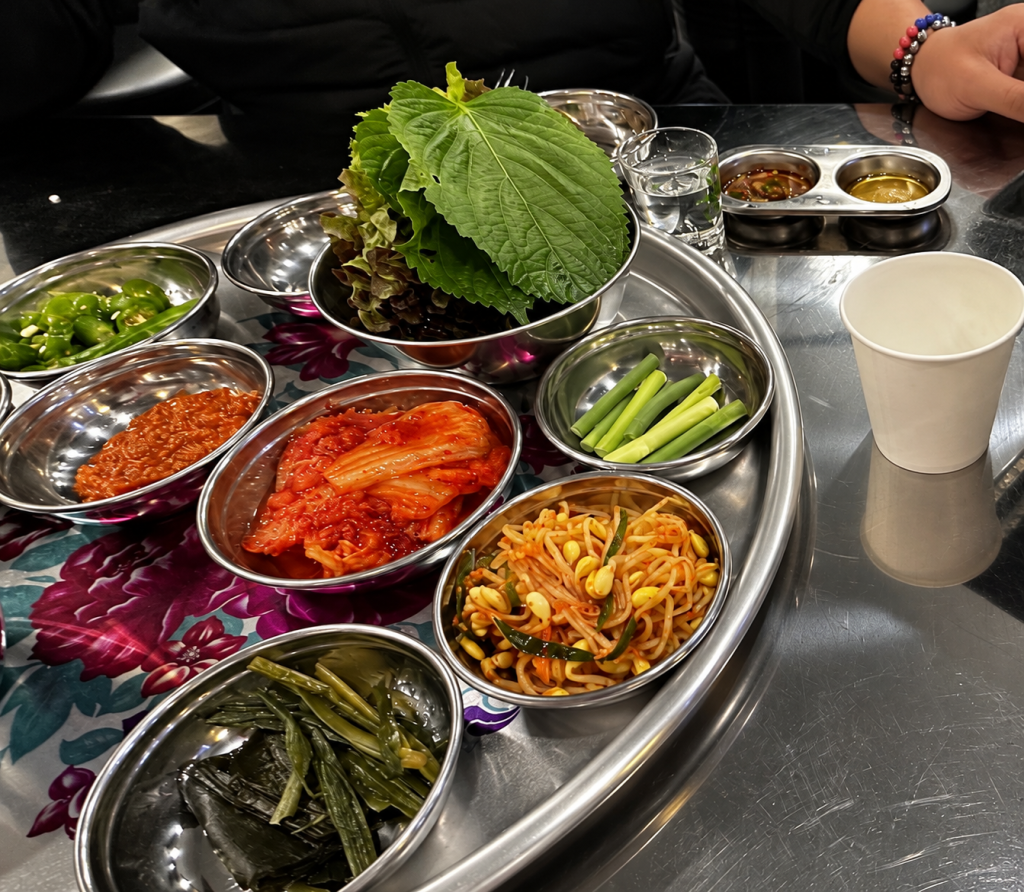
Koreans often eat grilled meat in Korean lettuce wraps (쌈, ssam), usually with garlic and fermented dipping paste (쌈장, ssamjang).
That is a perfectly normal way to eat beef.
Personally, though, I do not strongly recommend starting that way with good Hanwoo.
When lettuce, garlic, and ssamjang all go into one bite, the flavor of the beef becomes less noticeable.
With premium Hanwoo, I prefer to let the meat speak first.
Use the Side Dishes as the Meal Gets Richer
Even excellent beef can start to feel rich after several pieces.
This is where Korean barbecue side dishes become useful.
One of my favorites with Hanwoo is pickled wild garlic leaves (명이나물, myeongi-namul).
They are slightly sour and salty, and they work particularly well with rich beef without completely covering its flavor.
For a foreign visitor, I also think myeongi-namul is one of the easier Korean side dishes to enjoy.
Scallion salad, pickled onions, kimchi, and other small dishes give you ways to change the flavor as the meal continues.
I might eat the first few pieces with nothing but salt.
Later, when the beef starts to feel richer, I will eat a piece with myeongi-namul and then switch again.
That is how I think about Korean barbecue side dishes.
They are not just decorations around the grill. They help you enjoy rich meat in different ways from beginning to end.
What Should You Drink with Hanwoo?
For me, Hanwoo works with several kinds of alcohol.
Korean distilled liquor (소주, soju) is probably the easiest choice if you want the most recognizably Korean combination.
A soju-and-beer mix (소맥, somaek) also fits naturally into a Korean barbecue meal.
Wine works very well too.
When I have had wine with Hanwoo, I have often brought my own bottle and paid corkage rather than ordering from the restaurant’s wine list.
That does not mean a visitor needs to go out and buy a bottle.
Just know that some restaurants in Korea allow BYOB with a corkage fee. Check with the restaurant first.
Traditional Korean spirits can also be an interesting pairing.
Beer by itself?
Personally, it would not be my first choice with premium Hanwoo.
But that part is entirely personal taste.
Hanwoo Is Not Cheap
Hanwoo is expensive even for Koreans.
At a high-end Hanwoo restaurant in Seoul, the bill can rise quickly once you order several premium cuts, alcohol, and the finishing dishes.
If food is an important part of your trip and you want to make a proper occasion of it, I would personally budget around US$200 per person for a high-end Hanwoo dinner.
That is not a fixed price.
The actual bill depends heavily on the restaurant, the cuts you choose, and what you drink.
There is one thing I would pay particular attention to when reading the menu:
Do not judge the amount by the number of “servings.” Check the grams.
The amount a restaurant calls one serving can vary.
The weight in grams tells you much more clearly how much beef you are actually ordering.
Want Better Value in Seoul? Consider Majang
If you want to try Hanwoo in Seoul at better value, Majang Livestock Products Market (마장축산물시장, Majang Chuksanmul Sijang) is worth considering.
The way I usually do it is simple.
Choose the cuts and amount you want at a butcher shop, ask the butcher to recommend a nearby restaurant, and take the meat there.
You then pay a table-setting fee (상차림비, sangcharim-bi) and grill the beef at the restaurant.
Prices change depending on the cut, grade, and market conditions, so I would not give a fixed price.
From my experience, though, Majang can offer very good value for Hanwoo.
The market deserves a separate practical guide of its own, so I will leave the details for another article.
Don’t Leave After the Meat
If you go out for Hanwoo in Korea, I strongly recommend staying for the finishing meal.
Rice with soybean paste stew (된장찌개, doenjang-jjigae) and Korean cold noodles (냉면, naengmyeon) are common choices.
But there is one thing I particularly recommend.
If the restaurant cooks the beef on a cast-iron plate, check whether they make doenjang-jjigae or fried rice directly on the same plate after the meat.
If they do, order it.
The pan has already been used to cook all that beef, and the finishing dish picks up flavors left behind from the meal.
For me, this is not an afterthought.
It is part of the experience.
Do not finish the meat and immediately stand up. Stay for the last dish.
So, Is Hanwoo Worth the Price?
Hanwoo is expensive.
I do not think every traveler needs to spend this much money on a dinner in Korea.
But if food is part of the reason you travel, I think a proper Hanwoo meal can be worth the splurge.
Not simply because the beef carries a premium label.
You begin with different cuts, taste the meat simply with salt, change the pace with side dishes, have a drink, and then finish with stew or fried rice from the same meal.
That entire progression is part of what makes eating Hanwoo in Korea different from simply ordering a steak.
So if you get the chance to try good Hanwoo here, I would not judge it after two or three bites.
Eat all the way to the last spoonful. Then decide whether it was worth the price.
Have you tried Hanwoo in Korea? Which cut or way of eating it did you like most? Leave a comment below.


Leave a comment