
Jokbal: Why Koreans Love Pig’s Feet
At first, pig’s feet may not sound like the most tempting thing to order for dinner.
But in Korea, jokbal (족발) is a popular food, especially when several people are eating together.
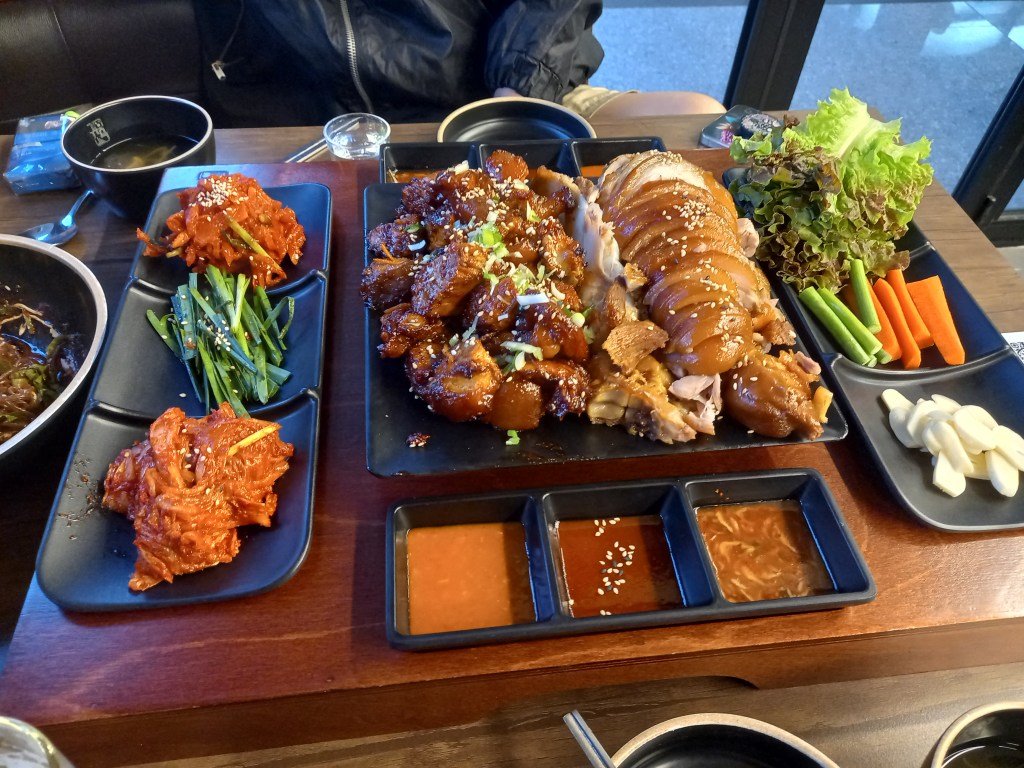
It usually arrives sliced on a large plate, surrounded by lettuce, garlic, kimchi, dipping sauces, and other side dishes.
And there is more than one way to eat it.
The photo at the top of this post is something I ordered myself: regular jokbal on one side and spicy buljokbal (불족발) on the other.
If you enjoy spicy food, this kind of half-and-half order is a good way to try both.
If you do not handle spicy food well, however, I would simply order regular jokbal.
You are not missing the point of jokbal by skipping the spicy version.
What Is Jokbal?
Jokbal is made from pig’s trotters that are slowly cooked in a seasoned broth, often with a soy-based flavor, until the meat becomes tender and the skin becomes soft and chewy.
It is then sliced and served on a large plate.
The meat and skin have noticeably different textures.
The meat is tender and savory, while the skin is chewy and slightly gelatinous.
For someone trying jokbal for the first time, the texture of the skin may actually be more surprising than the flavor.
Some people love that texture immediately. Others need a few bites to get used to it.
Jokbal is also commonly eaten as a shared dish.
Instead of ordering one plate for each person, people usually put a large plate in the middle of the table and share it.
Regular Jokbal vs. Buljokbal
Regular Jokbal — 족발
This is the classic version.
It is savory with a little sweetness, and the seasoning usually does not overpower the pork itself.
If you have never tried jokbal before, this is where I would start.
Buljokbal — 불족발
Buljokbal is jokbal coated in a spicy red sauce.
And there is something you should know before taking a big bite:
Buljokbal can be seriously spicy.
The heat level varies from restaurant to restaurant, but some versions are spicy even for Koreans.
If you are curious but not used to Korean spicy food, try a small piece first.
If you already know that you do not handle spicy food well, just order regular jokbal.
Regular jokbal is the classic dish, and you can fully enjoy jokbal without trying the spicy version.
If you love spicy food, a half-and-half order is a good way to compare the two.
How Koreans Eat Jokbal
You can simply pick up a slice of jokbal and eat it by itself.
But I recommend trying it several different ways.
That is part of the fun.
1. Try Your First Piece Plain
For your first bite, eat one slice of regular jokbal without adding anything.
This lets you taste the seasoning and notice the contrast between the tender meat and the chewy skin.
After that, start experimenting with the things around the plate.
2. Add a Little Saeujeot
Jokbal is commonly served with saeujeot (salted fermented shrimp).
If you have never eaten saeujeot before, this is how I recommend trying it.
Do not soak the whole piece of jokbal in the salty liquid.
Instead, pick up a few of the tiny shrimp and place them directly on top of a slice of jokbal.
Then eat them together.
Saeujeot is very salty, so you really do not need much.
3. Try It With Ssamjang
Another easy way to eat jokbal is with ssamjang (savory fermented dipping sauce).
Lightly dip one edge of the meat into the sauce.
You do not need to cover the whole piece.
Ssamjang has a strong savory flavor, so a small amount is usually enough.
4. Make a Ssam
A ssam is a Korean-style wrap made with lettuce or other leafy vegetables.
This is one of my favorite ways to eat jokbal.
But there is one useful thing to know before you make one.
Korean ssam is normally meant to be eaten in one bite.
It is not usually eaten like a sandwich, where you bite off half and keep eating the rest.
So do not build a giant wrap.
Make it small enough to fold and eat all at once.
My Favorite Jokbal Ssam
This is my personal favorite combination.
Start with:
- one palm-sized lettuce leaf
- one kkaennip (Korean perilla leaf)
- one slice of jokbal
- a little saeujeot (salted fermented shrimp)
- one piece of garlic lightly dipped in ssamjang (savory fermented dipping sauce)
Put the perilla leaf on top of the lettuce, add the jokbal and the other ingredients, fold everything together, and eat the whole thing in one bite.
You get the freshness of the lettuce, the distinctive aroma of the perilla leaf, the chewy pork, the salty saeujeot, and the garlic and ssamjang all at once.
That is my pick.
If raw garlic is too strong for you, use a smaller piece or simply leave it out.
Don’t Be Intimidated by All the Side Dishes
A jokbal table can look a little complicated when you first see it.
There may be lettuce, garlic, kimchi, radish kimchi, saeujeot, ssamjang, and several other side dishes around the main plate.
You do not have to use everything at once.
Try different combinations and find the one you like.
Kimchi and other spicy or tangy side dishes are especially good between bites of rich pork.
Makguksu Goes Very Well With Jokbal
At many jokbal restaurants, you will also see makguksu (spicy buckwheat noodles) served with the meal or offered as a common side dish.
Makguksu is usually spicy, tangy, and refreshing, which makes it a good contrast to the rich pork.
I like eating some jokbal, taking a bite of makguksu, and then going back to the meat.
You can also eat a little makguksu together with a slice of jokbal.
It is a very good combination.
What Do I Drink With Jokbal?
Jokbal works well with many kinds of alcoholic drinks.
Personally, I usually drink soju with it.
That is simply the combination I prefer.
What to Look for on a Korean Menu
If you are in a jokbal restaurant and cannot read the menu, these Korean words may help.
| Korean | What It Means |
|---|---|
| 족발 | Regular jokbal |
| 불족발 | Spicy jokbal |
| 반반족발 | Half regular + half spicy |
| 반반세트 | Half-and-half set |
| 냉채족발 | Cold-style jokbal with vegetables and a tangy mustard-style sauce |
The exact menu names can vary from restaurant to restaurant.
If you want regular and spicy jokbal together, you can try saying:
반반족발 주세요.
Banban jokbal juseyo.
Half-and-half jokbal, please.
If you are not comfortable pronouncing it, just show the Korean sentence to the staff on your phone.
That works too.
And if you do not want anything spicy, simply look for:
족발
You can also show the staff:
족발 주세요.
Jokbal juseyo.
Jokbal, please.
Sometimes the easiest communication tool is simply having the right Korean words on your screen.
What Is Naengchae Jokbal?
You may also see naengchae jokbal (냉채족발) on some menus.
This is a different style of jokbal served with vegetables and a tangy, mustard-style sauce.
Compared with regular jokbal, it tastes fresher and sharper.
So when someone says “jokbal,” it does not always mean exactly the same style of dish.
There are several variations.
Jokbal vs. Schweinshaxe: Same Pig, Completely Different Idea
Jokbal always makes me think of another pork-leg dish I ate years ago.
In 2007, during a 47-day trip around Europe, I spent some time in Dresden, Germany.
There, I ate Schweinshaxe at SchillerGarten by the Elbe River.
I still remember it as the best Schweinshaxe I have ever had.
What interests me now is how differently Germans and Koreans treat a similar part of the pig.
Schweinshaxe goes in the direction of roasting and crispy skin.
Jokbal goes almost in the opposite direction.
The skin is soft and chewy rather than crispy, and the meat is sliced and eaten with vegetables, sauces, and side dishes.
Same animal.
Similar part.
Completely different ideas about what makes it delicious.
That is one of the things I enjoy most about comparing food cultures.
If It Is Your First Time, Here Is What I Would Do
If a foreign friend asked me how to try jokbal for the first time, this is what I would suggest.
1. Start with regular jokbal.
If you enjoy spicy food and the restaurant offers a half-and-half set, you can order that instead.
If you do not handle spicy food well, stay with regular jokbal.
2. Eat your first slice plain.
Taste the meat and skin before adding anything.
3. Put a few tiny saeujeot shrimp on the next piece.
Do not soak the meat in the salty liquid.
4. Try another piece lightly dipped in ssamjang.
A little is enough.
5. Make a lettuce-and-perilla ssam.
Keep it small enough to eat in one bite.
6. Have some makguksu between bites.
It helps balance the richness of the pork.
7. If you enjoy spicy food, try a small piece of buljokbal.
Then you can decide whether you want another one.
So, Should You Try Jokbal?
If the words “pig’s feet” make you hesitate, I understand.
But Korean jokbal is much more than a piece of pig’s foot placed on a plate.
It is slowly cooked, sliced, shared, wrapped in vegetables, combined with sauces and side dishes, and eaten in several different ways.
And in my opinion, learning how to eat jokbal is part of understanding why Koreans enjoy it.
So if you see 족발 on a menu in Korea, you now know what it is.
More importantly, you know what to do when it arrives.
Have a question about Korean food or eating in Korea? Leave a comment below. If I know the answer, I’ll be happy to help when I can.


Leave a comment