
Why Koreans Get Attached — Understanding Jeong (정)
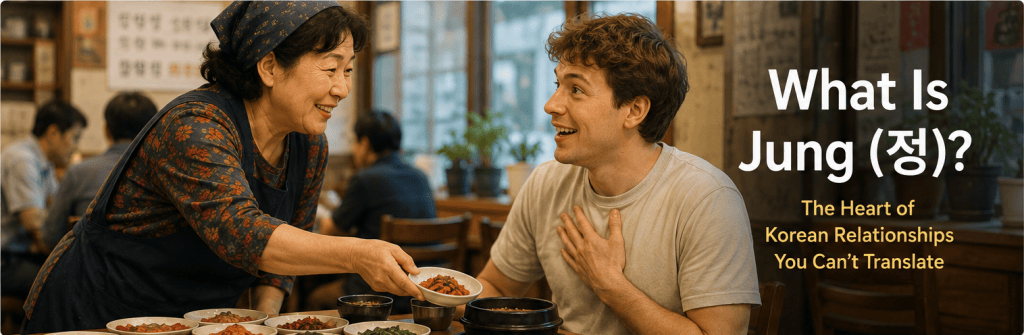
Imagine walking into a small neighborhood restaurant in Korea.
You are clearly not Korean, but you try a few words anyway.
“Annyeonghaseyo.”
When the food arrives:
“Masisseoyo.”
And when you are finished:
“Gamsahamnida.”
Your Korean may not be perfect. It doesn’t need to be.
From what I’ve seen, many Koreans become a little warmer when a foreign visitor makes an honest attempt to speak Korean. Sometimes the awkward pronunciation itself makes people smile.
The owner may ask where you are from.
A few minutes later, she might bring you a small dish you didn’t order.
You look confused.
“Did I order this?”
She waves her hand and says:
“Service.”
Now, this can be confusing if you are new to Korea.
In Korean restaurants, “service” often means something given to you for free — perhaps an extra side dish, a drink, or a small portion of food.
It does not mean a service charge, and you are not expected to pay for it.
It is simply the restaurant saying:
“This one is on us.”
But if this happens on your first visit, I wouldn’t immediately call it jung.
It may simply be kindness, curiosity, or appreciation for the effort you made to speak Korean.
Now imagine you come back.
The owner recognizes you.
You exchange a few words.
You visit again.
Eventually, she remembers what you like, gives you something extra without asking, or wonders why you haven’t been around lately.
Now something has changed.
There is familiarity.
There is history, even if it is only a small one.
That is where jung (정) starts to make much more sense.
So, What Does Jung Actually Mean?
There is no perfect English translation for jung.
“Love” is too strong.
“Kindness” is too simple.
“Affection” works sometimes.
“Attachment” gets closer in other situations.
But none of them quite captures it.
Jung is a mixture of familiarity, emotional attachment, shared history, affection, and the feeling that develops after spending time with someone.
The important part is this:
Jung is usually built over time.
It is not usually the sudden excitement of meeting someone for the first time.
It grows.
You see the same person again and again.
You eat together.
You work together.
You help each other.
You argue.
Sometimes you get annoyed with each other.
And at some point, the relationship becomes harder to explain with a simple sentence like, “I like this person.”
There is history now.
That history matters.
That is where jung often begins.
Jung Isn’t Just About Family or Close Friends
Jung can exist between family members and close friends, but Koreans use the idea much more broadly.
You can develop jung with a longtime coworker.
With a neighbor.
With the owner of a restaurant you have visited for years.
With a regular customer.
With someone you have worked with for a long time.
Sometimes, strangely enough, you can even develop jung with someone you don’t particularly like.
There is a Korean expression:
정들다 — jung deulda
It means, roughly, that jung has developed between you and someone or something.
Then there is an even more interesting expression:
미운 정 — miun jung
This is difficult to translate naturally.
You might be tired of someone.
They annoy you.
You complain about them.
You may even insist that you don’t like them very much.
But after spending years together, if something happens to that person, you still care.
You can dislike someone and still have jung for them.
It sounds contradictory.
To Koreans, it really isn’t.
Human relationships are rarely as simple as “like” or “dislike.”
Jung isn’t simple either.
What Jung Looks Like in Everyday Korea
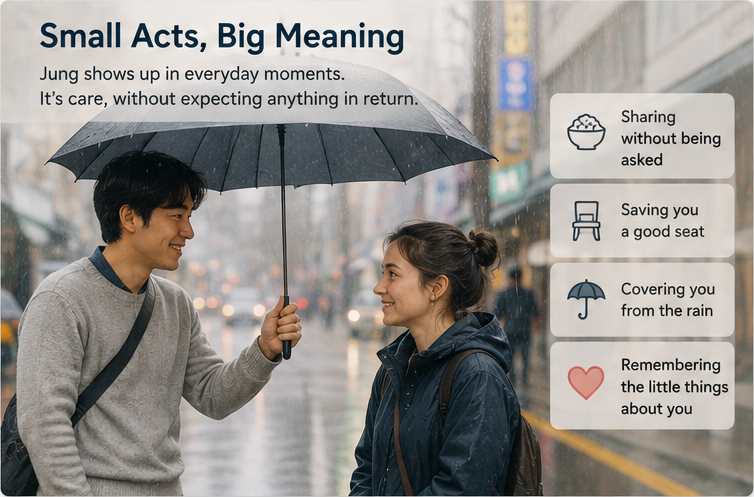
Jung is easier to understand through small actions than through definitions.
It can be a restaurant owner giving a regular customer something extra.
It can be a neighbor sharing food.
It can be a coworker quietly checking whether you have eaten.
It can be someone packing fruit or snacks for you before you go home.
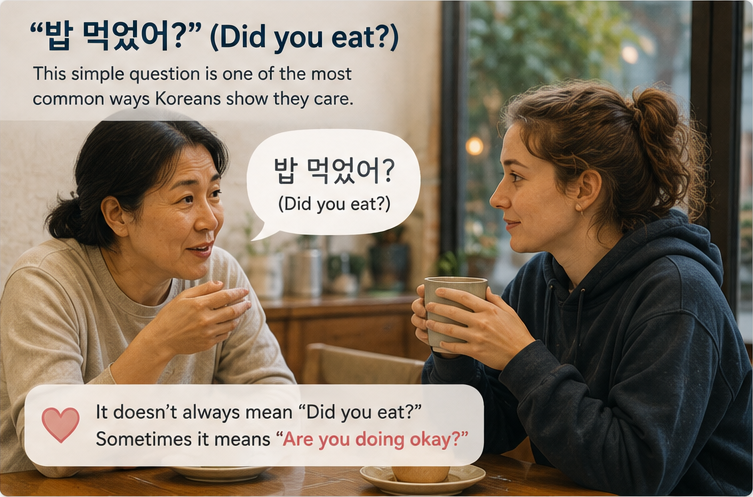
Sometimes it appears in one of the most ordinary Korean questions:
“밥 먹었어?” — “Did you eat?”
Literally, it is just a question about food.
But depending on the relationship and situation, it can mean something closer to:
“Are you doing okay?”
“I’m checking on you.”
“I’m thinking about you.”
The important part is usually not the monetary value of what someone gives you.
A free drink may be worth very little.
An extra side dish may cost almost nothing.
A few pieces of fruit are not an expensive gift.
But someone thought about you and decided to do a little more than they had to.
That small extra effort is often where jung becomes visible.
A Little Korean Can Help Break the Ice
You do not need to speak Korean well to connect with people in Korea.
And speaking a few Korean words does not magically create jung.
But from my experience, even imperfect Korean can be a surprisingly good icebreaker.
A simple:
안녕하세요 — Annyeonghaseyo — Hello
맛있어요 — Masisseoyo — It’s delicious
감사합니다 — Gamsahamnida — Thank you
can sometimes change the atmosphere of an interaction.
The point is not that your pronunciation has to be correct.
The point is that you tried.
Many Koreans appreciate seeing a foreign visitor make that small effort.
Sometimes it leads to a smile.
Sometimes to a question.
“Where are you from?”
Sometimes that becomes a short conversation.
And if you return later, perhaps they remember you.
That still isn’t automatically jung.
But it can be the beginning of familiarity.
And familiarity is one of the places where jung can eventually grow.
Your pronunciation may be wrong. Your intention is usually much easier to understand.
Why Food Is So Often Connected to Jung
If you spend enough time around Koreans, you may notice how often food appears when people care about each other.
“Did you eat?”
“Try this.”
“Eat some more.”
“Take this home.”
You can say you are completely full and somehow leave with a bag of food anyway.
Food is one of the most common ways Koreans show care without saying anything dramatic.
This is also why a neighborhood restaurant can be an interesting place to see Korean relationships develop.
At first, you are simply a customer.
You come back.
Then you become a familiar face.
Eventually, the owner may remember your usual order.
Perhaps you get an extra side dish or a drink — the kind of little “service” I mentioned earlier.
The food itself may not be worth much.
The relationship behind it can mean more.
Jung Can Be Warm — But It Can Also Be Complicated
It would be easy to describe jung as one of those beautiful, heartwarming features of Korean culture.
But that wouldn’t tell the whole story.
Jung can also make relationships complicated.
The longer you have known someone, the harder it may become to refuse a favor.
You may feel that you should help because of everything you have been through together.
You may continue a relationship even when part of you wants to walk away.
Sometimes logic says:
“This relationship doesn’t make sense anymore.”
But emotion says:
“We’ve known each other for too long.”
A Korean might explain that simply by saying:
“정이 들어서.”
Because jung developed.
That doesn’t mean the relationship is healthy.
It doesn’t mean staying is always the right decision.
It simply explains why separating yourself emotionally may not be easy.
Jung can make relationships warmer, but it can also make them harder to leave.
That complicated side is just as important as the warm side.
Is Jung Still Important in Modern Korea?
Korean society has changed enormously.
People move more often.
Families are smaller.
Workplaces are changing.
Younger Koreans may place more importance on privacy and personal boundaries than previous generations did.
Relationships can also be more temporary.
The neighbor you saw every day for 20 years may no longer exist in the same way in a big apartment city.
The coworker you expected to spend decades working beside may change companies after a few years.
But that doesn’t mean jung has disappeared.
Its form may simply be changing.
You can still see it between longtime friends.
Between coworkers.
Between neighbors.
Between regular customers and small business owners.
Between people who have spent enough time together that they are no longer strangers.
Koreans still remember the people who took care of them.
They still get attached.
And sometimes they still do a little more for someone simply because there is history between them.
You May Experience Jung Without Knowing the Word
You don’t need to memorize the meaning of jung before visiting Korea.
And you certainly don’t need to go around looking for it.
Jung is not something Koreans are supposed to perform for tourists.
If anything, trying to force it would miss the whole point.
It develops naturally.
But during your time in Korea, you may eventually have a moment when you think:
“Why is this person doing this much for me?”
Maybe the owner of a restaurant remembers you.
Maybe someone gives you extra food.
Maybe someone goes out of their way to help you when they really don’t have to.
Maybe a person you have known for a while starts treating you less like a customer, coworker, or neighbor and more like someone they personally care about.
Not every act of kindness is jung.
But moments like those can help you begin to understand it.
Jung is not something Koreans give on command. It grows through familiarity, time, and small acts of care.
Have you ever experienced something in Korea that felt warmer or more personal than you expected? Leave a comment below. I’d love to hear about it.
Have a question about Korea? Leave a comment below. If I know the answer, I’ll be happy to help when I can.


Leave a comment