
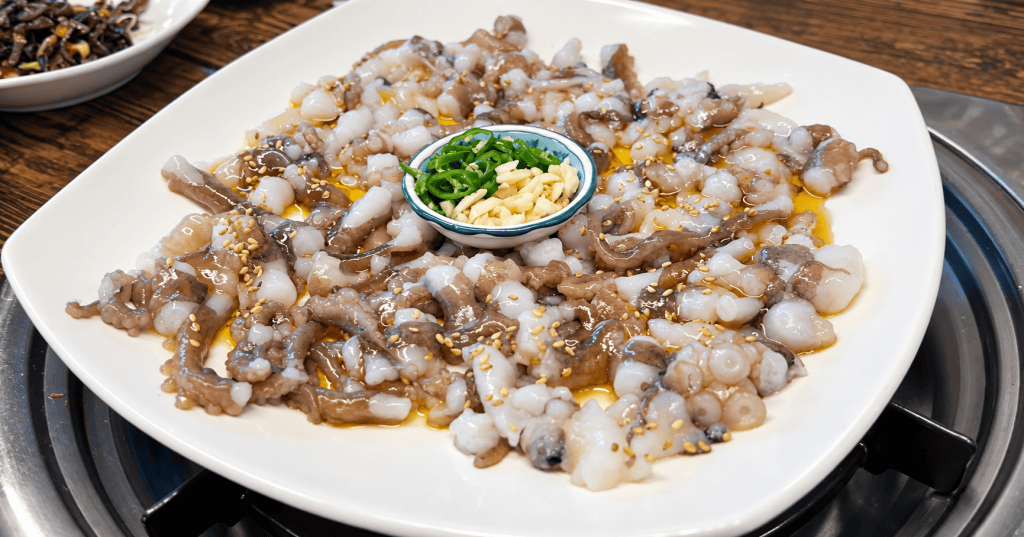
“Oh my God. It’s still moving.”
That is a pretty understandable reaction the first time you see live octopus (산낙지, sannakji).
The octopus has already been cut into pieces, but those pieces can still move around on the plate.
To a first-time visitor, it may look more like a food challenge than dinner. For Koreans, though, it is usually just another way to eat seafood.
How Koreans Actually Eat Sannakji
Sannakji is usually cut into bite-sized pieces and served with sesame oil, salt, and sesame seeds.
At a Korean seafood restaurant (횟집, hoe-jip), one plate is often ordered for the table and shared by several people. It is also commonly eaten as food served with alcohol (안주, anju).
A very normal Korean situation might be finishing dinner and moving somewhere else for a second round of drinks (2차, i-cha). Someone orders Korean distilled liquor (소주, soju), and then another person says:
“Should we get a plate of sannakji?”
That is much closer to the sannakji I know than someone sitting alone in front of a whole plate as if they were taking a bravery test.
There is one important safety point, though.
Start with a small piece and chew it thoroughly before swallowing.
The suction cups can still stick after the octopus has been cut, so swallowing a large piece without chewing it properly can be dangerous. Choking incidents involving sannakji have been documented in Korea.
The Strange Part Is Actually Kind of Fun
The flavor of sannakji is milder than its appearance suggests. For me, the sesame oil and the chewy, springy texture stand out more than the taste of the octopus itself.
Sometimes you can still feel movement in your mouth, and the suction cups may lightly stick to your tongue or the inside of your cheek.
Your first reaction might be:
“Wait. This thing still hasn’t given up?”
It can feel strange at first. But that can also be part of the fun.
I have foreign friends who could not bring themselves to eat sannakji the first time they saw it. After trying it a few times, some of them now actually look for it.
What once felt strange became part of what they enjoy about eating it. That is why, to me, sannakji is more memorable as an experience than as a flavor.
For the Experience, Sannakji. For the Taste, I Prefer Squid Sashimi.
This is purely my personal preference.
If a foreign friend asked me, “I want to try something unusual while I’m in Korea. What should I eat?” I would say sannakji.
But if the question were, “Which one tastes better?” I would choose squid sashimi (오징어회, ojingeo-hoe).
I especially like thinly sliced squid sashimi with a sweet, sour and spicy red dipping sauce (초고추장, cho-gochujang).
For the experience: sannakji.
For the taste: squid sashimi.
If you would rather eat octopus cooked, try light octopus soup (연포탕, yeonpotang).
The octopus is cooked in a light broth, and in my experience, the key is not to leave it in too long. Overcook it and it gets tough. Cook it just right and it stays chewy but still tender.
If spicy food is more your thing, there is also spicy stir-fried octopus (낙지볶음, nakji-bokkeum), usually eaten with rice.
So seeing octopus (낙지, nakji) on a Korean menu does not mean something will arrive at your table still moving.
Do You Have to Try Sannakji in Korea?
No.
If eating something that is still moving makes you uncomfortable, there is no reason to force yourself.
But if you like seafood and want a slightly unusual food experience in Korea, sannakji can be a fun one to remember.
Just start small. And chew it well.
Have a question about Korean food or something you saw while traveling in Korea? Leave a comment below. If I know the answer, I’ll be happy to help when I can.


Leave a comment