
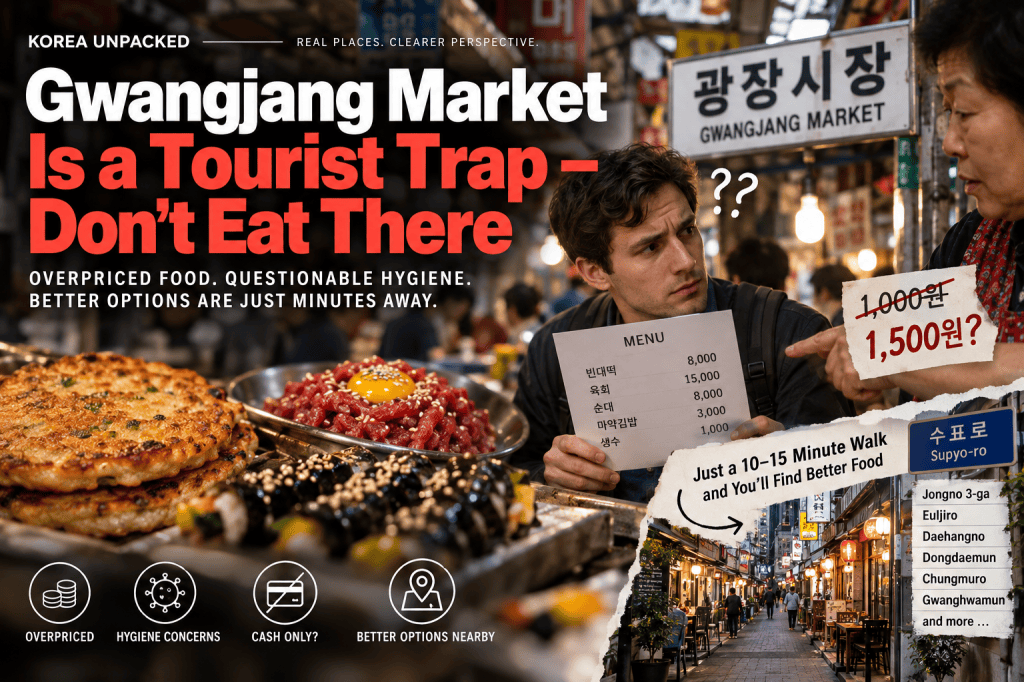
Gwangjang Market Is a Tourist Trap — Don’t Eat There
Imagine this.
A foreign traveler sits down at a stall in Gwangjang Market (Gwangjang Sijang, 광장시장) with a Korean friend. The two of them have been speaking English.
They order after checking the posted prices.
But when it is time to pay, the amount they are told is different.
The Korean friend asks about the price again, this time in Korean.
The amount changes.
The problem is not just the extra few thousand won.
If you do not know what things normally cost in Korea, you may not even realize that you were overcharged.
Gwangjang Market appears in countless travel guides, videos, and social media posts. I understand why it is often recommended as one of Seoul’s must-visit food markets.
It is old, lively, photogenic, and packed with Korean food in one place.
But I see it differently.
I am not saying every vendor at Gwangjang Market is dishonest.
My point is simpler: travelers do not need to take unnecessary risks when there are so many other places to eat nearby.
If a foreign friend came to Seoul, I would not recommend having a full meal there.
I have known this part of Seoul for a long time.
More than 25 years ago, when I was in university, the village bus from where I lived ended at Jongno 5-ga Station (Jongno O-ga Yeok, 종로5가역).
Gwangjang Market and the surrounding Jongno area were places I visited regularly.
From what I remember, stories about foreigners being charged differently were not completely unfamiliar even then.
What bothers me is that similar controversies are still appearing today.
You May Be Overcharged Without Even Knowing It
Gwangjang Market has faced repeated controversies involving prices, portion sizes, and sales practices.
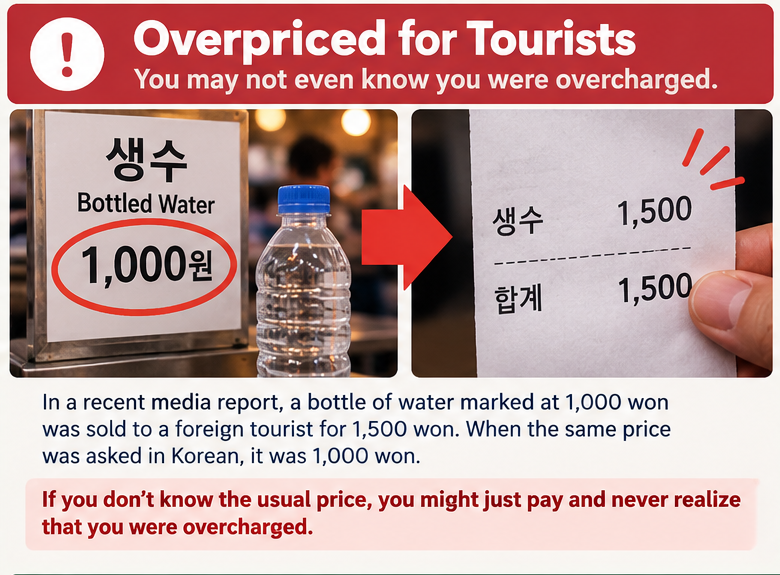
In one recent media investigation, reporters posing as foreign tourists asked the price of bottled water that was marked at ₩1,000. [Source: Seoul Shinmun]
They were charged ₩1,500.
When the price was later asked in Korean, the answer was ₩1,000.
There have been other cases as well.
In 2023, a ₩15,000 plate of assorted jeon (jeon, 전) drew criticism for its small portion, while the customers were also encouraged to order more.
There have also been controversies involving sundae (sundae, 순대), portion sizes, and additional charges.
For someone visiting Korea for the first time, the difficult part is knowing what is normal.
How much should a plate of sundae cost?
How much bindaetteok (bindaetteok, 빈대떡) should you expect for a certain price?
What does a normal portion look like?
A first-time visitor may have no reference point.
So even when something feels a little strange, it is easy to think:
“I guess this is just what things cost in Korea.”
And being an experienced traveler does not necessarily protect you.
If someone regularly makes money by taking advantage of tourists, that person may have dealt with far more tourists than you have dealt with dishonest vendors.
They may know what visitors do not know, when they are unlikely to question a price, and how much extra they will tolerate before deciding it is not worth arguing.
Someone doing something wrong can still be very experienced at doing it.
Payment can cause confusion too.
Some stalls have been reported to push customers toward cash or bank transfers. Cash-only businesses are not automatically illegal in Korea, but if a business is a registered credit-card merchant, it cannot simply refuse card payment because the customer wants to use a card.
Hygiene Is Just as Concerning as Price
Price is not the only reason I hesitate to recommend eating there.
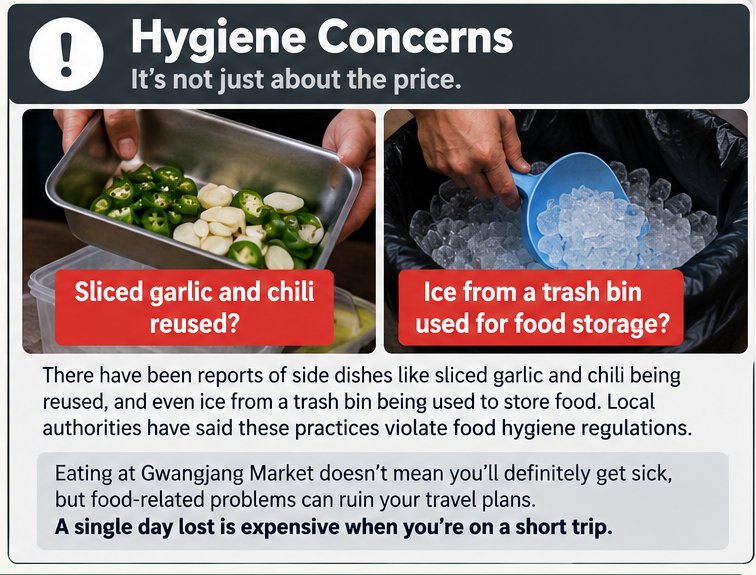
Recent reporting showed sliced garlic and chili that had already been served to customers being collected and stored again.
Local authorities explained that reusing sliced garlic and chili in this way violates food hygiene rules.
In another case, ice retrieved from a trash bin was rinsed and then used to keep food cold. [Source: Seoul Shinmun]
To be precise, the ice was reported as being used for food storage, not served in customers’ drinks.
None of this means that eating at Gwangjang Market will automatically make you sick.
That is not my argument.
My point is about risk during a trip.
If you are overcharged by a few thousand won, you lose a few thousand won.
If food causes stomach problems and you spend the next day in your hotel room, you could lose restaurant reservations, tours, sightseeing plans, or an entire day of your trip.
On a short trip abroad, losing one day is expensive.
Most of Gwangjang Market’s Famous Foods Are Available Elsewhere
The foods most commonly associated with Gwangjang Market include bindaetteok (bindaetteok, 빈대떡), yukhoe (yukhoe, 육회), sundae (sundae, 순대), kalguksu (kalguksu, 칼국수), tteokbokki (tteokbokki, 떡볶이), and mandu (mandu, 만두).
But think about that list.
Almost none of these foods require you to eat at Gwangjang Market.
You can find them all over Seoul.
I even checked NAVER Map around Jongno 3-ga Station (Jongno Sam-ga Yeok, 종로3가역), just west of the market.
I searched separately for yukhoe and bindaetteok.
Each search showed dozens of places nearby.
And that is just one small part of central Seoul.
There are restaurants throughout the city that have specialized in these foods for years.
So if the same food is available just a short distance away, why gamble an entire meal at one famous tourist market?
I do not think you need to.
If You Still Want to Eat One Thing, Try Mayak Gimbap
Travel is not only about finding the best food.
You are also buying experiences.
So if you have already come all the way to Gwangjang Market and want to try something simply because you are there, I would probably choose mayak gimbap (mayak gimbap, 마약김밥).
Mayak gimbap (mayak gimbap, 마약김밥) is a small, simple type of gimbap. The name literally uses the Korean word for “drug,” implying that it is supposedly addictive — there are, of course, no drugs in it.
I tried it many years ago.
My reaction was basically:
“Why, though?”
It was not terrible.
I just did not understand why I needed to come to Gwangjang Market specifically to eat it.
Still, mayak gimbap has been associated with the market for a long time.
So being able to say,
“I ate mayak gimbap at Gwangjang Market.”
may be worth it as a small travel experience.
That is about as far as I would go.
Have your real meal somewhere else.
In 10–15 Minutes, You Have Many More Choices
You do not need to go far.
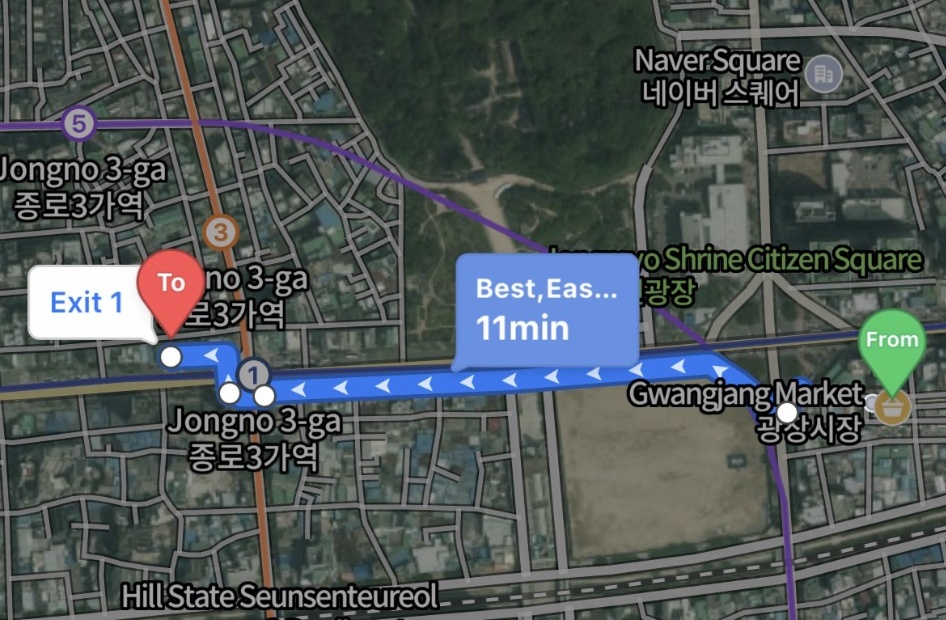
From Gwangjang Market, you can walk toward the Jongno 3-ga (Jongno Sam-ga, 종로3가) area in roughly 10–15 minutes.
In particular, the side streets around Supyo-ro (Supyo-ro, 수표로) — the name of a road in the area — have many older restaurants, bars, and everyday places frequented by local workers.
You can find sundae-guk (sundae-guk, 순대국), bossam (bossam, 보쌈), gukbap (gukbap, 국밥), grilled meat, jeon (jeon, 전), and plenty of Korean dishes that work well with drinks.
If the weather is good in the evening, eating and drinking at the outdoor tables around Jongno 3-ga can be an excellent choice.
If you are taking a taxi or another vehicle, your choices expand even further.
Outside rush hour, when traffic is moving reasonably well, areas such as Daehangno, Dongdaemun, Euljiro, Chungmuro, Jongno, and Gwanghwamun are all relatively close.
You are already in the middle of Seoul.
You do not need to force a meal at Gwangjang Market. Move 10 or 15 minutes and give yourself more choices.
Have a question about Korea? Leave a comment below. If I know the answer, I’ll be happy to help when I can.


Leave a comment