
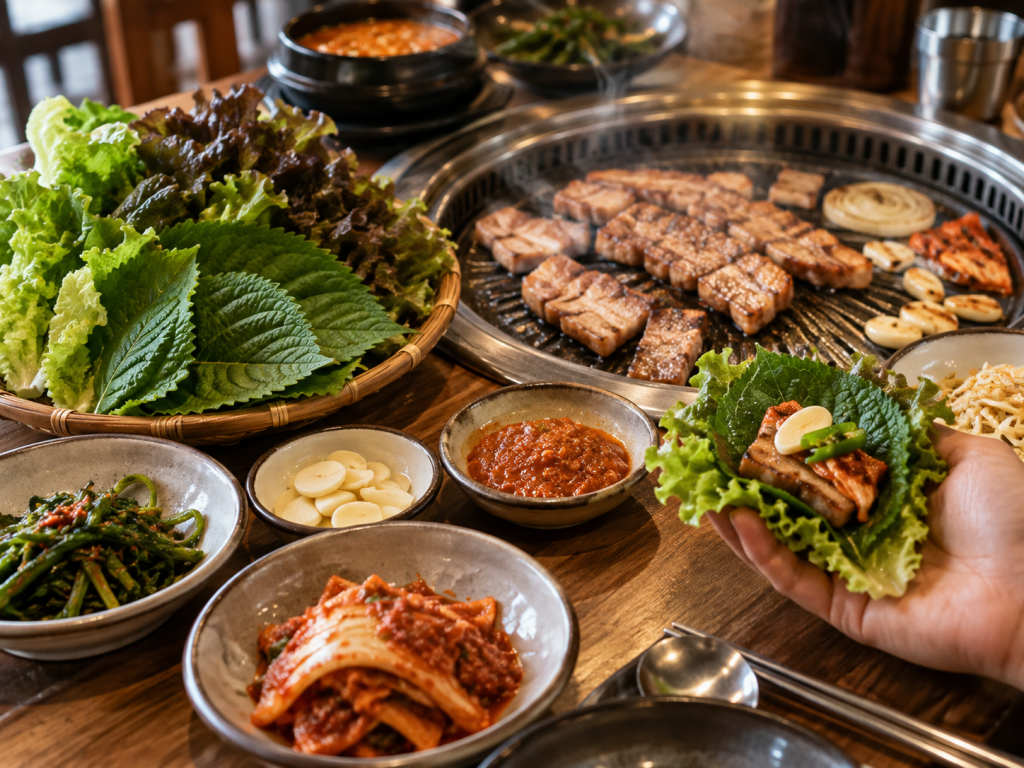
One mistake I sometimes see when someone tries Korean wraps for the first time is the giant ssam.
A large lettuce leaf comes out. Then goes in the meat, rice, garlic, chili, kimchi, green onion salad, and a big spoonful of sauce.
By the time the wrapping starts, it is already too big for one bite.
That is almost the opposite of how I like to eat ssam.
For me, ssam is not about putting everything on the table into one leaf.
It is about building one good bite.
And that bite changes depending on what I am eating.
The ssam I make for grilled pork belly is different from the one I make for marinated pork ribs. Bossam is different again. So are raw fish, eel, and dakgalbi.
Sometimes I do not make a wrap at all.
What Is Ssam?
Ssam (쌈, ssam) literally refers to wrapping food before eating it.
The most familiar versions use lettuce (상추, sangchu) or perilla leaves (깻잎, kkaennip), usually with meat, sauce, garlic, or other side dishes inside.
But ssam does not always mean a leafy green.
Thin pickled radish sheets (쌈무, ssammu), for example, can serve the same purpose.
There is no single recipe.
That is important.
A good ssam is not the one with the most ingredients. It is the one where the ingredients make sense together.
Why Do Koreans Eat Ssam?
Traditional ssam often centered on rice wrapped in leafy vegetables, seaweed, or other greens.
My impression is that making a meal more filling probably mattered more in that style of eating.
At a modern Korean barbecue table, though, I think ssam serves another purpose just as well:
It keeps rich food from becoming tiring.
Eat several pieces of fatty pork belly by themselves and the flavor eventually starts to repeat.
Then add a fragrant perilla leaf.
The next bite might have garlic.
Another might include pickled onion or grilled kimchi.
With eel, ginger changes the bite. With bossam, salted shrimp and kimchi do it.
The main food stays the same, but each bite can feel different.
That is a big part of why I enjoy ssam.
My First Rule: Taste the Food Before You Wrap It
I usually do not start a meal by making a wrap.
I taste the main food first.
Not necessarily completely plain, but with minimal seasoning.
For grilled pork belly (삼겹살, samgyeopsal), that might be salt or an oil-and-salt dip (기름장, gireumjang).
For marinated pork ribs, I first taste the meat with its own seasoning.
For Korean-style raw fish (회, hoe), I usually start with soy sauce.
And with good Korean beef, especially Hanwoo (한우, hanwoo), I want to know what the beef itself tastes like first.
My rule is simple:
First taste the food. Then build the bite.
Once I know the main flavor, I can decide what I actually want around it.
Keep It Small, Wrap It Tight, Eat It in One Bite
This is probably my biggest ssam rule.
Keep it small. Wrap it tight. Eat it in one bite.
I normally do not put rice inside my ssam because it makes the wrap bigger very quickly.
But size is not the only reason one bite matters.
The flavor of ssam is supposed to come together at once.
The meat, sauce, garlic, vegetables, and aromatics enter your mouth together.
Then the taste changes as you chew.
The meat may hit first. Then the aroma of the leaf appears. Garlic or chili follows. Pickled onion, kimchi, ginger, or wasabi can change it again.
That movement of flavors is part of the point.
One bite, many flavors.
Samgyeopsal: Perilla Leaf, Oil Dip and Garlic
I personally prefer perilla leaves to lettuce with pork belly.
I dip the pork in the oil-and-salt sauce, put it on the leaf, and add garlic with a little savory soybean-and-chili paste (쌈장, ssamjang).
That is already enough for me.
For someone trying Korean barbecue for the first time, however, I would start with lettuce.
Perilla has a strong herbal aroma that some foreigners love immediately and others need time to get used to.
A good progression is: lettuce first, then lettuce and perilla together, and finally perilla by itself.
Grilled kimchi also works well with pork belly. I do not usually put it in my own ssam, but it is an easy combination for a first-time visitor to try.
There is another version I like when pickled myeongi leaves (명이나물, myeongi-namul) are served.
A piece of pork belly with salt, wrapped in a myeongi leaf with just a little wasabi.
Nothing else is necessary.
Dwaeji-Galbi: Add Onion
For marinated pork ribs (돼지갈비, dwaeji-galbi), I build the bite differently.
The meat already has a sweet and salty marinade, so I like adding pickled onions or onions in a mustard dressing.
I may add garlic with a little ssamjang as well.
The onion gives the heavily seasoned meat a fresher, sharper contrast.
Same pork.
Different ssam.
Bossam and Jokbal: Just One or Two Salted Shrimp
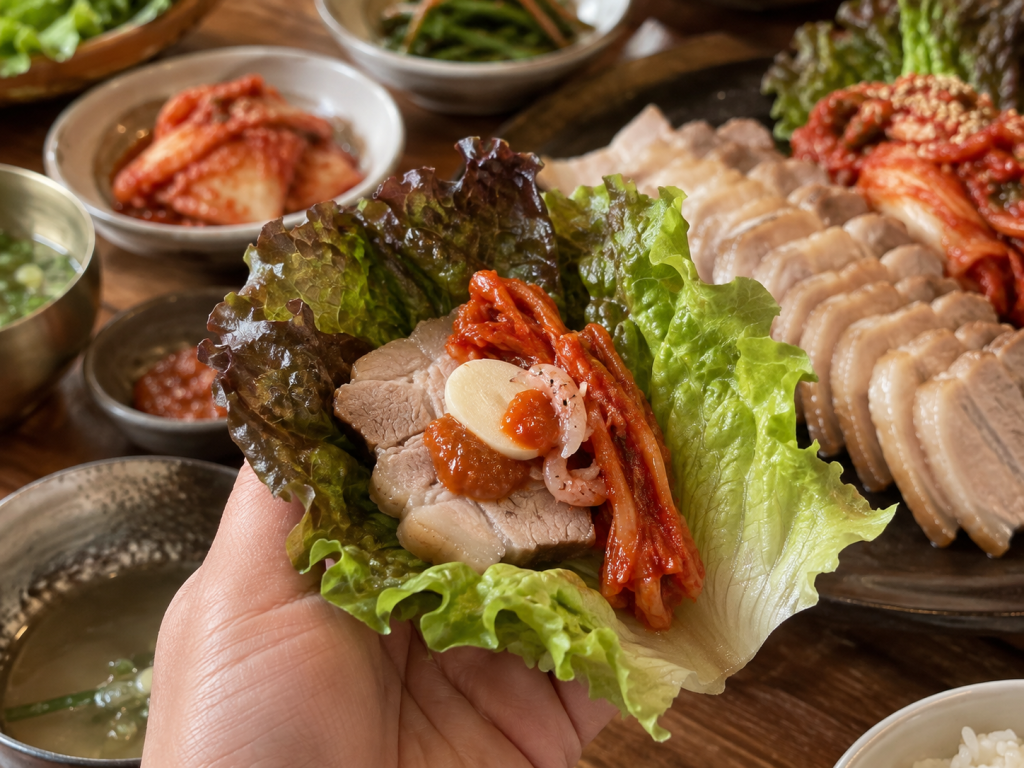
For boiled pork wraps (보쌈, bossam) and braised pig’s feet (족발, jokbal), I usually want kimchi and salted shrimp.
I add radish kimchi or bossam kimchi, plus garlic with a little ssamjang.
Then comes salted shrimp (새우젓, saeujeot).
But very little.
Saeujeot is quite salty, so I usually pick up only one or two tiny shrimp, rather than spooning a lot of the salty liquid into the wrap.
That small amount is enough.
Raw Fish: Perilla Only, for Me
I do not usually wrap every piece of raw fish.
Most of the time, I prefer the fish simply dipped in soy sauce.
But when I do make a ssam, I use a perilla leaf rather than lettuce.
I dip the fish in soy sauce first, then add garlic and often a piece of chili.
I also make my own small sauce mixture.
It is mostly ssamjang, with roughly 10 percent sweet, sour and spicy red chili paste (초고추장, cho-gochujang), plus a little wasabi.
This is not a standard Korean recipe.
It is just how I mix mine.
I use only a small amount in the wrap.
The soy sauce, fish, perilla, garlic, chili, and wasabi produce a completely different bite from eating the fish alone.
Grilled Eel: Ginger Changes Everything
With grilled eel, ginger becomes much more important.
I eat the eel with its sauce, ginger, and raw garlic.
But unlike with pork, I do not dip that garlic in ssamjang.
In fact, I usually leave ssamjang out completely.
The eel sauce and ginger already give the bite enough flavor.
This is why I do not think of ssamjang as something that automatically belongs in every ssam.
The main food decides the wrap.
Dakgalbi: Ssam Does Not Have to Be Lettuce
Spicy stir-fried chicken (닭갈비, dakgalbi) shows another side of ssam.
Some restaurants may not serve lettuce or perilla leaves at all.
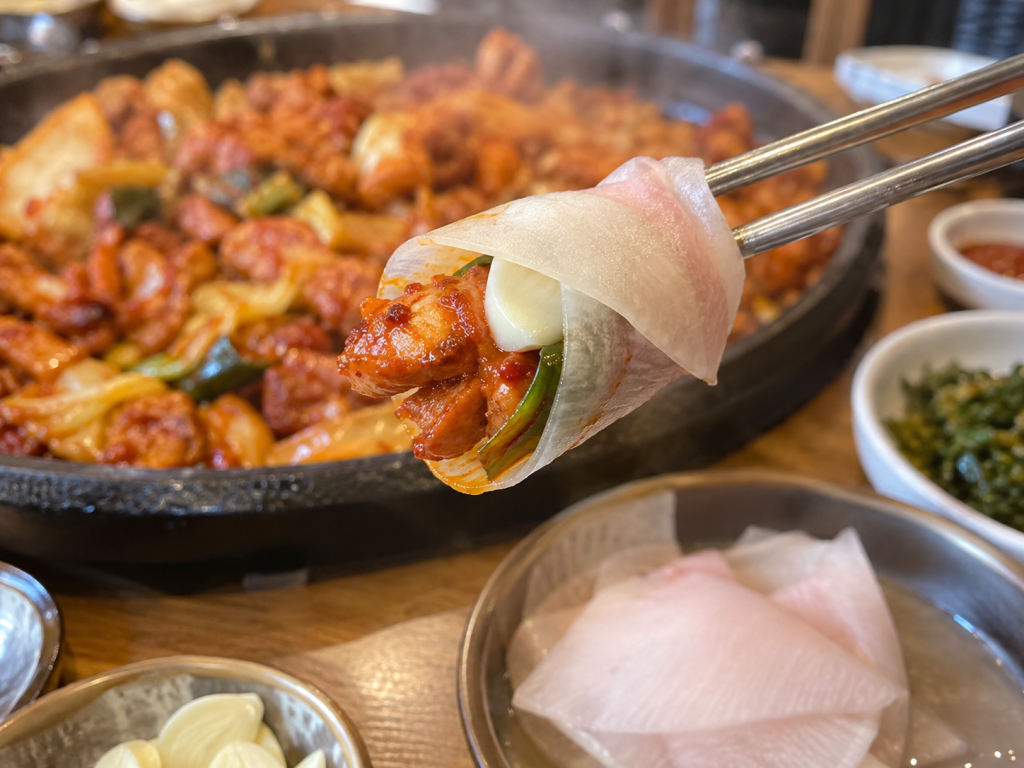
Instead, you often get thin pickled radish sheets.
I like putting a piece of dakgalbi and a little garlic onto the radish and wrapping it together.
The cool, sour radish works especially well against the strongly seasoned chicken.
Ssam does not always mean lettuce.
A Kimchi Jjigae Ssam I Remember from Sacheon
One of the more unusual ssam styles I remember comes from the Sacheon and Samcheonpo area in South Gyeongsang Province.
There are places where pork from kimchi stew (김치찌개, kimchi-jjigae) is taken out of the pot and eaten in lettuce wraps.
From what I remember, lettuce was much more common than perilla for this style.
I would take a piece of pork from the stew, put it on lettuce, and add garlic and ssamjang.
I usually would not put the stew kimchi itself into the wrap because the liquid makes it messy.
It is a good reminder that ssam is not limited to Korean barbecue.
Not Everything Needs Ssam
Hanwoo is my example.
Plenty of Koreans eat Hanwoo with lettuce or perilla wraps.
I usually do not.
With good beef, I prefer tasting the meat itself with minimal seasoning.
If the richness starts to build up, I may eat a garlic clove dipped in ssamjang separately.
No wrap required.
Ssam is common in Korea.
It is not compulsory.
Chili Is Optional
I have deliberately left chili out of most of the combinations above.
That is because you never quite know what you are going to get.
One Korean green chili can be mild.
The next one can be brutally hot.
If a whole chili is served, I sometimes cut or bite a tiny piece from the tip first.
If it gives off a strong spicy smell, I become cautious.
That is not a scientific test. It is just a habit I picked up from years of eating them.
I try a small bite first.
If it is manageable, then it can go into the next ssam.
No reason to destroy the next five bites with one unexpectedly angry chili.
There Is No Perfect Ssam
A good ssam is not about adding more.
Choose what fits the food, keep it small, and eat it in one bite.
That is when all those flavors meet — and keep changing as you chew.
That changing bite is why I eat ssam.
Have a question about Korea? Leave a comment below. If I know the answer, I’ll be happy to help when I can.


Leave a comment