
There is a small scene in Descendants of the Sun that probably makes immediate sense to many Korean viewers.
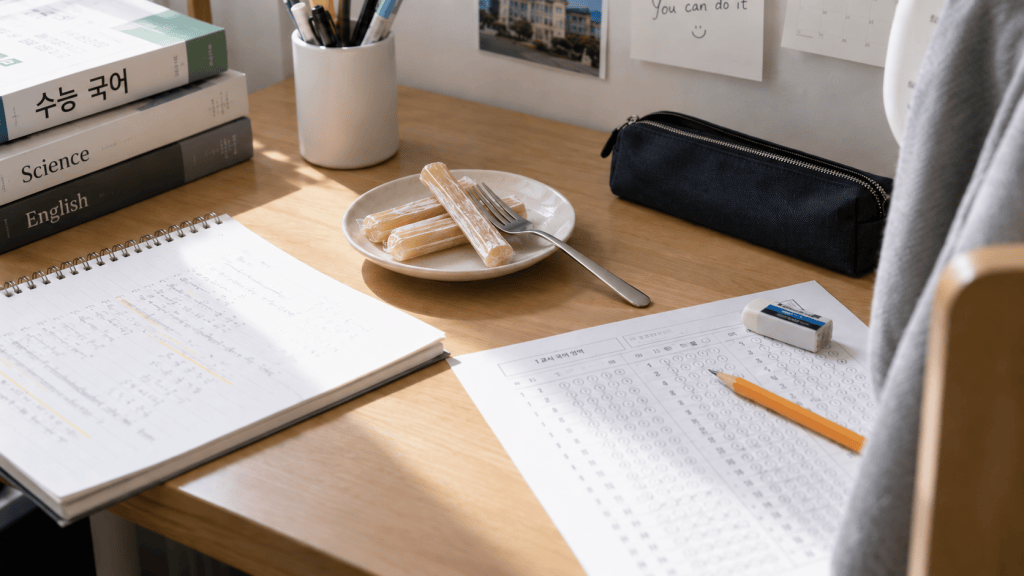
In Episode 15, the young soldier Kim Gi-beom is about to take a qualification exam. Before he leaves, members of Alpha Team give him Korean taffy (엿, yeot) and a fork.
To a foreign viewer, the combination can look a little strange.
Candy makes sense.
But why a fork?
The joke only really works once you know the Korean words behind it.
The relevant scene runs from 2:37 to 3:10.
Why Give Yeot Before an Exam?
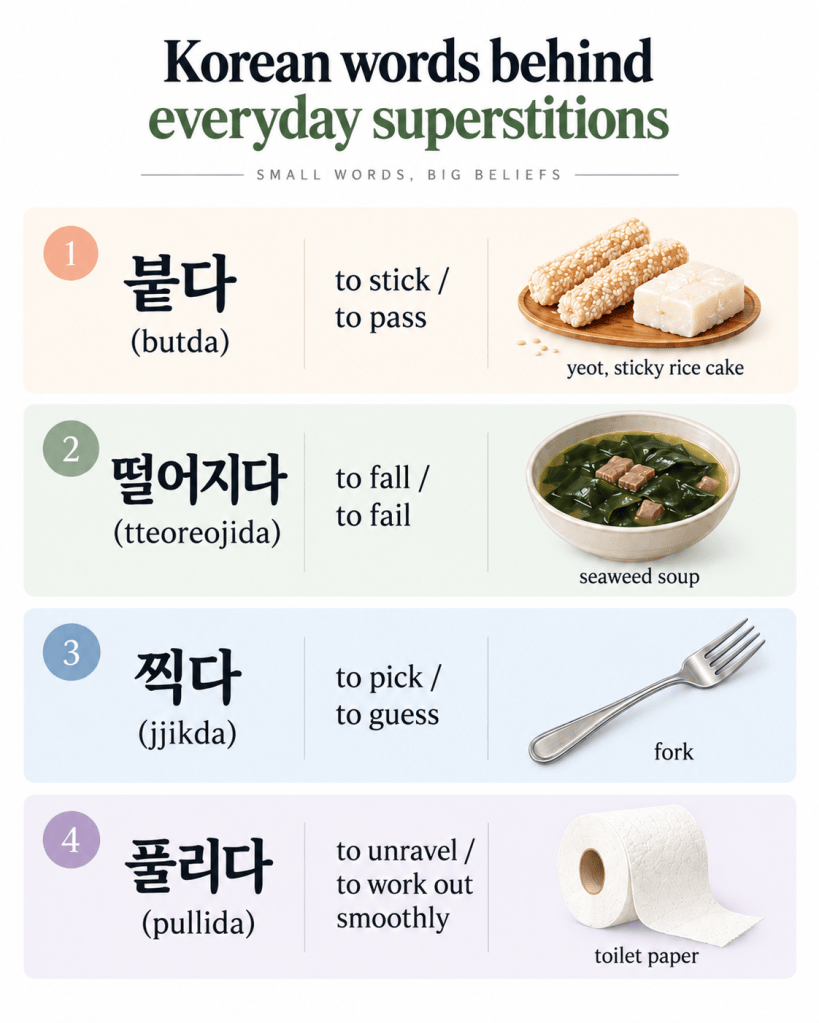
In Korean, the verb to stick is 붙다 (butda).
But the same verb is also commonly used when talking about passing an exam.
You can say:
to pass an exam — 시험에 붙다 (siheom-e butda)
Literally, it sounds like you “stick” to the exam.
That is why sticky foods became associated with exam luck.
Traditional Korean taffy (엿, yeot) and glutinous rice cake (찹쌀떡, chapssaltteok) are both sticky, so giving them to a student carries a simple message:
Stick to the exam. Pass it.
I have received yeot and rice cakes many times before exams or other important occasions myself.
I never thought eating them would magically change the result.
But that was never really the point.
Someone was telling me, in a very Korean way, “I hope you make it.”
Why Avoid Seaweed Soup Before an Exam?
The opposite idea works too.
Seaweed soup (미역국, miyeokguk) is slippery.
And in Korean, to fall or fail can be expressed with 떨어지다 (tteoreojida).
There is also another expression connected with failure:
to slip — 미끄러지다 (mikkeureojida)
So if sticky food helps you “stick,” slippery food sounds like exactly what you do not want before an exam.
That is why some Koreans avoid seaweed soup before an important test.
This is especially funny because seaweed soup is otherwise one of the most familiar foods in Korea. Koreans traditionally eat it on birthdays.
The food itself is not unlucky.
The meaning changes because of the situation — and because of the words attached to it.
Why Give Someone a Fork?
Now we come back to the fork in Descendants of the Sun.
In Korean, to pick or guess an answer is 찍다 (jjikda).
For example, if you do not know the answer on a multiple-choice test, you might simply 찍다 — pick one.
The same verb can also carry the physical sense of poking or stabbing something.
A fork does exactly that.
So giving someone a fork before an exam creates a visual joke:
If you do not know the answer, at least pick well — 잘 찍어 (jal jjigeo).
That is why the scene works.
The fork is not a magical object.
It is a Korean pun turned into a gift.
When You Want Everything to “Unroll Smoothly”
Toilet paper can work in a similar way.
The Korean verb 풀리다 (pullida) can mean something like to unravel, become untangled, or work out smoothly depending on the context.
A roll of toilet paper keeps unrolling.
So giving toilet paper can carry the wish that things will also 술술 풀리다 (sulsul pullida) — work out smoothly and without getting stuck.
I have personally brought toilet paper as a gift several times.
Again, I was not thinking that the toilet paper itself had some kind of supernatural power.
The meaning was in the gesture.
You give an ordinary object and attach a good wish to the way it behaves.
Sometimes a Single Sound Is Enough
Not every Korean superstition is connected to a verb.
Sometimes the connection comes from sound.
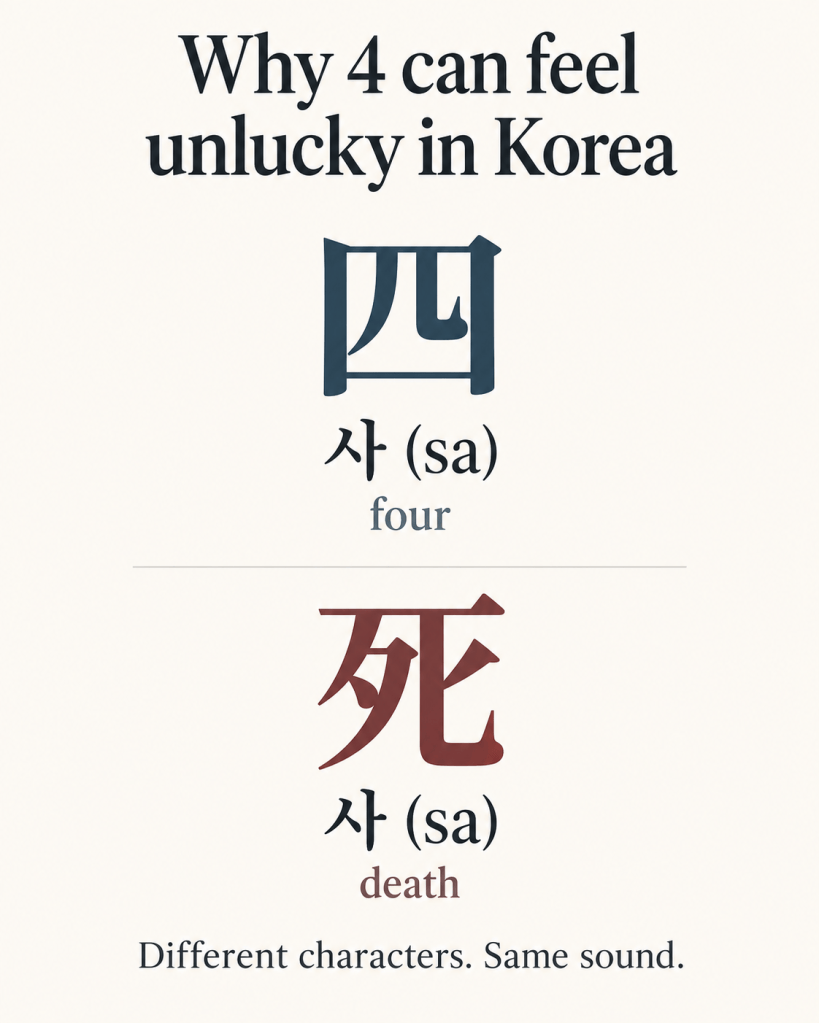
The Sino-Korean word for the number four is:
四 — 사 (sa) — four
The word for death can also be pronounced:
死 — 사 (sa) — death
The Chinese characters are completely different.
But in Korean, they sound the same.
That is why the number 4 has long been associated with bad luck in Korea.
You can still find buildings where the fourth floor is marked with F instead of 4, especially in elevators.
A foreign visitor might see the missing number and wonder what happened.
For a Korean speaker, the connection between four and death is immediately obvious.
Do Koreans Actually Believe All of This?
This is where things get more interesting.
Some people take these customs seriously.
Some do not believe them at all.
And many people fall somewhere in between.
That was true in my experience too.
I have received sticky candy and rice cakes before important events, but I did not think, “Now I will pass because I ate this.”
Children can also treat customs like these almost as games, jokes, or little rules they learn from adults.
Give someone yeot.
Tell them to pick the right answer.
Avoid the slippery food today.
The practice can survive even when the supernatural belief behind it is weak.
So calling everything simply “superstition” can miss part of what is happening.
Sometimes it is belief.
Sometimes it is encouragement.
Sometimes it is humor.
Sometimes it is just something people have always done.
The Language Does Not Explain Every Korean Superstition
Not every Korean superstition comes from wordplay.
Korea has many other beliefs and customs with completely different historical or cultural roots.
But the examples in this article are interesting because Korean makes the logic unusually easy to see.
붙다 (butda) — stick, and pass.
떨어지다 (tteoreojida) — fall, and fail.
찍다 (jjikda) — pick an answer.
풀리다 (pullida) — unravel, and work out smoothly.
사 (sa) — four, and also the sound of death.
Once you understand those words, several customs that might look random from the outside suddenly become much easier to understand.
And that is why the Descendants of the Sun scene works so naturally for a Korean audience.
The yeot and the fork do not need a long explanation.
The language already contains the joke.
From the outside, some Korean customs can look strange.
But sometimes, once you understand the words inside them, the reason becomes visible.
Have a question about Korea? Leave a comment below. If I know the answer, I’ll be happy to help when I can.


Leave a comment