
10 Things Tourists Should Know Before Taking a Taxi in Korea — From a Former Taxi Driver
Taking a taxi in Korea is usually easy.
But there are a few small things that foreign visitors may not know — especially if it is their first time using a taxi here.
Some people call a taxi through an app. Others simply hail an available taxi on the street. The basic experience is similar, but payment, communication, luggage, and even where you sit can work a little differently from what you are used to.
I drove a corporate taxi in Seoul for more than six months, and I met many foreign passengers along the way.
This article is not about how to call a taxi. I’ve covered that in my other guides.
Instead, these are the small things I think are worth knowing once you actually start using taxis in Korea.
1. You Don’t Need to Tip Taxi Drivers in Korea
Let’s start with the easy one.
You do not need to tip your taxi driver in Korea.
Not tipping is not rude, and drivers generally do not expect it.
You pay the taxi fare, and that is normally the end of the transaction.
If a driver does something unusually helpful for you, you can always give a little extra if you want.
But that is entirely your choice.
For an ordinary taxi ride in Korea, no tip is required.
2. If There Are Only One or Two of You, Sit in the Back
If you are traveling alone or with one other person, the back seat is usually the most natural place to sit.
This is not a rule.
You are not doing anything wrong if you sit in the front.
But many Korean taxi drivers are simply more used to solo passengers sitting in the back.
Some drivers even move the front passenger seat forward to give the person in the back more legroom.
If three or four people are taking the taxi, using the front passenger seat is completely normal.
But if you are alone or traveling as a couple, the back seat is usually the easiest choice.
3. A Taxi May Fit Four Passengers, But Not Four Large Suitcases
A standard sedan taxi may have room for four passengers.
That does not mean it has room for four passengers and four large suitcases.
This is especially important when traveling to or from the airport.
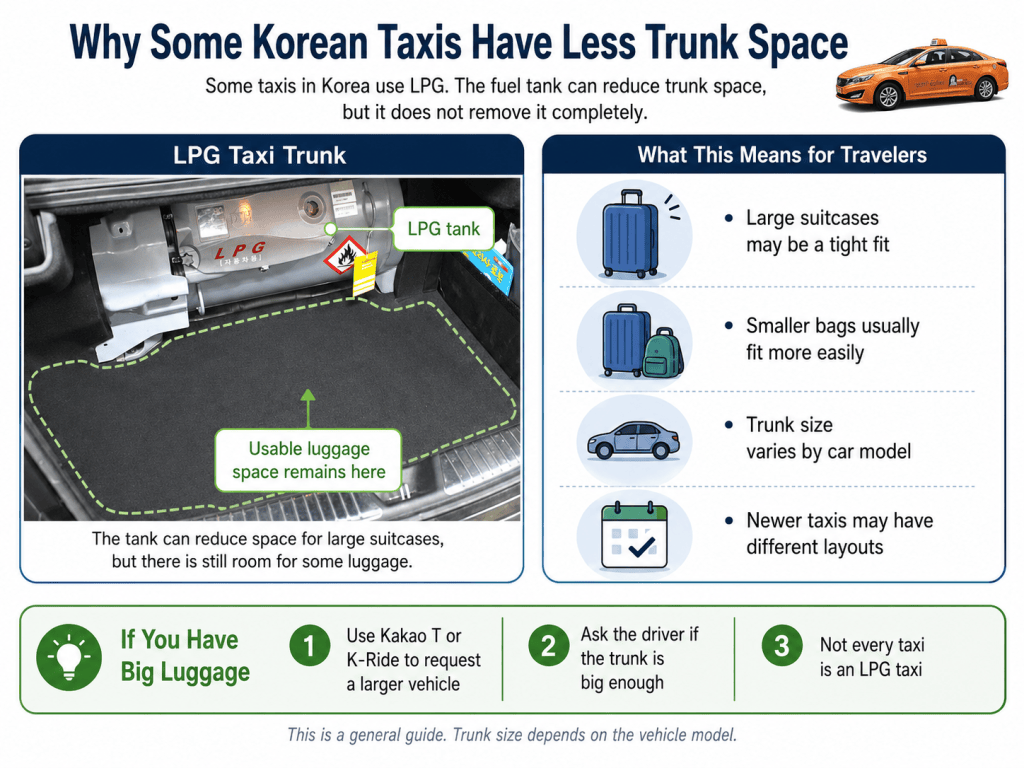
Some sedan taxis — especially LPG models — may have less usable trunk space than you expect because part of the trunk can be occupied by the LPG fuel system.
Other vehicles may have more room, so it depends on the car.
If several people are traveling with several large suitcases, consider requesting a larger vehicle.
Four passenger seats and four suitcase spaces are two completely different things.
4. Let the Driver Handle the Trunk
If you have luggage, give the driver a moment to open the trunk.
Many drivers can release it from inside the car, and some will get out to help with your bags.
Here’s a small Korean taxi habit that tourists may not know.
If the driver has not noticed that you are waiting for the trunk, give the trunk lid a light tap.
Just a gentle tap is usually enough to let the driver know you need it opened.
There is no need to pull hard on the trunk yourself.
And if the vehicle has a powered trunk, it is better not to force it open or closed by hand.
From a driver’s point of view, the easiest rule is simple:
Let the driver handle the trunk. If necessary, just tap it lightly.
5. Don’t Expect Your Taxi Driver to Speak English — Use Your Phone
It is better not to assume that your taxi driver will speak conversational English.
From my experience driving a taxi in Seoul, many drivers can understand a few simple words, numbers, or very basic expressions.
But once you start speaking in full English sentences, communication can become difficult very quickly.
That does not mean the driver is being unfriendly.
They may simply not understand what you are saying.
Fortunately, you usually do not need much conversation.
If You Called the Taxi Through an App
If you called through an app, the driver normally already has your destination on the screen.
There is usually no need to explain it again.
If You Hail a Taxi on the Street
If you stop a taxi on the street, show the driver your destination on your phone.
A Korean place name, Korean address, or map pin is much more useful than a long explanation in English.
If You Change Your Destination
If you decide to go somewhere else during the ride, do the same thing.
Show the new destination on your phone.
A map pin can often explain in two seconds what a full English sentence cannot.
So my advice is simple:
Don’t expect a conversation. Use your phone when you need to communicate something important.
6. A Strange-Looking Route Does Not Always Mean the Driver Is Taking You for a Ride
You look at your phone and think:
“Why are we going this way?”
It happens.
But there may be a perfectly reasonable explanation.
Seoul has a complicated road network.
One-way streets, divided roads, restricted turns, U-turn locations, construction, and traffic conditions can all change the route.
A building may look very close on the map, but the taxi may need to drive around several blocks just to reach the correct entrance.
Navigation apps also change routes in real time depending on traffic.
When I was driving in Seoul, the route that looked shortest on a map was not always the fastest route.
Sometimes it was not even possible to drive that way.
That does not mean every strange route is automatically correct.
If something looks seriously wrong, check your map and ask the driver if you can.
But a route that looks a little longer than expected is not by itself proof that the driver is trying to increase your fare.
Sometimes Seoul roads are just Seoul roads.
7. Street-Hailed Taxis Use the Meter — App Calls Can Work Differently
There are several ways to get a taxi in Korea, and the payment system can be slightly different depending on how you got the ride.
If You Hail a Regular Taxi on the Street
There is no separate fee just because you stopped a taxi on the street.
The driver starts the meter, and you pay the metered fare at the end of the ride.
Legal surcharges, such as late-night surcharges when applicable, are calculated according to the official fare system.
You can normally pay directly by cash or credit card.
If You Use k.ride
k.ride works differently.
It is designed for international travelers and uses automatic payment through a payment method registered in the app.
So if you used k.ride, you normally do not need to hand the driver cash or a card when you arrive.
Check the app instead.
You do not want to pay twice.
If You Use Kakao T
Kakao T is not the same as k.ride.
For a regular Kakao T taxi call, the taxi fare itself is still calculated by the meter.
A regular call generally does not have a separate calling fee.
However, Kakao T also offers paid calling options.
For example, a Booster-type option may add a separate service fee in exchange for improving your chances of getting a taxi more quickly.
The taxi fare itself is still based on the meter.
So when using an app, take a second to look at what you selected before pressing the final call button.
Taxi fare and app service fees are not always the same thing.
And remember: an estimated fare shown in an app is still an estimate.
Traffic, actual travel time, distance, toll roads, and applicable surcharges can affect the final amount.
8. If Your Driver Speaks English, Ask Where Locals Eat
This is not really a taxi rule.
It is just something I think travelers should try.
If you happen to get a driver who speaks enough English to have a conversation, take advantage of it.
Ask:
“Where do you eat around here?”
Taxi drivers spend their entire working day moving between neighborhoods.
Many of them know plenty of restaurants.
And I do not necessarily mean the restaurants that appear at the top of Google or Instagram.
You might hear about a small neighborhood place that tourists rarely visit.
Of course, taxi drivers are not professional food critics.
One driver’s favorite restaurant is still just one person’s opinion.
But if you want to know where ordinary locals actually eat, your taxi driver can be a surprisingly useful person to ask.
9. Check the Seat Before You Close the Door
Before you leave the taxi, take five seconds.
Look around your seat.
Check for:
- your phone
- wallet
- passport
- small bag
- shopping bags
Phones are especially easy to leave behind.
You put your phone beside you, arrive at the destination, grab your luggage, and get out.
Then the taxi disappears into Seoul traffic.
Now you have a problem.
Five seconds before closing the door can save you several hours later.
10. What to Do If You Leave Something in a Taxi
First: don’t panic.
What you should do depends on how you took the taxi.
If You Used an App
Check your trip history first.
Look for:
- the license plate number
- trip time
- pickup location
- destination
- driver or taxi company information
- any contact or customer-support option available in the app
If possible, contact the driver or taxi company as quickly as you can.
If You Hailed the Taxi on the Street
A receipt can be extremely useful.
If you paid by card, your payment record may also help identify the taxi.
Try to remember as much as possible:
- when you got in
- where you got in
- where you got out
- the taxi’s license plate number, if you saw it
If you are in Seoul, the 120 Dasan Call Center can also be useful for guidance in taxi-related situations, including lost property.
If the Driver Brings Your Item Back
This is something I want to explain from a former taxi driver’s point of view.
Imagine that you call the driver and he is already several kilometers away.
He has your phone.
You want him to bring it back.
For the driver, that means turning around, driving back to you, and spending time that could otherwise have been used carrying another passenger.
That return trip is not free.
If you ask the driver to bring your property back to you, you should expect to pay for the return journey.
From my experience as a driver, using the taxi meter for that return drive is the clearest way to calculate the cost.
That payment is not a tip.
It is payment for the driver’s time and travel back to you.
Any additional thank-you or reward is a separate matter.
From a former driver’s point of view, my advice is simple:
Pay for the trip back. Then, if you genuinely want to give the driver something extra to say thank you, that is up to you.
A Few Things to Remember
You do not need to remember everything in this article.
Just keep a few things in mind:
No tip required.
Sit in the back if you can.
Think about luggage space.
Don’t expect much English — use your phone.
Know whether you are paying through the app or directly to the driver.
And always check the seat before you close the door.
Taking a taxi in Korea is usually easy.
Knowing these small details just makes it easier.
If you want to know more about using taxis in Korea, you may also want to read:
How to Use k.ride in Korea: A Practical Taxi Guide for Foreign Travelers
How to Get a Kakao Taxi at Incheon Airport: A Former Driver’s Pickup Guide
Have a question about taxis or traveling in Korea? Leave a comment below. If I know the answer, I’ll be happy to help when I can.


Leave a comment