
Hongdae Area Guide: More Than Just Hongdae
Hongdae (홍대) is one of those places in Seoul that changes depending on when you arrive.
Come in the afternoon, and you can spend hours shopping, eating, walking, or sitting in a café.
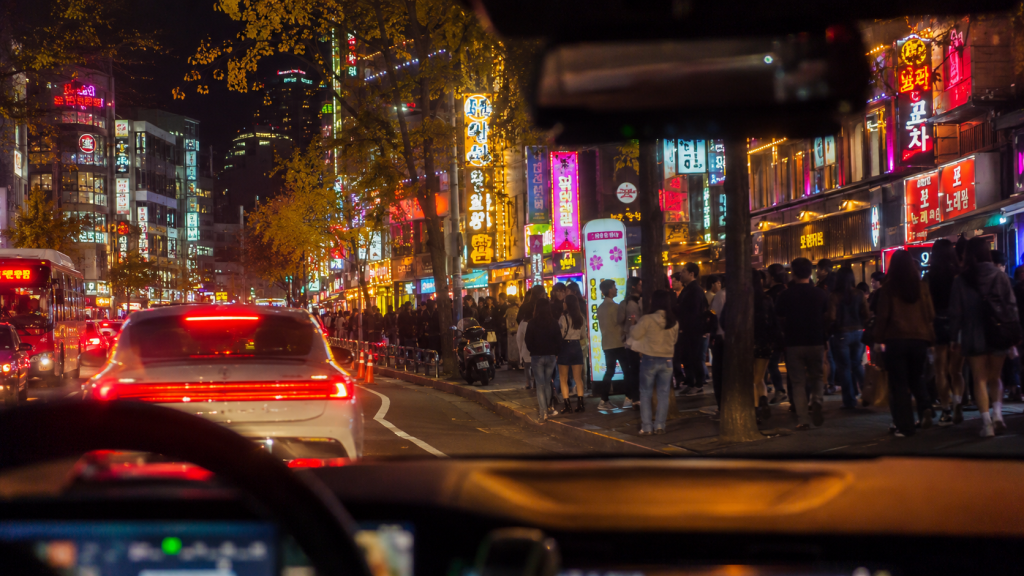
Come back late at night, and the same streets can feel completely different. The music gets louder, bars fill up, clubs get busy, and people seem in no hurry to go home.
When I drove a taxi in Seoul, I saw that side of Hongdae many times.
I picked up foreign tourists, international students, and U.S. service members late at night—and sometimes early in the morning, when they were finally heading home after spending the whole night out.
But the Hongdae I like is not just the crowded nightlife district.
Walk a little farther, and the neighborhood slowly changes.
That is when Hongdae gets more interesting.
Hongdae Is Not Really Just One Neighborhood
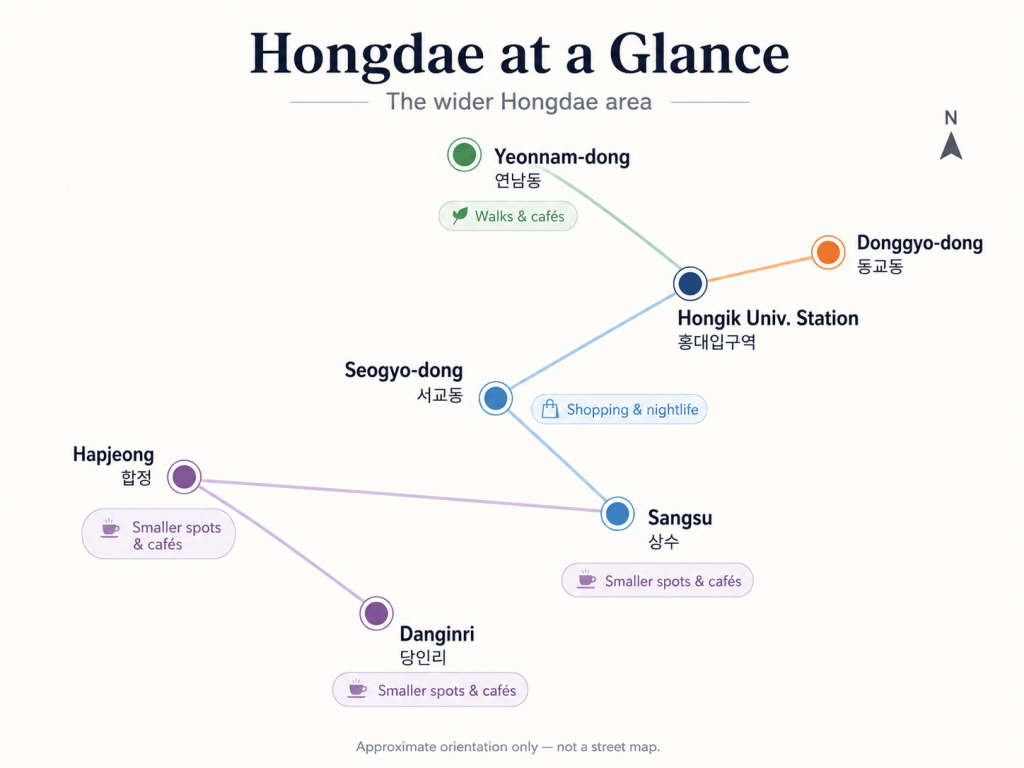
The name Hongdae comes from Hongik University (홍익대학교), but what people casually call “Hongdae” spreads into several connected neighborhoods.
There is Seogyo-dong (서교동), Donggyo-dong (동교동), Yeonnam-dong (연남동), Sangsu (상수), and Hapjeong (합정).
You can walk between them without feeling like you have suddenly entered a completely different part of Seoul.
But little by little, the mood changes.
That is why I think of Hongdae less as one clearly defined neighborhood and more as a group of connected areas with different personalities.
Seogyo-dong: The Hongdae Most Visitors Imagine
Seogyo-dong (서교동) is probably closest to the Hongdae most first-time visitors picture.
This is where shopping, restaurants, bars, street performances, live music, clubs, and nightlife are packed together.
It is energetic, noisy, crowded, and sometimes a little chaotic.
And that is part of the appeal.
The difference between afternoon and late night can be dramatic.
You may walk down the same street twice on the same day and feel as though you are visiting two different places.
When I was driving a taxi, this was also where I saw how international Hongdae could feel after dark.
Foreign tourists were common, but I also picked up people who were clearly studying or living in Korea.
The wider Hongdae–Sinchon area has universities and plenty of young foreigners around, especially students and exchange students, so seeing different languages and nationalities on the street never felt unusual to me.
Even if you have no interest in clubs, I think it is worth seeing Hongdae at night at least once.
The all-night energy is part of the neighborhood.
Donggyo-dong: Where the City Starts to Soften
Around Donggyo-dong (동교동) and Hongik University Station (홍대입구역), Hongdae begins to blend into something a little different.
There are still cafés, restaurants, shops, and places to stay everywhere.
But start walking toward Yeonnam-dong and the transition can feel almost invisible.
One moment you are in busy Hongdae.
A little later, the streets feel calmer and you realize the neighborhood has changed around you.
I like that about this part of Seoul.
You do not always need a plan or a destination.
Sometimes you just keep walking.
Yeonnam-dong: Walking Along an Old Railway
Yeonnam-dong (연남동) is still popular and busy, but compared with central Hongdae, it feels like the city slows down a little.
A big part of that feeling comes from Gyeongui Line Forest Park (경의선숲길).
Railway tracks once ran through this area.
After sections of the railway were moved underground, the old rail corridor was turned into a long green walking space.
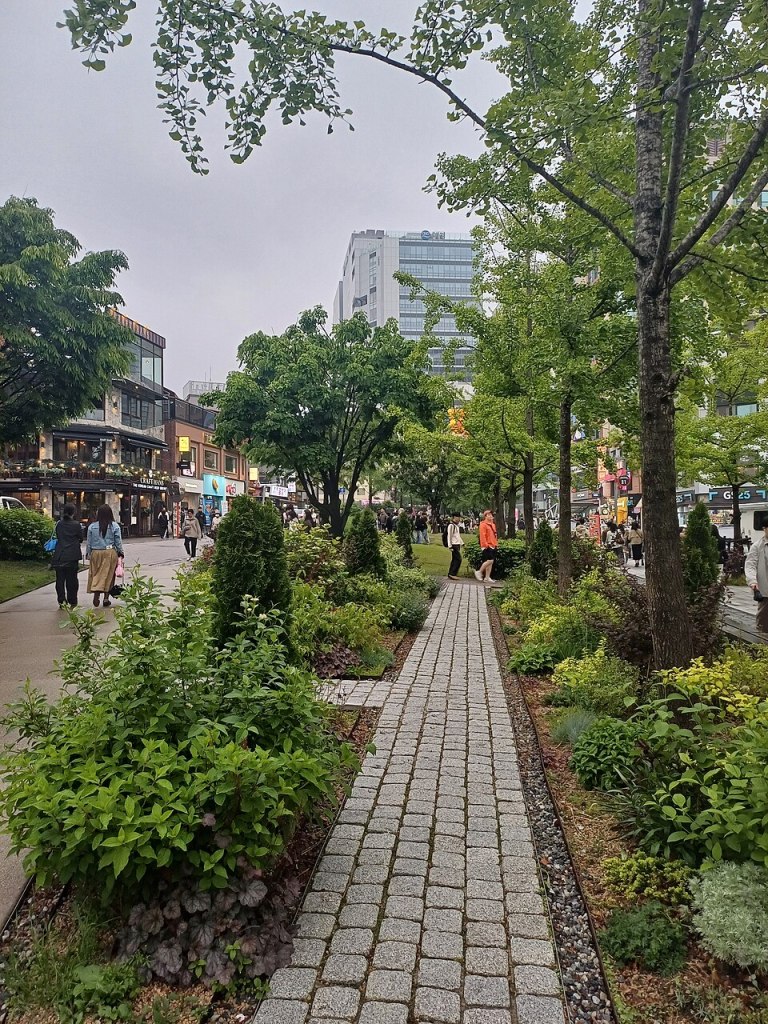
The Yeonnam section became so popular that people started calling it Yeontral Park (연트럴파크)—a playful combination of Yeonnam and Central Park.
I like the contrast.
Trains once passed through here.
Now people walk with coffee in their hands, meet friends, sit outside, and disappear into the small streets on either side of the park.
Food is another reason Yeonnam is interesting.
The area has long-running Chinese restaurants connected to the local Chinese community, and today there are also newer Chinese and fusion restaurants.
There is enough history and food here for a separate article, so I will save the details for later.
Sangsu and Hapjeong: Some of My Favorite Nights Were Here
Some of my favorite nights around Hongdae were not spent on the busiest streets at all.
Walk toward Sangsu (상수) and Hapjeong (합정) and you start finding smaller restaurants, bars, and independent places.
I used to go to a yakitori restaurant around Sangsu that I really liked.
If the wait was too long, I would sometimes just walk to a small late-night restaurant nearby instead.
No complicated plan.
No checklist.
Just: “This place is full. Let’s go there instead.”
I like neighborhoods where you can do that.
For cafés, I personally prefer heading farther toward Danginri (당인리) around Hapjeong.
If I wanted coffee and a little breathing room after the noise of central Hongdae, that is one direction I would go.
The Food Scene Is a Battlefield — in a Good Way
There are plenty of excellent Korean restaurants around Hongdae.
If you visit in winter and you are comfortable eating raw fish, I would also recommend trying bang-eo (방어, yellowtail). It is one of those foods many Koreans start looking forward to when the weather gets cold.
But if you are open to different kinds of food, I would not limit myself to traditional Korean dishes here.
From Sinchon through Hongdae, Yeonnam, Sangsu, and Hapjeong, there are Korean restaurants, Korean-style Chinese food, Japanese-inspired places, fusion restaurants, bars, cafés, and tiny independent shops competing for the same customers.
From a business owner’s point of view, this kind of commercial district can feel like a battlefield.
There are simply so many choices that being “pretty good” may not be enough to survive.
For customers, though, that competition can be wonderful.
So if you walk past an interesting Chinese restaurant or a small Japanese place, I would not skip it simply because you came to Korea.
Food does not have to be traditionally Korean to tell you something about Korea.
Chinese, Japanese, and Western food all change when they live here long enough.
That can be worth experiencing too.
So Which Part Should You Visit?
If you are visiting for the first time, this is roughly how I would think about it.
For energy, shopping, street culture, clubs, and nightlife
→ Central Hongdae / Seogyo-dong (서교동)
For walking, cafés, and a slower afternoon
→ Donggyo-dong (동교동) / Yeonnam-dong (연남동)
For smaller restaurants, bars, and a more local night out
→ Sangsu (상수) / Hapjeong (합정)
For cafés and a little more breathing room
→ I personally like going toward Danginri (당인리).
But you do not really have to choose.
These areas are close enough that walking between them is part of the fun.
Don’t Treat Hongdae Like a Checklist
I would not describe Hongdae by saying:
“Go there, see this famous attraction, take a photo, and leave.”
For me, the neighborhood itself is the attraction.
Walk until the streets change.
Stop somewhere because it looks interesting, not because somebody ranked it No. 1.
Have coffee in the afternoon.
Stay for dinner.
If you still have energy, see what the neighborhood feels like after midnight.
And if central Hongdae gets too loud or too crowded, just keep walking.
My favorite part of Hongdae has often been the part where Hongdae starts becoming somewhere else.
Have a question about Hongdae or another area in Seoul? Leave a comment below. If I know the answer, I’ll be happy to help when I can.


Leave a comment