

Korean Politeness for Travelers: Simple Phrases You Can Actually Use
Korean polite speech can seem complicated at first.
The way Koreans speak can change depending on age, status, familiarity, and the relationship between two people. Even the same idea can be expressed differently depending on who is talking to whom.
But if you are traveling in Korea, you do not need to learn the whole system.
A few simple expressions can get you through a surprising number of everyday situations.
Start With “-yo” and “juseyo”
One of the easiest things to notice in polite Korean is -요 (-yo).
You will hear it everywhere. For travelers, it is a useful sign that a phrase is being said in a polite, everyday style.
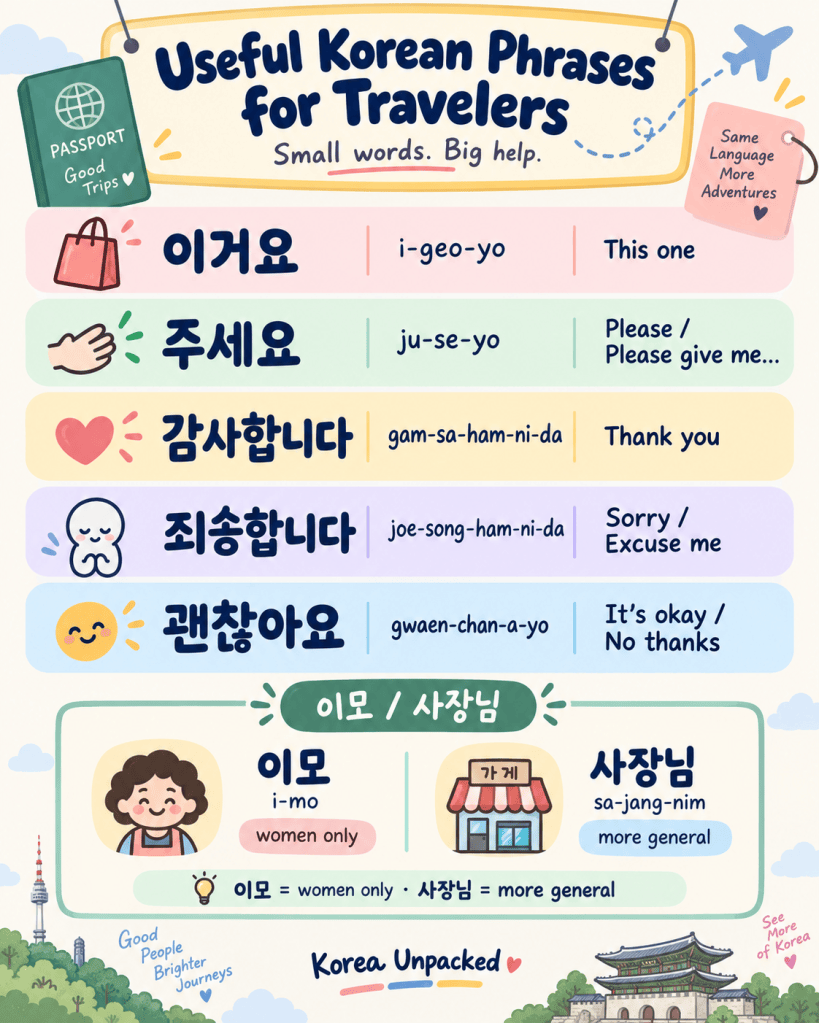
Here are a few expressions worth remembering:
- 이거요 (i-geo-yo) — This one.
- 주세요 (ju-se-yo) — Please / Please give me…
- 괜찮아요 (gwaen-chan-a-yo) — It’s okay / No, thank you.
- 감사합니다 (gam-sa-ham-ni-da) — Thank you.
- 죄송합니다 (joe-song-ham-ni-da) — Sorry / Excuse me.
If you cannot read a menu, just point and say:
이거 주세요.
i-geo ju-se-yo
This one, please.
You can use the same pattern in many situations.
물 주세요.
mul ju-se-yo
Water, please.
하나 주세요.
ha-na ju-se-yo
One, please.
It may not be sophisticated Korean, but it works.
[Insert Useful Korean Phrases card here]
What Should You Call Someone?
사장님 (sa-jang-nim) literally means “boss” or “owner,” but Koreans use it much more broadly in taxis, restaurants, shops, salons, and other service situations.
You may also hear:
이모 (i-mo)
It literally means “aunt,” but in some casual restaurants or markets, it can be used for an older woman.
A simple rule:
이모 = women only, more situational
사장님 = more general and more versatile
Don’t Worry Too Much About Making Mistakes
Some travelers hesitate to speak Korean because they are worried about pronunciation or grammar.
In everyday travel situations, most Koreans are not expecting a visitor to speak perfect Korean.
If you try:
감사합니다.
gam-sa-ham-ni-da
Thank you.
or:
주세요.
ju-se-yo
Please.
the meaning will usually be clear even if your pronunciation is not perfect.
Using the wrong ending once is unlikely to create a serious problem.
You are traveling, not taking a Korean-language exam.
The goal is communication.
Just Say It
Sometimes a Korean person may smile or laugh when a foreign visitor suddenly speaks Korean.
Do not automatically assume they are making fun of you.
They may simply be surprised or pleased because they were not expecting to hear Korean.
So do not spend too long trying to build the perfect sentence in your head.
Your pronunciation may be a little off.
Your grammar may not be perfect.
People will often still understand what you mean.
Just say it.


Leave a comment