
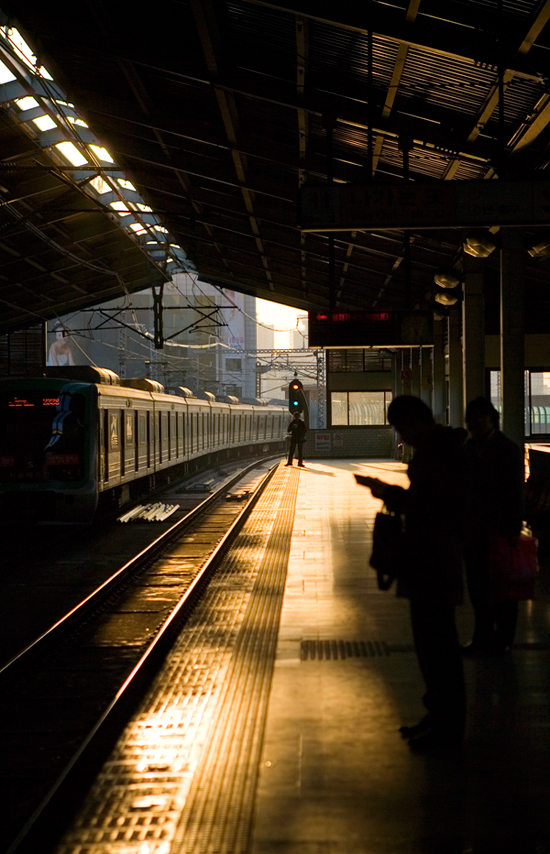
The Seoul subway map can look intimidating the first time you see it.
There are a lot of lines, and they stretch far beyond Seoul into Gyeonggi Province and Incheon. If you are visiting Korea for the first time, you may feel like you need to understand the whole system before you can use it.
You don’t.
If I had to give a first-time visitor one piece of advice, it would be this:
Trust the system.
Get a T-money card, use NAVER Map to find your route, and tap your card when you get on and off.
Let the system calculate the fare for you.
You Can Start at Incheon Airport
If you are arriving through Incheon International Airport, you can start using Korea’s public transportation system right away.
For most visitors, T-money is the simplest transportation card to start with.
The AREX All-Stop Train accepts T-money and connects the airport with places such as Hongdae and Seoul Station, where you can continue onto the Seoul subway system.
The AREX Express Train is different. It requires a separate ticket.
The easiest way to remember it is:
All-Stop Train → T-money works
Express Train → Separate ticket
The All-Stop Train from Incheon Airport to Seoul Station costs around ₩5,000 for an adult, depending on which terminal you start from.
Start With About ₩20,000 on Your T-money Card
You can buy and top up a T-money card at subway stations and convenience stores such as CU, GS25, and 7-ELEVEN.
In Korean, topping up a transportation card is called 충전 (chungjeon).
It is a good idea to keep some cash with you, especially for topping up a standard T-money card. Foreign-issued credit cards may not work with every top-up method.
If you are starting at Incheon Airport, I would load about ₩20,000 at first.
Why not just ₩10,000?
The airport train alone can cost around ₩5,000, and you may need another subway or bus ride to reach your hotel.
After that, you can simply add another ₩10,000 at a time when needed.
Each time you tap out of a bus or subway, the reader shows your remaining balance.
Check it when you get off.
Personally, I top up again when the balance drops below about ₩5,000. That is not an official rule. It is simply a level I find convenient.
You can also refund a small remaining balance before leaving Korea, so there is no need to load a large amount onto the card in advance.
If possible, use one T-money card per person. Each card keeps track of its own rides, exits, and transfers.
Install NAVER Map
For getting around Seoul, NAVER Map is one of the most useful apps to have.
Enter your destination and it can show you:
- subway routes
- bus routes
- transfers
- estimated travel time
- walking directions to stations and bus stops
You do not need to study Seoul’s transportation network before your trip.
Tell the app where you want to go and follow the route.
For a First Trip to Seoul, Use the Subway as Much as Possible
If this is your first visit, I would make the subway — 지하철 (jihacheol) — your main form of transportation.
English signs and announcements are widely available, traffic jams do not affect the trains, and travel times are generally easier to predict.
There are certainly routes where a bus is more convenient.
But for a first-time visitor, a simple strategy is to take the subway as close to your destination as possible, then use a bus or taxi for the remaining distance if needed.
On the Subway, Follow “Transfer” and “Exit”
Tap your T-money card when you enter the station and again when you leave at your destination.
At a transfer station, follow the Transfer — 환승 (hwanseung) signs.
When you are ready to leave the station, follow Exit — 출구 (chulgu).
You do not need to understand every line on the map. You mainly need to know whether you are changing trains or leaving the station.
There is one more useful tip before you go upstairs.
Check your exit number while you are still on the platform.
At some stations, different stairs or escalators lead toward different groups of exits.
If you go upstairs on the wrong side, you may not be able to reach the exit number you need directly from there.
So check your exit number first, then follow the stairs or escalator leading toward that group of exits.
It can save you from having to backtrack through a large station.
There is one situation that sometimes confuses first-time visitors.
You May Have to Tap During a Transfer
On some connections involving the Airport Railroad or Line 9, you may encounter another fare gate or card reader even though you have not reached your destination yet.
That does not necessarily mean you accidentally exited the subway.
If you are following the Transfer — 환승 (hwanseung) signs and a gate asks you to tap your card, just tap it.
The system will handle the fare calculation.
Since March 2026, failing to properly tap out of the Seoul metropolitan subway system can also result in an additional base fare the next time you use the card.
The easiest rule is:
Tap in. Tap out. And if a transfer gate asks you to tap, just tap.
Buses Are a Little Trickier
Seoul buses are extremely useful once you get used to them, but they can be more confusing than the subway for a first-time visitor.
Instead of trying to learn the entire bus network, I would use buses mainly when the subway does not get close enough to your destination.
There are just a few things you need to know.
First, Make Sure You Are at the Right Bus Stop
Check both the bus number and the direction.
A bus stop is 정류장 (jeongnyujang) in Korean.
The same route going in the opposite direction may stop across the road or at another stop nearby.
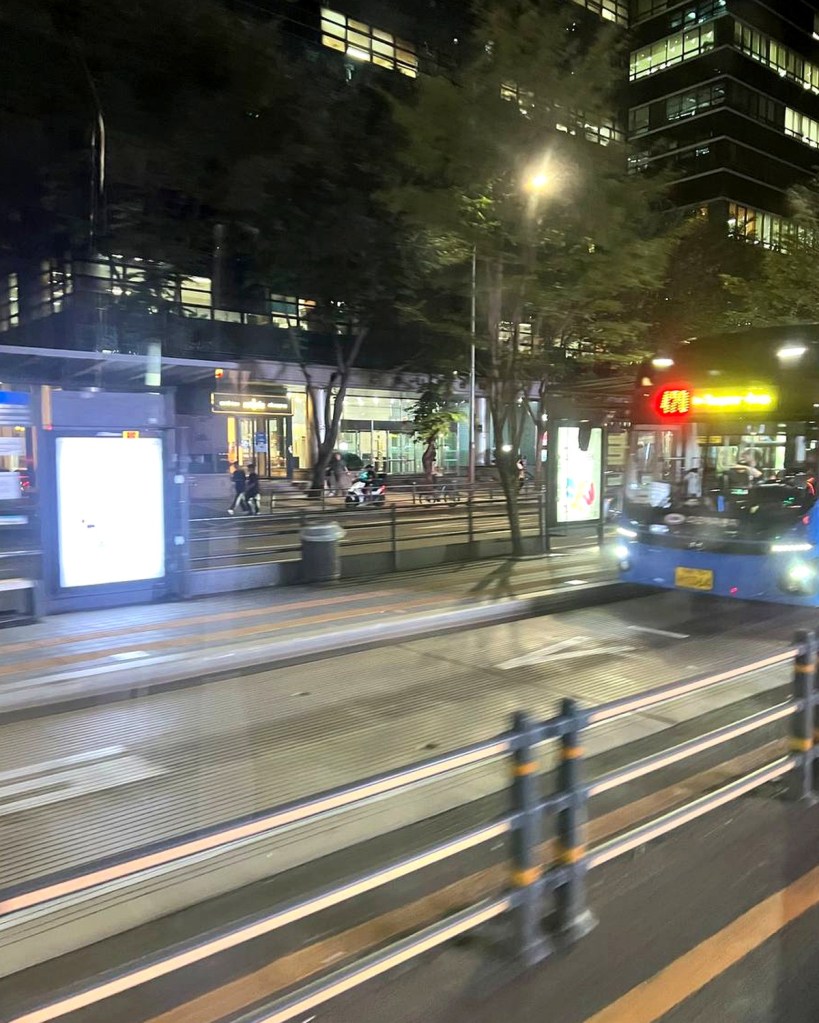
And on some major roads in Seoul, the bus stop may not be on the sidewalk at all.
It may be in the middle of the road on a dedicated bus lane.
If NAVER Map says the stop is there but you cannot see it along the sidewalk, check the center of the road.
If You Are Confused, Check the Five-Digit Bus Stop Number
Seoul bus stops usually have a five-digit stop number.
This is especially useful when several stops have the same or similar names, or when a large transfer area has multiple boarding points.
Compare the stop number shown in NAVER Map with the number displayed at the actual stop.
A simple way to check is:
Bus number → Direction → Bus stop number
That can prevent a lot of mistakes.
Check the Electronic Arrival Board
Many bus stops in Seoul have electronic displays showing real-time arrival information.
They can tell you which buses are approaching and roughly how long you have to wait.
Checking both NAVER Map and the display at the stop gives you an easy way to confirm that you are waiting for the right bus.
At Busy Stops, Look for Bus Numbers on the Ground
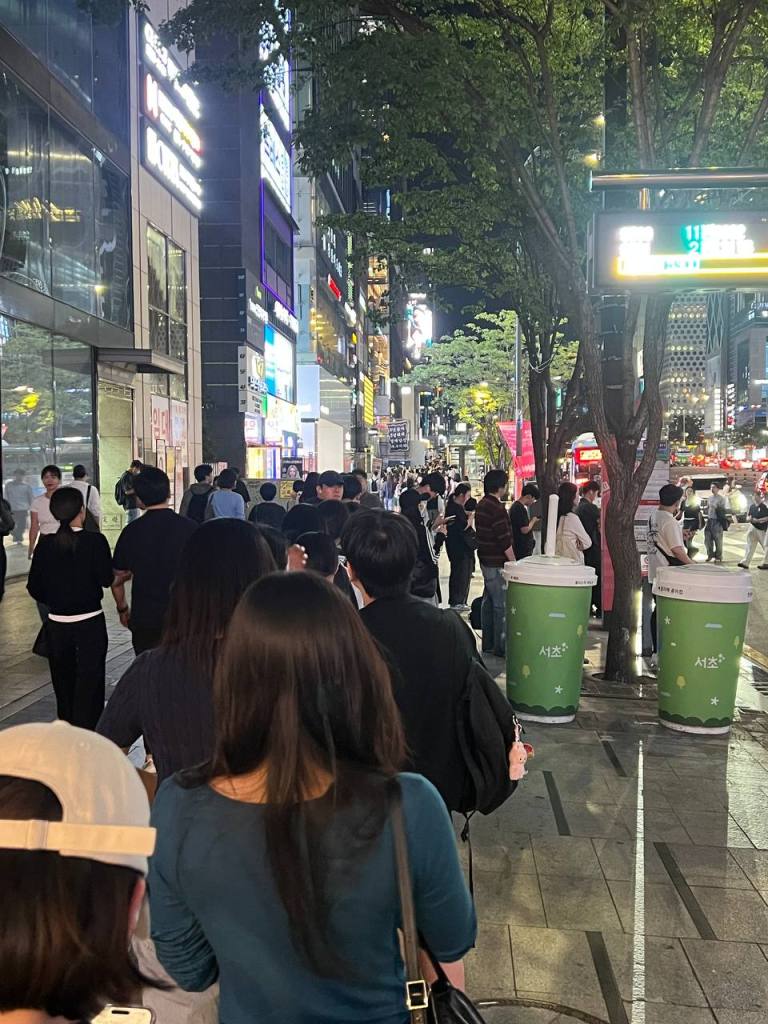
At some major bus stops, especially around areas such as Myeongdong and Gangnam, you may see several separate lines of people waiting for different buses.
This is particularly common with express buses heading toward Gyeonggi Province.
At some stops, route numbers are marked on the pavement to show where each queue begins.
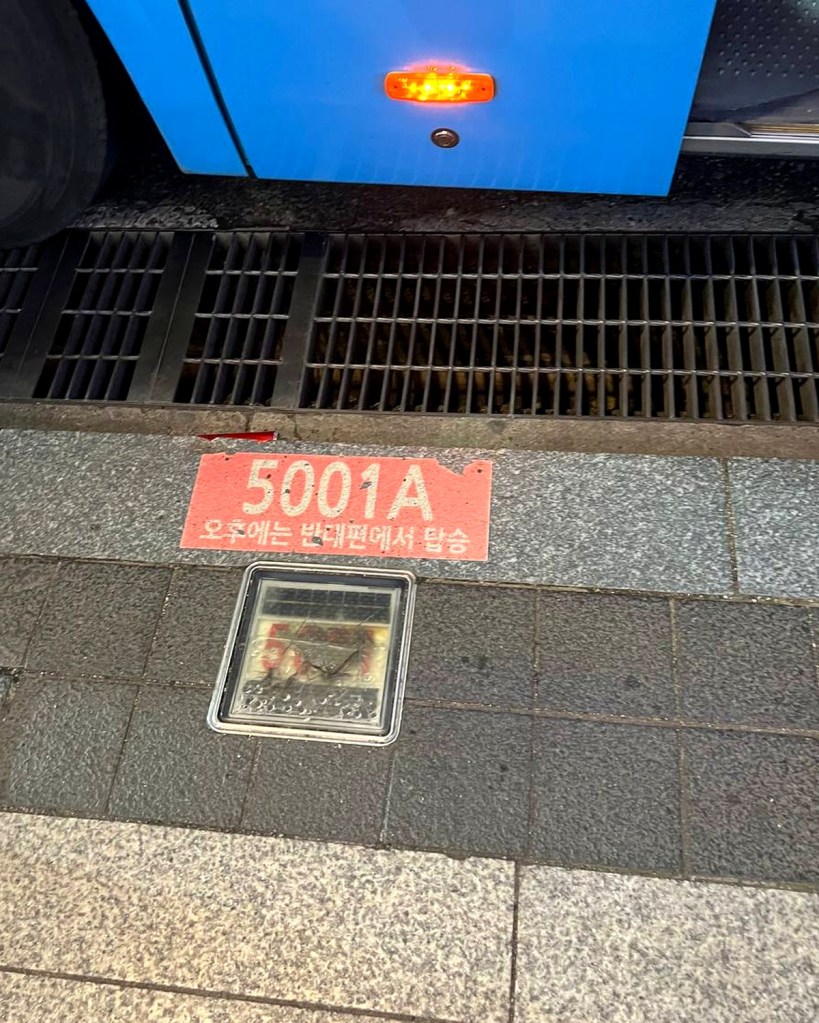
If several lines have formed, do not just join the nearest one.
Find your bus number and join the back of that line.
It can look chaotic the first time you see it, but once you find your route number, it becomes much easier.
Tap When You Board, and Press the Stop Button Before You Get Off
On most Seoul city buses, you board through the front door and get off through the rear door.
Tap your T-money card when you get on.
Inside the bus, announcements and displays show the upcoming stops.
When your stop is getting close, press one of the stop buttons.
If the bus is crowded, it can help to move toward the exit before you reach your stop.
And if you are standing, hold onto a handrail or strap. Seoul buses can sometimes accelerate or brake more quickly than visitors expect.
Before getting off, tap your T-money card again.
Even if you are not planning to transfer, make this a habit.
You do not need to memorize which bus types calculate fares differently.
Just tap when you get on and tap when you get off.
Don’t Try to Calculate Every Fare
When you tap your T-money card, the reader shows the fare charged and your remaining balance.
If you travel farther or transfer to another form of transportation, the system calculates any additional fare automatically.
Most Koreans do not calculate every transfer fare either.
We just tap the card.
You can do the same.
Check the balance when you get off and let the system handle the math.
Transfers Are Usually Within 30 Minutes
If you get off one form of public transportation and board another within 30 minutes, the integrated transfer discount can apply.
Between 9 p.m. and 7 a.m., the transfer window is extended to 60 minutes.
You can make up to four transfers, for a total of five rides.
Again, you do not need to calculate all of this every time.
The simple version is:
Tap when you get off, and if you are transferring, try to board the next ride within 30 minutes.
The System Does Not Stop at the Seoul City Border
A T-money card bought in Seoul does not suddenly become useless when you cross into Gyeonggi Province or Incheon.
The greater Seoul metropolitan transportation system connects Seoul, Gyeonggi, and Incheon.
You can take the subway out of Seoul and then transfer to a Gyeonggi bus, or travel from Incheon into Seoul using the same card.
The Airport Railroad is also connected to this wider network.
You do not need to buy a new transportation card just because you are leaving Seoul.
The huge metropolitan transit map may look complicated at first.
But for a traveler, that size is actually an advantage.
One card can take you surprisingly far.
Sometimes Walking Is Better Than Taking the Subway
The Seoul subway is excellent, but that does not mean you should use it for every short trip.
In central Seoul, areas such as Jongno, Euljiro, Chungmuro, and Myeongdong have many places that are closer on foot than they may appear on a subway map.
I used to walk between Euljiro and Jongno quite often.
On the subway map, the different lines and stations can make the area look more spread out than it really is.
For a short subway trip, you still have to walk to the station, go underground, wait for the train, ride it, and then come back up to street level.
And when traffic is heavy, a short taxi ride can sometimes take longer than expected too.
So before taking the subway for a nearby destination, check the walking time in NAVER Map.
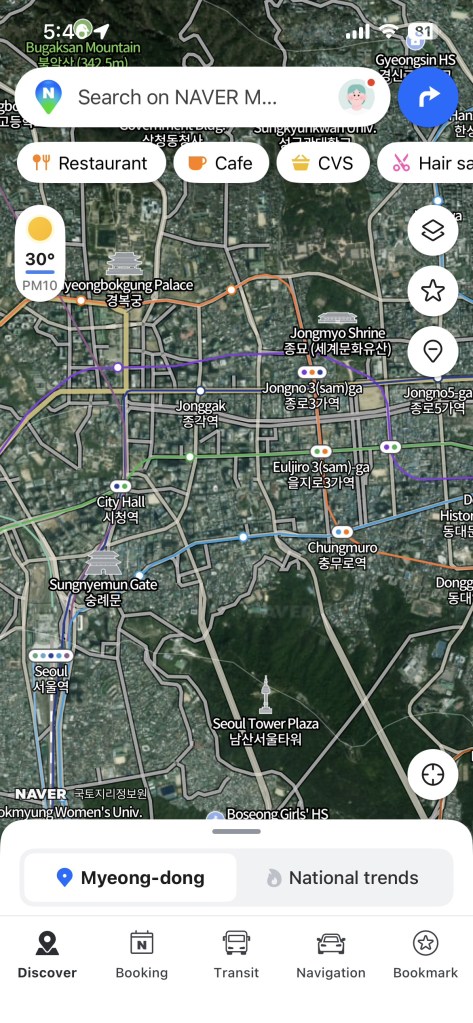
Central Seoul can be more walkable than it looks on the subway map. Check the walking time before automatically taking the subway.
If it looks reasonable, walking may be the simpler option.
You may also see parts of Seoul you would completely miss underground: Cheonggyecheon, old commercial buildings, small alleys, and neighborhood restaurants.
Sometimes the best way to get around central Seoul is simply to stay above ground.
For Long Distances, Consider Combining the Subway and a Taxi
From my experience driving a taxi in Seoul, one thing I would suggest is not treating taxis and the subway as an either-or choice.
For a long trip across the city, it can make sense to use the subway for the longest part of the journey and a taxi only for the shorter first or last section.
For example:
Hotel → Taxi → Long subway ride → Taxi if needed
This will not always be faster or cheaper.
Traffic conditions, the number of people traveling, luggage, and your exact destination all matter.
But when the roads are heavily congested and you need to cross a large part of Seoul, it can be a useful option.
On the other hand, late at night when the roads are clear—or when you have a lot of luggage—taking a taxi all the way may be more convenient.
Do not think of taxis and the subway as competitors.
Sometimes the best option is to use both.
You Can Pay for a Taxi With T-money, but I Don’t Recommend Relying on It
Many taxis accept T-money.
Personally, however, I prefer to keep T-money mainly for buses and subways and use a regular credit card or another payment method in taxis.
When I was driving a taxi in Seoul, I occasionally saw T-money payments fail or situations where the transaction had to be checked again because it was unclear whether the payment had gone through properly.
That is also one reason I do not recommend loading a large amount of money onto your T-money card at once.
Food and Drinks: Better Not While Riding
Carrying a sealed drink or packaged food onto public transportation is generally not a problem.
But I would avoid eating or drinking while riding a bus or subway.
Strong-smelling food and anything that can spill should be avoided in particular.
The same goes for alcohol.
You do not need to study a complicated list of what is technically allowed and what is not.
A simple rule works well:
If you are on public transportation, it is usually better not to eat or drink.
The Simplest Way to Get Around Seoul
If this is your first trip to Seoul, keep it simple.
If it’s close, consider walking.
If it’s far, take the subway.
If the subway does not get you close enough, use a bus or taxi for the gap.
Use NAVER Map to find the route.
Tap your T-money card when you get on and when you get off.
Check the balance when you leave.
You do not need to memorize Seoul’s huge transportation system.
Don’t memorize Seoul’s public transportation system. Trust it. Tap your card, follow the signs, and let the system do the math.
Have a question about public transportation in Korea?
Leave a comment below. If I know the answer, I’ll be happy to help when I can.
Your question may also help me understand what other travelers find confusing about getting around Korea.


Leave a comment