
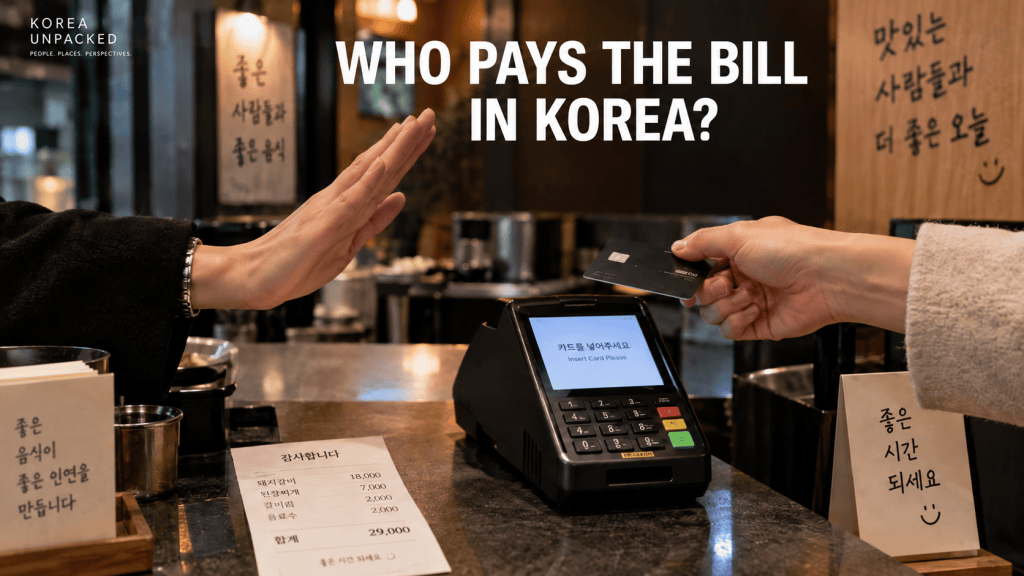
Who Pays the Bill in Korea? Usually the Senior Person — But Maybe Not Forever
When I was driving a taxi in Seoul, I once picked up a foreign passenger.
At first, he was just another customer. But during the ride, we started talking about Korea, and the conversation went surprisingly well.
By the time we reached his destination, we had exchanged contact information. We kept messaging afterward and eventually became friends.
At some point during that first taxi ride, we also talked about our ages.
I misunderstood his age and thought I was older.
So I told him:
“Whether we meet in Korea or the U.S., I’ll pay for our first meal. I’m the older brother. That’s Korean culture.”
By “older brother,” I meant an older male friend or brother figure (형, hyung), a relationship that can matter quite a lot in Korea.
Later, while we were messaging, I realized I had gotten his age wrong.
He was actually older than me.
So he replied:
“Then I’ll pay for our first meal.”
My answer was simple.
“Deal.”
Looking back, that was a very Korean conversation.
Why Does the Older Person Often Pay in Korea?
In Korea, being older or holding a higher position has traditionally meant more than simply receiving respect.
It has also come with an expectation that you should look after people who are younger or junior to you.
That attitude often extends to the table.
An older friend, senior colleague, or boss may reach for the bill first.
I have even seen some older Koreans look almost uncomfortable when a younger person tried to pay.
“Why are you paying when I’m here?”
Not every Korean thinks this way, of course.
But in the Korea I grew up in, it was a very familiar scene.
At Work, Rank Can Matter More Than Age
Workplace relationships can work in a similar way.
I am not talking about an official company dinner paid for with a corporate card. That is a different matter.
I mean private meals or drinks between colleagues.
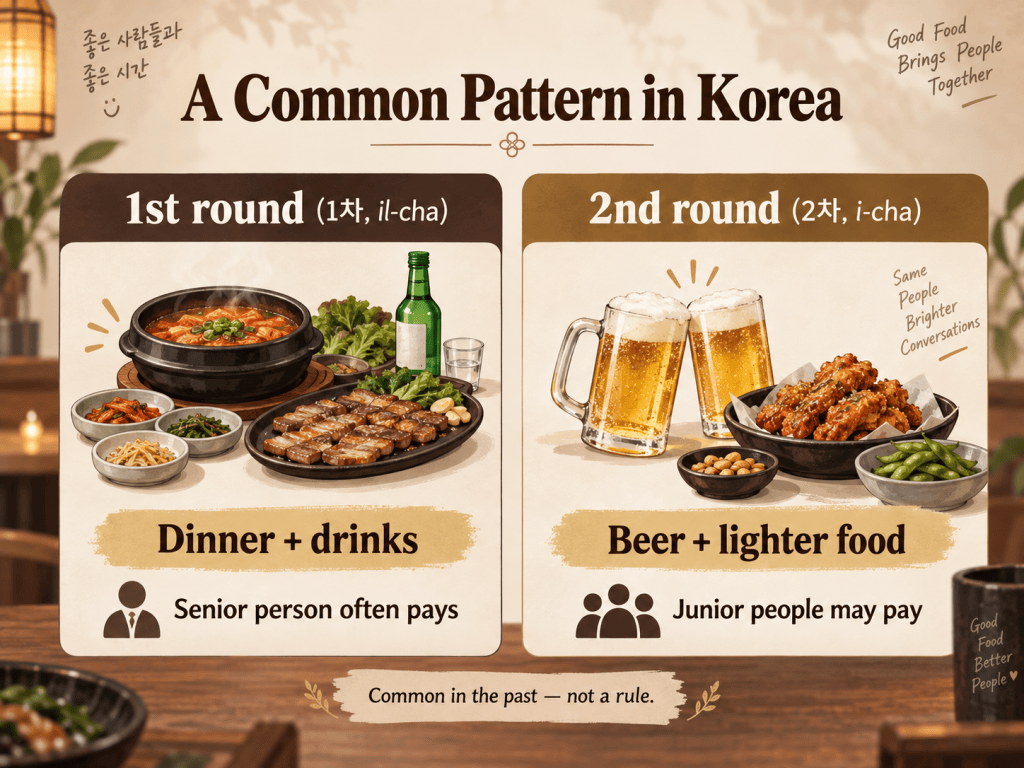
In the past, a senior employee might pay for the more expensive first round (1차, il-cha), usually dinner and drinks.
Then younger colleagues might pay for a lighter second round (2차, i-cha), perhaps beer and a simple snack.
The total was not divided precisely in half.
Someone paid now, and someone else picked up the next bill.
That was one way people shared the cost.
The Same Person May Pay Differently Depending on the Relationship
I used to teach at an academy, and I still meet some of my former students.
When they were still students, I almost always paid for the meal.
To me, a teacher buying food for his students felt completely natural.
But things started to change once they reached their thirties and began working full-time.
If I paid for dinner, they would say:
“Teacher, we’ll pay for the second round.”
What is interesting is how they pay when they meet each other.
Among themselves, they usually split the bill on the spot.
Koreans often call this an even split (엔빵, en-ppang), or N-bbang.
So the same people may split a bill immediately with friends but still insist on buying the next round when they are with an older teacher.
Who you are eating with still matters.
My Generation Remembered the Next Turn, Not the Exact Amount
When I was younger and drinking with friends, at least in my circle, we did not usually calculate every bill down to the last won.
One friend might pay today.
Someone else would pay the next time.
Or one person would buy the first round and another would pay at the next place.
We did not worry much about whether someone had paid a few thousand won more.
The important thing was that the same person did not keep paying forever.
Maybe that sounds a little like an ajae (아재, ajae) talking — a middle-aged Korean guy with a certain generational vibe.
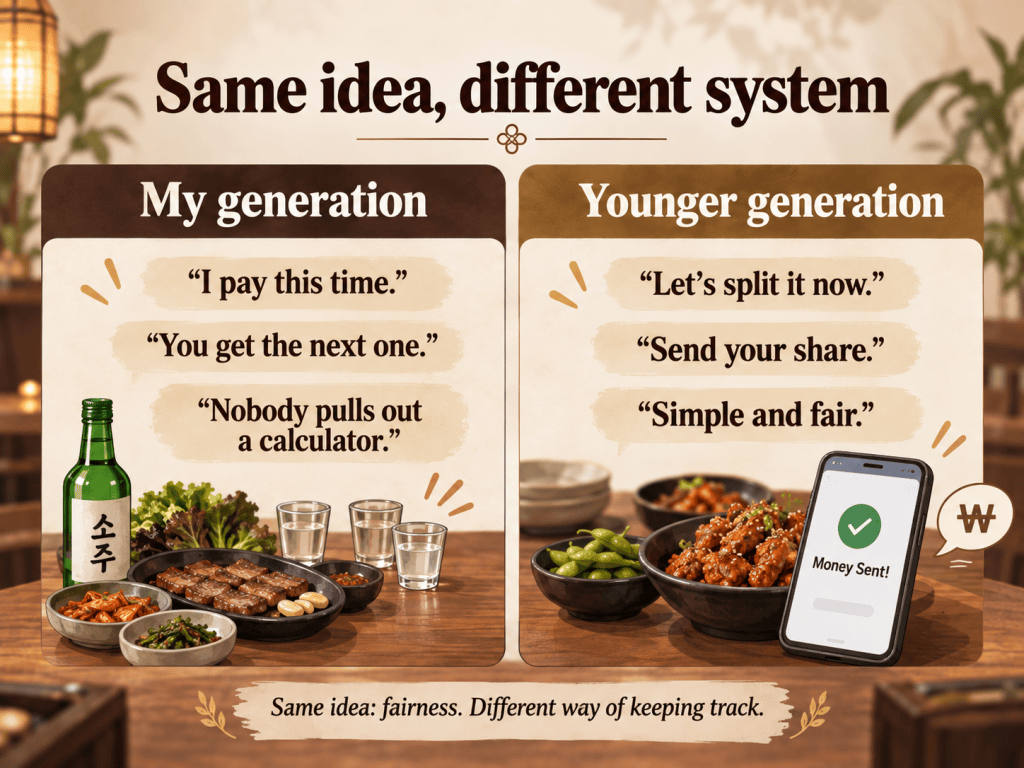
I paid this time. You get the next one. Nobody pulls out a calculator.
Many younger Koreans seem much more comfortable splitting the bill immediately.
And the second round is not as automatic as it once felt, either.
If everyone is going home after one meal, splitting that bill right away is simply easier than remembering who should pay next time.
Dating Costs Have Changed Too
Dating was a little different.
When I was younger, it was quite normal for the man to pay more of the dating expenses.
That was certainly true in my relationships.
Looking back, I probably paid around 90 percent of the costs in some relationships.
In one relationship, I paid almost everything.
What is interesting is that my friends and I rarely sat around discussing questions like:
“Should the man pay more?”
“Should couples split everything fifty-fifty?”
At least in my circle, there was not much reason to ask.
Men paying more simply felt normal.
My friends even had a joke:
“When spending money on your girlfriend starts to feel like a waste, it might be time to break up.”
Just a joke between friends.
Things became more flexible as I got older.
By the time I was in my thirties, the women I dated were more likely to be working and earning their own income.
Sometimes I paid.
Sometimes my girlfriend paid.
And sometimes she would simply say:
“It’s on me today.”
오늘은 내가 쏠게. (oneureun naega ssolge)
The Korean expression literally uses the verb “to shoot,” but in this context it means, “I’m paying.”
In that case, I was perfectly happy to let her pay.
These days, I often see younger Koreans online asking how dating costs should be divided.
That difference itself is interesting to me.
Something my generation often treated as obvious has become something couples now discuss and decide for themselves.
Family Is Different Again
Family does not always follow the “older person pays” rule.
When I go back to my hometown, I try to pay when I eat with my mother.
Sometimes I also pay when I have drinks with my older brother.
He is older than me, but he has a family and children to support.
I live alone.
In a situation like that, age is not always the most important factor.
Circumstances matter too.
So Who Pays the Bill in Korea?
Even today, if there is a clear difference in age, seniority, or rank, the older or more senior person often pays first.
That is the Korea I grew up with.
A senior may buy dinner.
A boss may pick up the drinks.
An older friend may pay for the younger one.
Then, over time, the other person finds another way to return the gesture.
A junior buys the next round.
A former student pays for drinks.
A friend pays next time.
The system I grew up with was less about dividing every bill exactly and more about remembering whose turn came next.
But many younger Koreans seem to be handling that reciprocity differently.
They are more comfortable dividing the bill immediately, or simply deciding together what feels fair.
So if a foreign friend asked me today:
“Who usually pays the bill in Korea?”
I would probably still answer:
“Usually, the older or more senior person pays first.”
But now I would add one more line.
“At least for now.”


Leave a comment