
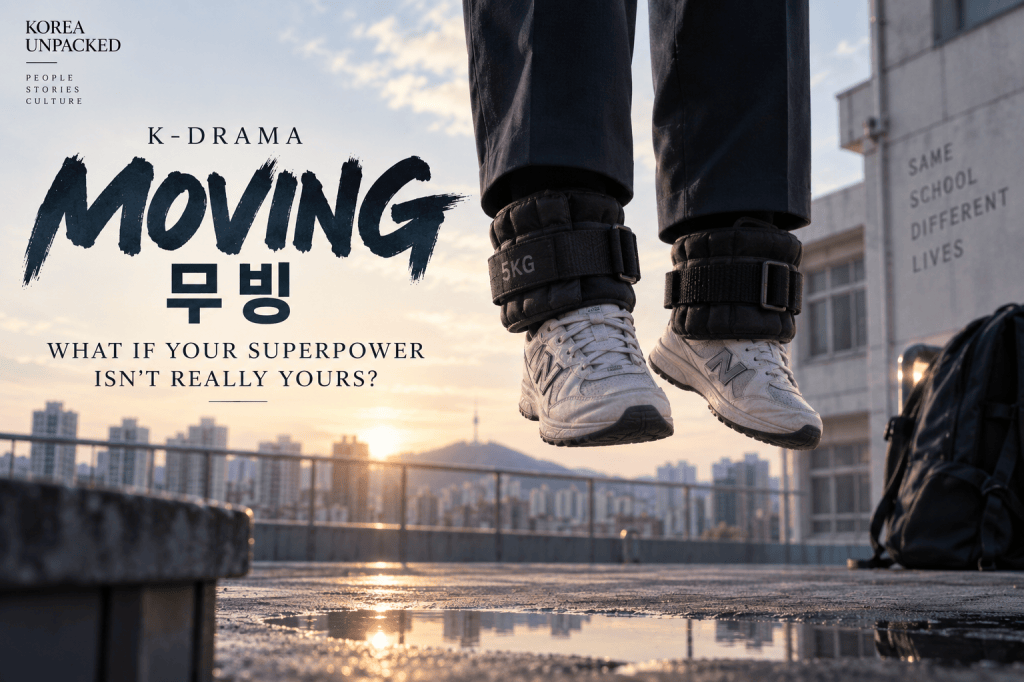
K-Drama Moving: Who Really Holds the Most Dangerous Power? — 6 Questions Before Season 2
There are people in Moving who can fly.
There are people who can survive gunshots and heal from injuries that should kill them.
But while watching the series, the most dangerous power did not feel like a superpower to me.
It was the power to decide someone else’s life for them.
Who becomes an agent.
Where they are sent.
What they are expected to sacrifice.
Many of the characters in Moving are denied the right to make the most important choices in their own lives.
With Season 2 on the way, I found myself thinking again about some of the questions Season 1 left behind.
That also made me think about the way writer Kang Full sees ordinary people.
In works such as 26 Years, he often seems to stay with people whose lives have been damaged by state power or by systems much larger than themselves.
In Korean, there is an expression for a tender, aching affection (애틋함, aeteutham).
It is difficult to explain with words like love or sympathy alone.
It carries affection, sadness, concern, and a sense of pain for someone you care about.
I often feel that kind of aeteutham in Kang Full’s stories.
I also tend to be drawn to stories about people who lose control of their lives because of something they never chose, or who are forced to make sacrifices they never wanted.
So while watching Moving, I became less interested in the question, “Who is the strongest?”
Another question kept coming back to me.
Who is deciding how these people are allowed to live?
Of course, I am not saying this is necessarily the message Kang Full intended.
This is simply how I watched the drama.
1. Who Is the Real Main Character — the Parents or the Children?
My answer is:
Neither.
At first, Moving seems to be about the children.
But as the story progresses, the parents’ past begins to take up a much larger part of the story.
So it is natural to ask whether the parents are the real protagonists, or whether the children are.
I saw it differently.
To me, the parents and the children are two generations showing us the same problem.
The parents have already had their abilities used by the state.
Because of those abilities, they were sent on dangerous missions, separated from people they loved, and forced to give up ordinary lives.
The children have not reached that point yet.
That is why the parents’ stories feel like both the past and a possible future for their children.
So I do not think the most important question is which generation is the real main character.
The more important question is:
Will the children be forced to repeat the lives of their parents?
2. Why Did the Parents Hide Their Children’s Powers?
The parents are not hiding their children’s abilities simply because those abilities are dangerous.
They hide them because they know what happened to their own lives.
Kim Doo-sik, Lee Mi-hyun, and Jang Ju-won were used because the state needed what they could do.
They understand that the moment an ability becomes known, it may no longer fully belong to the person who has it.
So what the parents are protecting is not just a secret.
They are protecting their children’s right to choose their own lives.
There is also, in my view, a very Korean kind of parental emotion here.
Korean parents often say something like:
“I had a hard life, but I don’t want my child to live the way I did.”
Even if parents accepted hardship or sacrifice themselves, they often do not want to pass the same burden down to their children.
You can sometimes see this emotion in discussions about Korean education, family expectations, and parental sacrifice.
Of course, this does not mean every Korean parent thinks the same way.
But I saw something similar in the parents in Moving.
There were moments when they could not refuse what the state demanded from them.
But for their children, they want something different.
That is why I saw it this way:
They weren’t protecting the secret. They were protecting the child’s life.
3. Who Is the Real Villain in Moving?
Who is the real villain in Moving?
Min Yong-jun?
North Korea?
The CIA?
I see the problem a little differently.
I do not think the existence of a state system itself is evil.
South Korea is a divided country, and in the real world, intelligence agencies and national security organizations are necessary.
If people with superhuman abilities actually existed, it would not be completely irrational for a government to consider how those abilities might be used for national security.
The problem comes after that.
How is that power used?
The line is crossed when a person’s wishes are ignored, family members are used as leverage, individual rights are violated, and people are treated like weapons or resources that can be discarded when they are no longer useful.
In Moving, Min Yong-jun is someone who directly exercises that kind of power.
But by the end of Season 1, even he does not appear to be at the very top.
Then Shin Hye-won reappears.
What makes this even more interesting is that neither of them is some supernatural monster.
They are simply people working inside a government organization.
That is what made them more disturbing to me.
Maybe the thing more frightening than a superpower is ordinary institutional power —
the power to look at another person and decide, “Your life belongs to the state now.”
4. Who Is Shin Hye-won Really?
Shin Hye-won is one of the characters who leaves the most obvious unanswered questions at the end of Season 1.
At first, she appears to be a student.
But when she returns near the end, Min Yong-jun treats her completely differently.
That scene made me wonder:
Could Shin Hye-won be much older than she appears, and could she have been connected to this organization even longer than Min Yong-jun has?
From here, this is pure speculation on my part.
I have not read the original webtoon.
I have only watched the Moving drama.
Could someone like Shin Hye-won have been connected to the early stages of the system that eventually allowed the government to identify and manage people with special abilities?
Season 1 already shows us that the state has been using people with abilities for a long time.
So my question is not simply:
“When did the government first learn that these people existed?”
What I want to know is:
How did the system for finding, classifying, and controlling them begin?
I have no idea whether Shin Hye-won is actually connected to that history.
It is simply a theory I came up with after watching the final scenes of Season 1.
And it is one of the things I most want Season 2 to answer.
5. Why Did Joon-hwa Free Doo-sik?
The scene where North Korean agent Joon-hwa frees Kim Doo-sik stayed with me for a long time.
They come from different countries.
One is from South Korea.
The other is from North Korea.
But I do not think Joon-hwa looked at Doo-sik and saw someone completely different from himself.
I think he may have seen someone very much like himself.
In Korean, there is an expression for a sense of shared experience or identification (동질감, dongjilgam).
It is a very common word in Korea, but there is no single English word that captures it perfectly.
It is the feeling you get when you recognize something of your own situation, experience, or position in another person.
That is how I interpreted Joon-hwa’s reaction to Doo-sik.
They were enemies.
But both had been used by their own countries.
Both had been forced to make sacrifices they did not choose.
Maybe Doo-sik was not simply a South Korean agent to Joon-hwa.
Maybe he saw someone and thought:
“You were used by your country too. And in the end, you were abandoned just like me.”
The battle at the school, and seeing people fight desperately for their families, may also have influenced his decision.
But the drama never directly explains what Joon-hwa was thinking.
This is simply how I interpreted that moment.
6. Was Frank Really a Villain?
Frank killed people.
He came to Korea under orders and hunted down retired people with special abilities.
There is no reason to make what he did sound better than it was.
His actions were clearly wrong.
But even so, I found it difficult to see Frank as nothing more than a villain.
He too was taken because of his abilities, raised by an organization, and turned into a weapon capable of killing people.
Did Frank really choose that life?
How many alternatives did he ever have?
That made me think:
He did terrible things, but he was also a victim of the system that turned him into a weapon.
Calling him a victim does not erase what he did.
But a person can be both a perpetrator and a victim of a larger power at the same time.
And when you look at Moving that way, a strange pattern appears.
South Korea has Kim Doo-sik.
North Korea has Joon-hwa.
On the U.S. side, there is Frank.
The systems are different.
But all three men were pulled into the needs of a state or an organization because of abilities they never asked for.
That is why I did not see the central conflict in Moving as simply South Korea versus North Korea, or Korea versus the United States.
To me, it was a story about who gets to make the decisions when the power of the state collides with the life of an individual.
Bonus: Who Was the Student Who Stopped Time?
You may remember the student who stopped time during the school scenes.
That student is Kim Young-tak.
I had only watched the Moving drama, so I had no idea who he was at first either.
Kim Young-tak is a character from another Kang Full work, Timing, and later also appears in Bridge.
So that very short scene was not just a random joke involving another superpowered student.
It was a small hint that Moving is connected to a much larger universe of Kang Full’s stories.
I am curious to see how much Season 2 expands that world.
So What Do I Want to See in Season 2?
Of course, it will be fun if Season 2 introduces new abilities and gives us bigger action scenes.
But that is not what I am most curious about.
The parents have already been used by the state.
That is why they hid their children’s abilities and tried to prevent them from inheriting the same lives.
But by the end of Season 1, the children’s abilities are no longer completely hidden.
So the next question seems unavoidable.
Will the children eventually be forced to use their abilities for the state, just as their parents were?
Or will this generation be allowed to choose their own lives?
For me, Moving was ultimately not a story about superpowers.
It was a story about the right to choose.
A person can fly.
A person can survive almost anything.
A person can possess extraordinary strength.
But if that person cannot choose how to live their own life, are they really free?
That is why, while waiting for Season 2, this is the question I keep coming back to:
When the government begins forcing sacrifices on you that you never chose, can an individual ever truly escape its power?
And maybe that is more frightening than any superpower in Moving.
Have a question about Korea, Korean culture, or something you noticed in a K-drama? Leave a comment below. If I know the answer, I’ll be happy to help when I can.


Leave a comment