

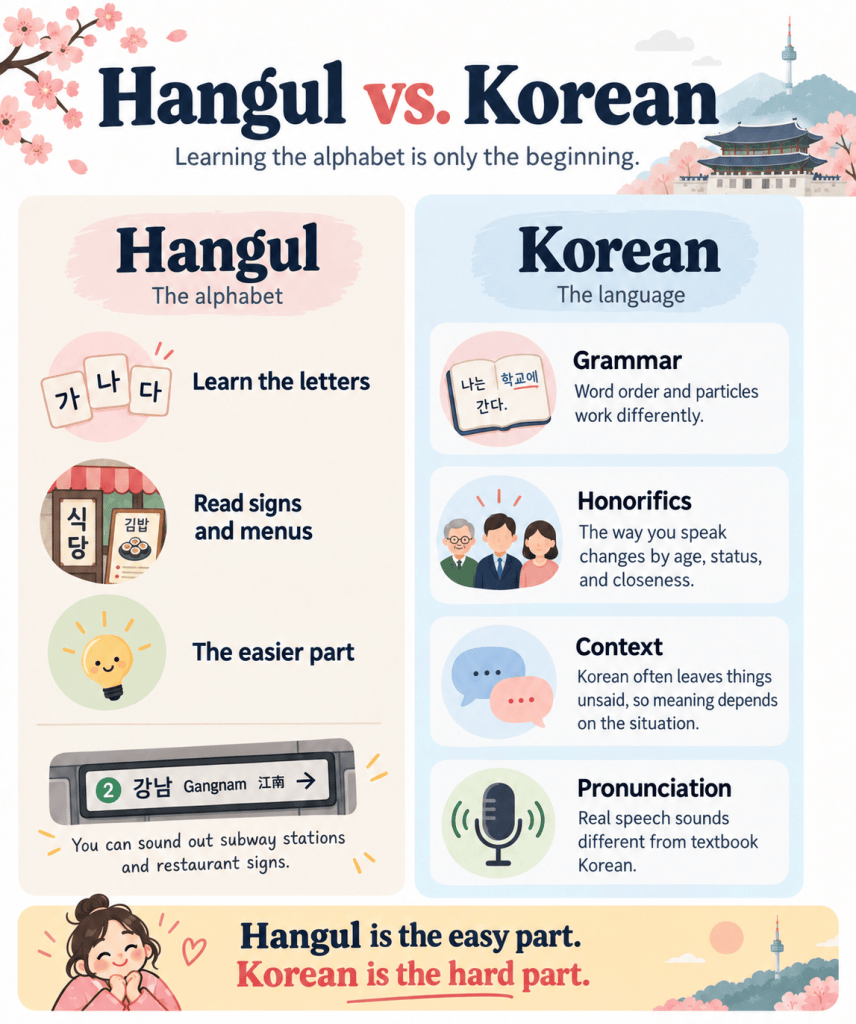
Hangul, the Korean alphabet, is surprisingly approachable. Learn how the consonants and vowels fit together, and before long you can sound out station names, restaurant signs, and words you have never seen before.
That can create a dangerous little moment of confidence: Korean is easier than I expected.
Reading Hangul and actually using Korean are two very different things.
Getting to basic reading and writing is relatively easy. Korean itself is hard. I think it is better to simply admit that.
You have to read the person and the situation
In Korean, the same basic message changes depending on who you are talking to and what kind of situation you are in.
A casual “Did you eat?” can be 밥 먹었어? (bap meogeosseo?). A more polite version is 밥 먹었어요? (bap meogeosseoyo?). With someone older or in a situation that calls for more respect, you may hear 식사하셨어요? (siksa-hasyeosseoyo?).
The dictionary meaning is similar. The social meaning is not.
So a Korean learner is not only choosing a sentence. You are also thinking about age, closeness, rank, and the situation at the same time.
If you want a practical introduction to that side of Korean, I wrote more about it in Korean Politeness for Travelers.
You have to understand what was not said
Koreans leave things out constantly when everyone in the conversation already knows what they are talking about.
You may hear short questions such as 먹었어? (meogeosseo?, “Did you eat?”), 했어? (haesseo?, “Did you do it?”), or 갔어? (gasseo?, “Did you go?”).
The subject, object, place, or even the entire topic may be missing because the speakers already share that information.
That means you are listening not only to the words inside the sentence, but also to the context outside it.
“Red” is not just one red
Korean can describe a similar color with different shades and impressions: 빨갛다 (ppalgata), 붉다 (bukda), 벌겋다 (beolgeota), or 불그스름하다 (bulgeuseureumhada).
English also has plenty of ways to distinguish colors. The point is not that Korean is uniquely complicated. The problem for a learner is that words that may all look like some version of “red” in a dictionary can create different pictures in a Korean speaker’s mind.
You eventually have to learn the feeling of the word, not only its translation.
The same feeling can be expressed in several ways
Take anger. Someone can be angry 화가 났다 (hwaga natda), irritated 짜증이 났다 (jjajeungi natda), or say they are really pissed off 열받았다 (yeolbadatda).
Those are not perfectly interchangeable. The cause, intensity, situation, and speaker’s attitude all matter.
Again, this is not unique to Korean. Every language has nuance. But Korean learners often discover that memorizing one dictionary equivalent does not tell them which expression sounds natural in a particular moment.
Why does something hot feel “cool”?
A cold drink can feel refreshing, or 시원하다 (siwonhada). That makes sense.
Then you sit in a hot bath and hear a Korean say, “Ah, 시원하다.” Or someone takes a spoonful of steaming soup and says the broth is 시원하다.
Here, the word is not simply describing temperature. It can describe a refreshed, relieved, clean, satisfying feeling.
Another expression is 기분 죽인다 (gibun juginda). Literally, it looks strange. In casual speech, however, it can mean something closer to “this feels amazing.”
This is where direct translation starts to break down.
Then you meet a dialect and start again
When I lived in the Philippines, I met foreigners who had watched a lot of Korean dramas and already knew some Korean. More than once, someone asked me what 뭐라카노? (mworakano?) meant.
They already knew the standard expression 뭐라고? (mworago?), something like “What did you say?”
I would explain that, in the situation we were talking about, 뭐라카노? was basically doing a similar job in Gyeongsang dialect. Their reaction was often simple: “Really?”
To me, the difference felt completely natural. To them, it sounded like a new language.
And to be precise, dialect expressions change with context and intonation, so 뭐라카노? is not a perfect one-to-one replacement for 뭐라고? in every situation. But that little conversation showed me how different the Korean that foreigners study can feel from the Korean they actually hear.
The dictionary is not wrong. It is just not always enough
A dictionary can tell you what a word means. It cannot always tell you how strong it feels, who normally says it, whether it sounds rough, whether it belongs to a region, or whether it fits the relationship between two people.
That is why someone can know a lot of vocabulary and still get lost when Koreans start talking naturally.
Why does “our mom” usually mean “my mom”?
Koreans commonly say 우리 엄마 (uri eomma, “my mom”), 우리 집 (uri jip, “my home”), and 우리 회사 (uri hoesa, “my company”).
If you translate 우리 (uri) mechanically as “our,” some of these expressions sound odd in English. But the Korean usage reflects a different way of framing relationships and belonging.
I went deeper into that in Why Koreans Say “Our Mom” — and Why “Our” Is the Wrong Way to Understand 우리 (Uri).
You should still try speaking Korean
Yes, Korean is hard.
Hangul is the easy part. After that come people and situations, missing context, subtle differences between similar words, expressions that do not translate literally, and regional speech.
Even native Koreans do not always write every word perfectly, space every sentence correctly, or choose the most precise expression every time. That is normal language use, not a language exam.
So if you are visiting Korea, do not wait until your Korean is perfect. Your pronunciation does not have to be perfect. Your honorifics do not have to be perfect.
You are not coming to Korea to take a Korean test. You are trying to talk to people.
Hangul is the easy part. Korean is the hard part. But you do not need perfect Korean to use it.
Have a question about Korean or something you heard in Korea? Leave a comment below. If I know the answer, I’ll be happy to help when I have time.


Leave a comment