
I’ve played golf in Korea, and I’ve played quite a few rounds in the Philippines.
After going back and forth a few times, I started noticing differences that had less to do with the game itself and more to do with everything around it.
Golf is still golf. But the atmosphere around a round can feel very different.
Tee times, pace of play, caddies, carts, the course layout, and even what happens after the round all felt a little different from what I was used to in Korea.
None of these things seems huge on its own. Put them together, though, and the experience feels noticeably different.
Four Hours in the Off-Season, Seven Hours in Peak Season
At some of the golf courses I played in the Philippines, tee times felt a little more flexible than they usually do in Korea.
If I arrived early and the course was open, I was sometimes able to get out earlier than expected.
During the off-season, when the course wasn’t crowded, I could finish 18 holes in about four hours and leave.
Peak season was a very different story.
Once, I waited about an hour and a half just to tee off, and the full 18 holes took almost seven hours.
So I wouldn’t simply describe golf in the Philippines as fast or slow.
From my experience, season and crowd levels make a huge difference.
During quieter periods, you can get through a round pretty efficiently. During peak season, your golf day can become much longer than expected.
Local Golfers Often Played at a More Relaxed Pace
There was another difference that had nothing to do with the season.
The Filipino golfers I saw often seemed to play at a more relaxed pace than Korean golfers.
At first, I wondered if that was just my impression, so I asked local caddies about it several times.
Most of them agreed.
In Korea, golfers tend to pay close attention to the group ahead, the group behind, and whether they are keeping pace.
The local golfers I saw in the Philippines seemed more comfortable taking their time and stopping for a break.
That doesn’t mean every Filipino golfer plays slowly.
But what I noticed on the course was generally consistent with what the caddies told me.
The Courses Looked Different Too
The course environment itself also felt different from Korea.
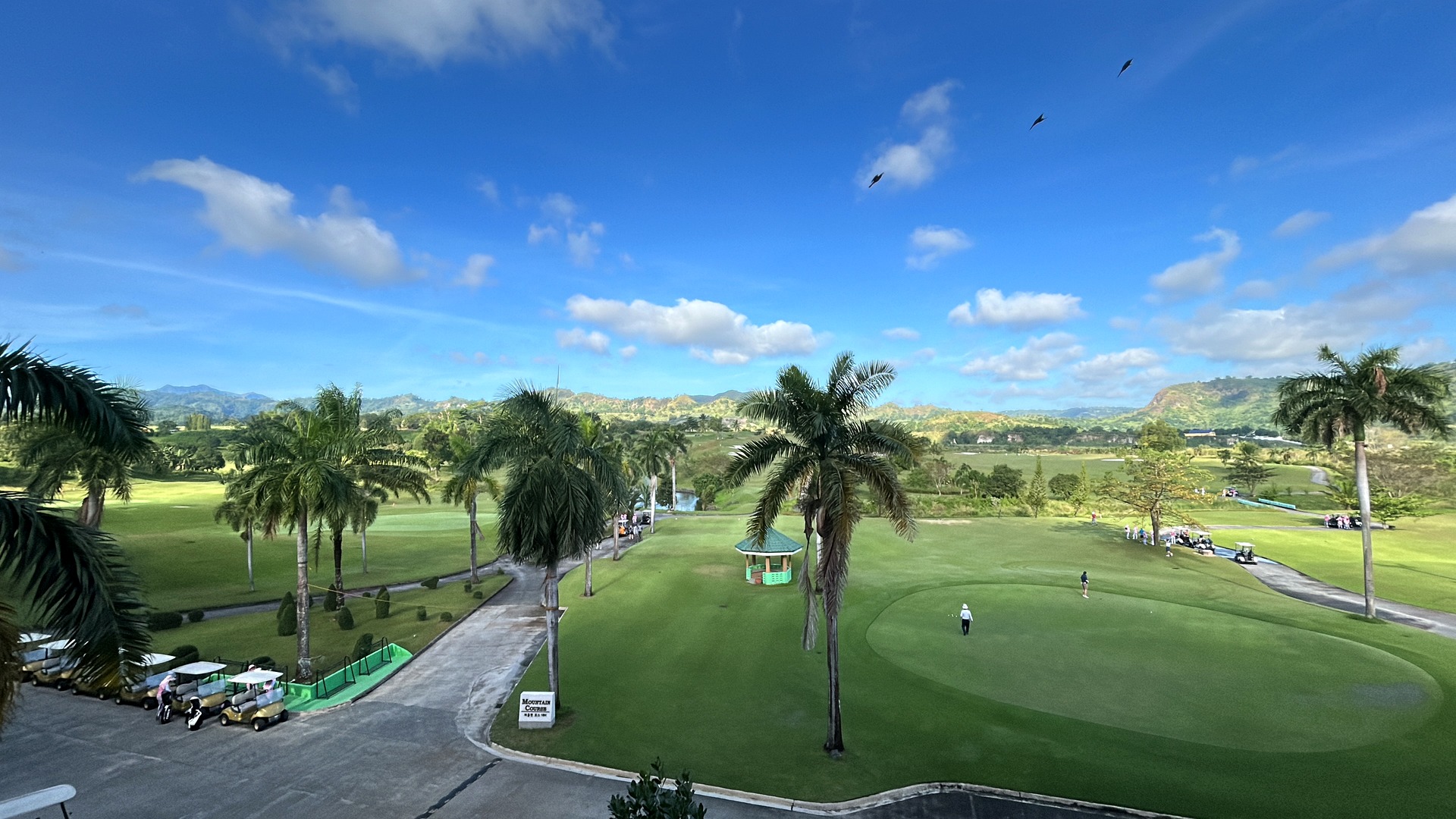
Among the courses I played, there were quite a few flat, open layouts, which are not as common in Korea.
I’m used to Korean courses that run through hilly or mountainous terrain, so wide, relatively flat fairways immediately gave the course a different look.

At some golf courses, carts were also allowed onto the fairway.
That is something I have rarely experienced in Korea, where I’m much more used to staying on the cart path.
Just being able to drive directly onto the fairway changed the visual rhythm of the round.
Another obvious difference was the one-player, one-caddie setup.
That is not something you normally see at Korean golf courses.
Put those things together — flatter courses, carts on the fairway, and a caddie walking with each golfer — and the scene on the course feels distinctly different.
One Golfer, One Caddie Means You Talk a Lot
At most of the courses I played, each golfer had their own caddie.
When the same person is with you for all 18 holes, you naturally end up talking.
On hot days, it was common to see caddies holding umbrellas over golfers.
For tips, I personally usually gave around 500 pesos at the end of the round.
If someone in my group was a beginner, I sometimes gave a little extra specifically to that player’s caddie.
A beginner can require more help with finding balls, keeping up with the group, and getting through the round smoothly.
One of my friends actually played his first full golf course round in the Philippines.
It was at D’Heights Country Club.

I gave a little extra to the caddie who was looking after him.
I Spoke Tagalog. The Caddie Answered Me in Korean.
One of the things I enjoyed most about golf in Clark was talking with the caddies.
When reading a putt, I often used a couple of Tagalog direction words.
- kaliwa — left
- kanan — right
So I would stand on the green and ask:
“Kaliwa, one cup?”
Meaning roughly, one cup to the left.
Or:
“Kanan, isa cup?”
A mix of Tagalog and golf English.
The caddies usually liked it when I tried to speak that way.
What made it even more interesting was that some of the caddies I met in Clark knew a little Korean.
So I would ask them something in Tagalog, and they would answer me in Korean.
“Yes, that’s right.” (네, 맞아요, ne, majayo)
Or:
“No, to the right.” (아니요, 오른쪽, aniyo, oreunjjok)
I would ask the caddie kaliwa or kanan, and the caddie would answer me in Korean.
We both knew a few words of the other person’s language, and that was enough to make the round more fun.
“China Battery, Korea Battery”
I also picked up some strange golf-course jokes from caddies.
A few caddies I played with would say “China battery” when a putt or shot came up short.
If the shot was too strong or went long, they would say “Korea battery.”
The first time I heard it, I had no idea what they were talking about.
Once they explained it, we all laughed.
I have no idea how widely those expressions are used at golf courses in the Philippines.
I only know that the caddies I met used them as a joke.
And those are exactly the kinds of things that stick in your memory.
I may forget what I shot that day. I still remember the jokes.
After the Round, We Often Just Ate Lunch in Our Golf Clothes
In Korea, it is common to finish a round, shower at the clubhouse, and change clothes.
On golf trips in the Philippines, I often saw a different routine.
If you want to shower and change at the golf course, you need to bring another bag with toiletries and a change of clothes.
That extra bag is surprisingly annoying.
And when your hotel is not far from the course, it is often easier to skip the shower, eat lunch in your golf clothes, and go back to the hotel afterward.
I saw Korean golfers do this quite often.
I did the same thing.
I’ve played quite a few rounds in the Philippines, and I have never showered at a golf course there.
It wasn’t because the courses lacked shower facilities.
For me, it was simply a matter of luggage and convenience.
Food and Drinks Felt a Little Different Too
Using the halfway house itself did not feel particularly different from Korea.
But at some courses, I could order something like a smoothie and have it brought out onto the course.
That was very welcome in the heat.
At the courses I personally visited, clubhouse food also often felt less painfully expensive than what I was used to at some golf courses in Korea.
I also encountered consumable arrangements at several places.
Depending on the course, a certain amount might be included for food and drinks, or there might be a minimum amount to spend.
When you’re on a golf trip, you are probably going to eat and drink around the round anyway.
So the system never felt particularly strange to me.
What I Remember Most About Golf in the Philippines
After playing golf in the Philippines several times, the differences I noticed were not limited to one thing.
The pace could change dramatically depending on the season. Local golfers often felt more relaxed about the speed of play. Flat courses, carts driving onto fairways, and one caddie for every golfer were all things I was not used to seeing in Korea.
But what I remember most is the rapport with the caddies and the course scenery that felt different from Korea.
Golf itself is the same game.
The environment and atmosphere around it can feel very different.
That is the biggest difference I remember from golf in the Philippines.
Have a question about golf in the Philippines or Korea? Leave a comment below. If I know the answer, I’ll be happy to help.
Leave a Reply