

Why BTS Called Their Album “ARIRANG” — and What the Name Means in Korea
When BTS returned as a full group after a long break, they chose a surprisingly simple name for their fifth studio album:
ARIRANG.
As a Korean, the title felt special to me.
But strangely, it did not feel unusual.
아리랑 (arirang) is so familiar in Korea that most Koreans probably do not spend much time asking what it actually is.
We hear it growing up.
We hear it at school, on television, at sporting events, and during major national occasions.
It is simply there.
But when someone outside Korea asks:
“Why Arirang?”
the answer suddenly becomes harder.
You could say:
Arirang is a traditional Korean folk song.
That is true.
But it does not really explain why BTS would choose ARIRANG as the name of such an important comeback album.
Start With What BTS Said About Their Korean Roots
We do not have to invent an explanation for why Korean elements mattered to this album.
BTS talked about it themselves.
RM described “Koreanness” as an important keyword connecting all seven members because it relates to where they started and to their roots.
Jin and Suga also said that, since all seven members are Korean, there had been a natural desire to include Korean elements.
J-Hope described returning and showing themselves again as something that ultimately begins with their roots.
RM also made an important distinction.
They did not want to take traditional Korean elements and use them as a fixed template.
They wanted to interpret them naturally in the way BTS exists now.
That matters.
Because ARIRANG does not feel like a title chosen simply to tell international fans:
“Look, we are Korean.”
The deeper question is closer to:
Where did we begin?
For BTS, Korea is part of that answer.
But Korea has thousands of cultural symbols.
So why Arirang?
So What Does “Arirang” Actually Mean?
Here is something that surprises many people:
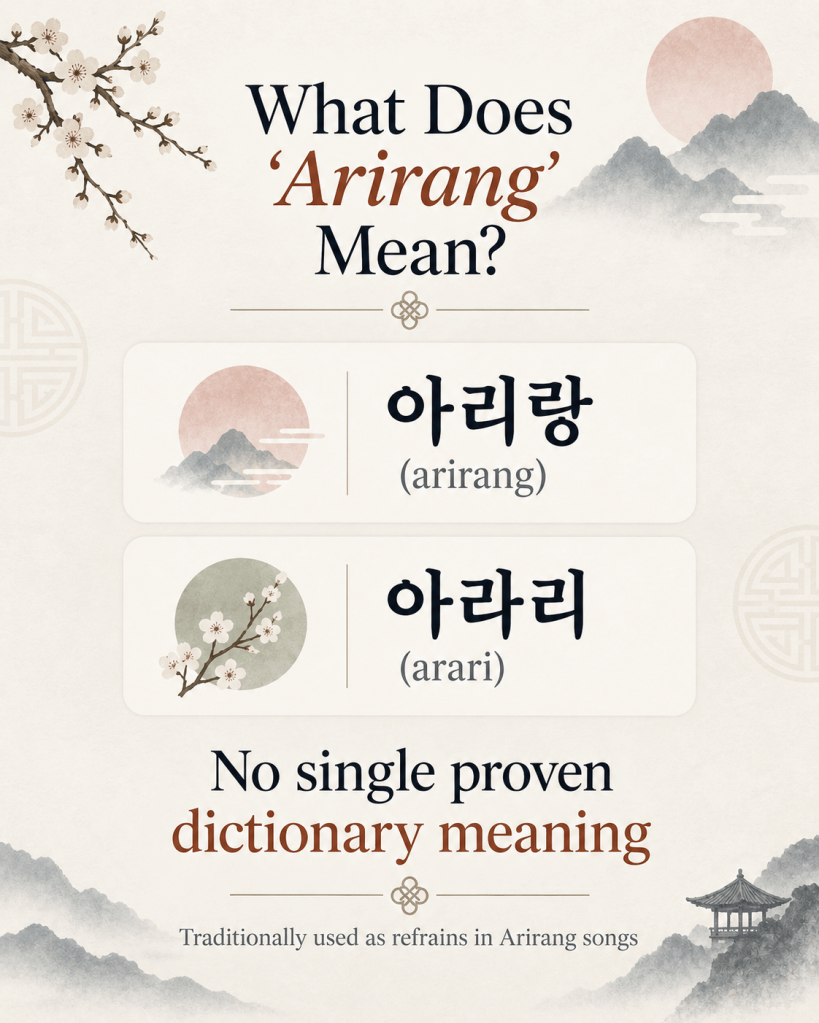
There is no single proven meaning of the word “Arirang.”
Many theories about its origin have appeared over the years.
One famous interpretation connects it to the Chinese characters 我離郎, roughly suggesting separation from a loved one.
Other theories link the name to historical figures or legends.
But none has been established as the definitive origin.
The Academy of Korean Studies describes 아리랑 (arirang) and related sounds such as 아라리 (arari) primarily as refrains used in Arirang songs, rather than words with one fixed lexical meaning.
So if someone asks:
“What does Arirang mean in English?”
the most accurate answer may be:
It does not have one proven dictionary meaning.
Even the name itself resists a single definition.
And that becomes more interesting when you look at the song.
Arirang Is Not One Fixed Song Either
Calling Arirang a Korean folk song is useful, but incomplete.
There is no single Arirang with one fixed melody and one fixed set of lyrics.
There is 정선아리랑 (Jeongseon Arirang), 진도아리랑 (Jindo Arirang), 밀양아리랑 (Miryang Arirang), and many others.
UNESCO estimates that there are around 3,600 variations belonging to roughly 60 versions of Arirang.
It also emphasizes that ordinary Koreans contributed to the tradition across generations, creating new lyrics and adapting the songs to different regions, periods, and genres.
That is crucial to understanding Arirang.
The Arirang we know today was not created by one famous composer and handed down as one finished work.
People kept singing it, changing it, and putting their own stories into it.
That is why, from my perspective, Arirang is not deeply Korean simply because it is old.
Arirang is deeply Korean because generations of Koreans kept making it their own.
Arirang as documented by UNESCO.
Calling Arirang a “Sad Korean Song” Misses Half the Picture
Another word often appears when Arirang is explained outside Korea:
한 (han).
It makes sense.
Many versions of Arirang contain emotions connected with separation, leaving, longing, or loss.
Those feelings can connect with han.
But this does not mean:
Arirang = han.
And describing Arirang simply as a sad Korean folk song misses something important.
Arirang can also contain 흥 (heung).
Heung is difficult to translate too, but it is associated with energy, excitement, rhythm, and the feeling of being carried along by a lively moment.
And this distinction matters:
Han is han. Heung is heung.
Heung is not hidden inside han.
Han does not automatically turn into heung.
But an Arirang performance can contain both.
You can sing lyrics filled with longing while moving to the rhythm.
One person may sing Arirang quietly and plaintively.
A group of people may sing another Arirang together with completely different energy.
Bang Si-hyuk also described Arirang as much more than a traditional folk song, emphasizing both its feelings of separation and longing and its living, energetic quality.
He described it as a “living heritage” that is continually reinterpreted depending on who sings it.
If you want to understand 한 (han) itself, I explain it separately here:
→ What Is Han (한)? The Korean Emotion That Is Hard to Translate
Being Korean Does Not Mean Copying the Past
This, to me, is where BTS choosing Arirang gets especially interesting.
When people outside Korea think of something “Korean,” they may immediately picture:
한복 (hanbok) — traditional Korean clothing.
Palaces.
Hanok houses.
Traditional instruments.
All of those are Korean.
But “Korean” and “old” are not the same thing.
RM said BTS did not want to use Korean elements as something fixed.
The goal was to reinterpret them naturally in the group’s current style.
Arirang fits that idea unusually well.
Because Arirang itself has never remained frozen in one form.
Different regions changed it.
Different generations changed it.
People added new lyrics.
Different musical genres adopted it.
So when BTS interprets Arirang through its own music and identity in 2026, that does not feel contradictory to the tradition.
In a way, it fits the tradition.
Taking something old and Korean, not simply copying it, but expressing it again in the voice of Koreans living now.
As a Korean, “ARIRANG” Did Not Feel Like a Retro Title to Me
From here, this is my own interpretation.
For someone outside Korea, ARIRANG may initially sound like a very traditional choice.
A global pop group suddenly naming an album after an old Korean folk song.
I can understand why it might look that way.
But that is not how the title felt to me.
BTS began in Korea and became a global group.
Then, after nearly four years without a full-group album, the seven members returned with an album centered on who they are now and where they go next.
BigHit describes ARIRANG as an album containing the members’ thoughts and identities, the emotions and reflections of their journey, and the direction they will take moving forward.
For an album like that, looking back at their roots makes sense.
And if you want a Korean cultural symbol that is deeply rooted here without being trapped in one fixed form, Arirang is a remarkable choice.
So to me, ARIRANG did not sound like:
“BTS is going back to old Korea.”
It sounded more like:
“BTS is talking about where they came from, in the way they exist today.”
BTS — “2.0” from the album ARIRANG.
Bang Si-hyuk Called Arirang a “Living Heritage”
Bang Si-hyuk later explained why he proposed Arirang as the album’s central concept.
His explanation is worth paying attention to because he specifically warned against reducing the idea to a shallow slogan.
He argued that Arirang should not be treated simply as:
Put Arirang in something and it becomes Korean.
Nor should it be reduced to the familiar idea that the most Korean thing is automatically the most global.
Instead, he described Arirang as a living heritage — something continually reinterpreted depending on who sings it — and said that quality made it a powerful vessel for the emotions and identity of BTS at this point in their career.
I think that distinction is important.
Because saying:
“BTS are Korean, so they chose the most Korean thing they could find.”
makes both BTS and Arirang less interesting than they really are.
Their Korean roots are clearly part of the story.
But Arirang also carries the idea that those roots can be reinterpreted rather than preserved in one fixed form.
So Why ARIRANG?
Let’s return to the original question.
Why would BTS name their comeback album ARIRANG?
The first part of the answer is clear.
BTS themselves said that their Korean roots and identity were an important starting point for the album.
But Arirang is interesting because it goes beyond simply being an old Korean song.
It has been changed and reinterpreted by generations of people.
It is deeply Korean, yet it has never existed in only one form.
Even the word Arirang itself does not have one definitively proven meaning.
And BTS likewise did not want to reproduce “Koreanness” as something frozen in the past.
They wanted to express it in their own way, now.
That is why I read the title like this:
ARIRANG looks back at where BTS came from without tying those roots to the past.
And that is also how Arirang itself has survived.
Arirang is deeply Korean not because it never changed, but because generations of Koreans kept making it their own.
Maybe that is why, as a Korean, the title ARIRANG never felt strange to me at all.
Have a question about Korea? Leave a comment below. If I know the answer, I’ll be happy to help when I can.


Leave a comment