
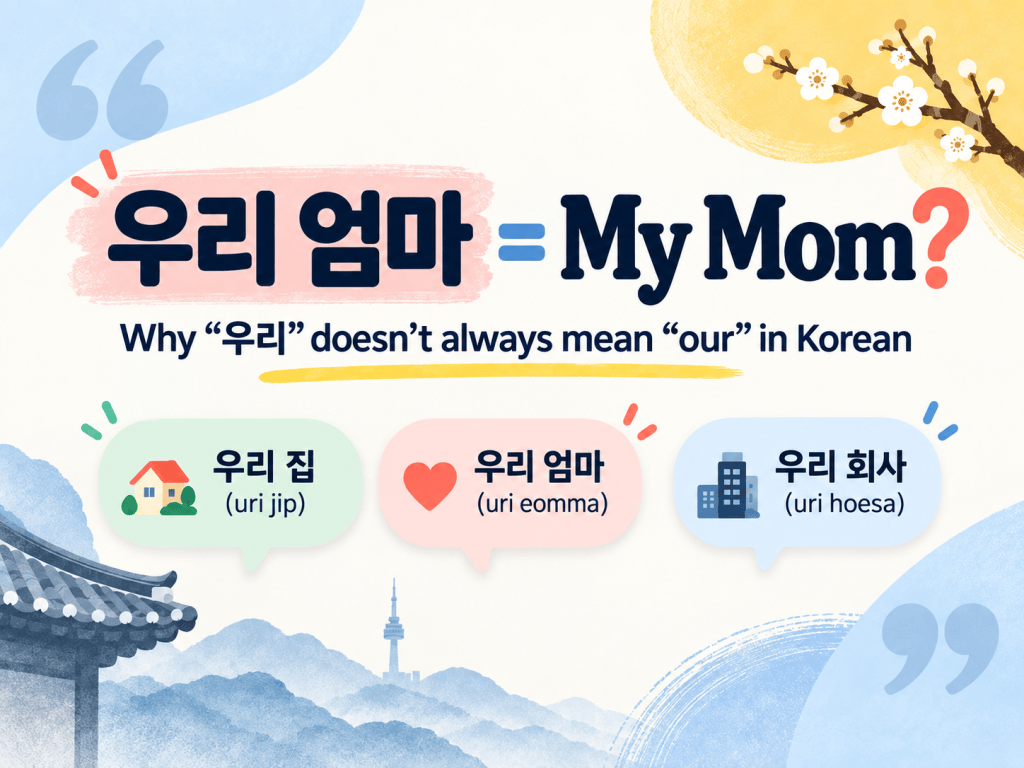
I never thought the Korean word uri (우리) was strange.
I grew up hearing it everywhere.
우리 집 (uri jip) — Our home.
우리 엄마 (uri eomma) — Our mom.
우리 회사 (uri hoesa) — Our company.
우리나라 (uri nara) — Our country.
And I used those expressions without thinking about them.
I never stopped to wonder whether saying “our mom” sounded collective. I never thought saying “our company” meant I felt some special affection for my workplace.
That was simply how people around me spoke, so that was how I spoke too.
It only started to sound strange when I began speaking English regularly with Americans.
Sometimes, while talking about Korea, I would unconsciously say “our country.”
In my head, I was simply translating 우리나라 (uri nara).
Then one day I thought about how it must sound to the person listening.
I was Korean. He was American. So why was I saying our country? We did not have the same country.
That was probably the first time I realized that a perfectly ordinary Korean expression could sound very different once it crossed into English.
After that, I became much more conscious about saying Korea or, when necessary, my country in English.
In Korean, though, nothing changed. I still say 우리나라 without thinking.
“우리 엄마” Usually Means “My Mom”
This is one of the first things that can confuse Korean learners.
우리 엄마는 오늘 집에 있어.
Uri eommaneun oneul jibe isseo.
My mom is home today.
If you translate each word literally, 우리 엄마 (uri eomma) looks like “our mom.”
But in normal conversation, it very often simply means my mom.
The National Institute of Korean Language also describes a use of 우리 before certain nouns to show a close relationship with the speaker, with examples such as 우리 엄마, 우리 학교, and 우리 집.
The same thing happens with workplaces.
우리 회사 진짜 엿같아.
Uri hoesa jinjja yeotgata.
The company I work for really sucks.
That sentence sounds completely normal in Korean.
And that example immediately breaks one overly simple explanation of uri. I am obviously not expressing warm affection for the company while saying it sucks.
So 우리 cannot always mean love, emotional attachment, or some beautiful sense of community. Sometimes it marks a place or group I belong to. Sometimes it is simply the expression that feels natural because I have heard it all my life.
There Can Be a “My Room” Inside “Our Home”
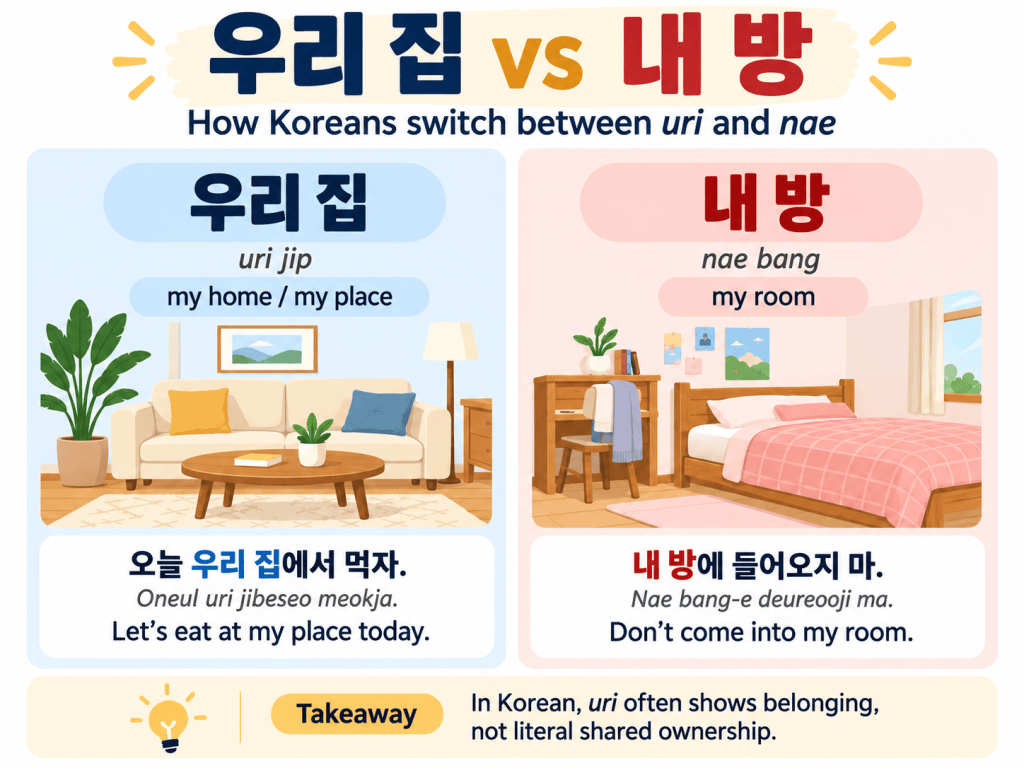
Koreans do not replace every my with uri.
A good example is the difference between a home and a room.
오늘 우리 집에서 먹자.
Oneul uri jibeseo meokja.
Let’s eat at my place today.
I can live alone and still say that naturally.
But inside that same home, I can say:
내 방에 들어오지 마.
Nae bange deureooji ma.
Don’t come into my room.
There is nothing contradictory about this to a Korean speaker.
There can be a “my room” inside “our home.”
If two people actually share a room, 우리 방 (uri bang) can also be perfectly natural.
That is why I hesitate when I see uri explained only as evidence that Koreans value the group over the individual. That may be part of the cultural background in some cases, but it does not fully explain how Koreans actually use the word.
We move between 우리 and 내 (nae, my) without consciously applying a cultural theory every time we speak. Most of the time, we simply know which one sounds natural.
The Opposite Direction Is Just as Interesting
The more I thought about uri, the more I noticed that the strange part is not limited to the first person.
Koreans can say this to one person:
네 엄마는 잘 계셔?
Ne eommaneun jal gyesyeo?
How is your mom?
But we can also say:
너희 엄마는 잘 계셔?
Neohui eommaneun jal gyesyeo?
How is your mom?
Even though 너희 (neohui) can look plural to a learner, it can be used when speaking to one person about someone closely related to that person.
To my ear, in ordinary conversation, 네 엄마 and 너희 엄마 often do not feel dramatically different in meaning. The exact choice can depend on habit, rhythm, speech style, and region.
I grew up in Gyeongsang Province, where another version is very familiar:
느그 엄마는 잘 계시나?
Neugeu eommaneun jal gyesina?
How is your mom?
Gyeongsang dialect
Again, the listener can be just one person.
So now we have something interesting. 우리 엄마 can mean my mom. 너희 엄마 can mean your mom, even when “you” is one person.
If you try to understand all of this by making a strict English chart of my / your / our, Korean starts looking unnecessarily confusing. That may be the wrong way to approach it.
When “우리” Comes Before a Person, It Can Signal Closeness
This is where uri becomes more than a strange possessive expression.
Imagine that someone normally calls a person simply Minsu. Then one day they say:
우리 민수 오늘 왜 이렇게 조용해?
Uri Minsu oneul wae ireoke joyonghae?
Why is Minsu so quiet today?
Here, 우리 민수 is not about ownership.
For me, it can signal something much more personal. There usually has to be some internal sense of closeness before I naturally start putting 우리 in front of someone’s name or title.
And the person hearing it may notice that change too. They can feel something like:
“Ah. This person sees me as one of their people now.”
That is difficult to reproduce with the English word our.
Depending on the situation, one of my people, part of my circle, or one of us may come closer to the feeling.
The word can mark an inner circle. And sometimes the moment someone starts using it tells you that the circle has changed.
Misaeng Shows This Better Than a Grammar Lesson
There is a memorable scene in the Korean drama Misaeng (미생, misaeng) that captures this feeling unusually well.
Early in the series, Oh Sang-sik does not fully accept Jang Geu-rae as one of his own. Then, while defending him to another manager, he refers to him as:
우리 애
uri ae
Literally: “our kid”
Later, Jang Geu-rae remembers it:
우리 애라고 불렀다.
Uri aerago bulleotda.
Literally: “He called me ‘our kid.’”
In the scene: “He called me one of his own.”
What matters in that scene is not really the word 애. It is 우리.
For Jang Geu-rae, that one word tells him something about his position. He is no longer completely outside. He has been brought a little further in.
Watch from 2:10:
This is the kind of thing a dictionary translation of our cannot show.
“우리 남편” Does Not Mean “Our Husband”
Korean can get even stranger if you keep translating literally.
우리 남편은 오늘 늦게 와.
Uri nampyeoneun oneul neutge wa.
My husband is coming home late today.
A Korean speaker is not suggesting that several people share one husband. It simply means my husband.
There is another expression Korean men can use for their wives:
우리 집사람도 그렇게 말해.
Uri jipsaramdo geureoke malhae.
My wife says the same thing.
Here, 집사람 (jipsaram) means a wife. If you try to build the meaning word by word from English, 우리 집사람 can look bizarre.
But Korean speakers do not stop to calculate who “our house person” belongs to. They understand the relationship.
“Uri” Is Not Just a Code Word for Korean Collectivism
It is common to explain uri through Korean collectivism.
There is some basis for connecting the word with ideas of community, belonging, and closeness. But explaining it only through “collective consciousness” misses how varied the word is in actual Korean.
My own experience is much less theoretical.
I do not think about collectivism when I say 우리 엄마.
I can live alone and still say 우리 집.
I can hate my workplace and still complain about 우리 회사.
But when 우리 suddenly appears in front of a person’s name, I may genuinely feel the relationship becoming closer.
The same word is doing different jobs in different situations.
That is why I would not tell a foreign learner, “Uri means our.” I would not even tell them, “Uri actually means my.” Both rules will eventually fail.
So How Should a Foreigner Understand “우리”?
If I had to give a Korean learner one practical rule, it would be this:
When you hear uri, do not start by asking who owns something. Start by asking what relationship the speaker is speaking from.
If you hear 우리 엄마, think my mom in most everyday contexts.
If you hear 우리 집, it may simply mean my home or my place.
If you hear 우리 회사, think the company I work for.
If you hear 우리 + a person’s name or title, pay attention to closeness, affection, belonging, or the speaker’s inner circle.
And sometimes 우리 really does mean the same thing as English our.
Context decides.
That is why replacing 우리 with one English word is not very useful.
I only realized this after hearing my own Korean habits come out in English.
For a foreign learner, the shortcut is simpler:
Don’t ask “Whose is it?” first. Ask “What relationship is the speaker talking from?”
Once you start listening that way, expressions like 우리 엄마, 우리 집, 우리 회사, and 우리 애 stop looking like strange exceptions.
They start sounding like Korean.
Have you heard a Korean expression that made no sense when translated literally? Leave a comment below. If I know the answer, I’ll be happy to help when I have time.


Leave a comment