

“How old are you?” can sound unexpectedly personal in English.
In Korea, it can be a practical relationship question.
Some time ago, when I was driving a taxi in Seoul, I had a foreign passenger I expected to see again. So I asked his age.
Not because I was collecting personal information. I was trying to work out how our relationship should sit in Korean terms.
He told me that next time we met, he would buy dinner. Because I had misheard his age while driving, I thought I was older. I joked that in Korea, the older-brother figure (형, hyeong — commonly written “hyung” in English) buys.
Later, I checked our chat and realized I had it backwards. He was older. So I corrected myself: “Okay. You’re hyung. Hyung buys.”
After that, I could message him, “Hyung, how is it going?”
That does not mean every older Korean is expected to pay. It was one small role expectation in that particular conversation.
The important part is this: once I understood who was older, the way I addressed him changed.
Age Is Often a Relationship Setting, Not Just Personal Data
Among Koreans, asking someone’s age is usually not automatically considered rude.
Context still matters. A stranger asking for no reason can feel intrusive. But when two people expect to keep talking, age can help set the relationship.
Sometimes Koreans ask for a birth year instead of asking, “How old are you?” The purpose is similar: it helps both people understand where they stand relative to each other.
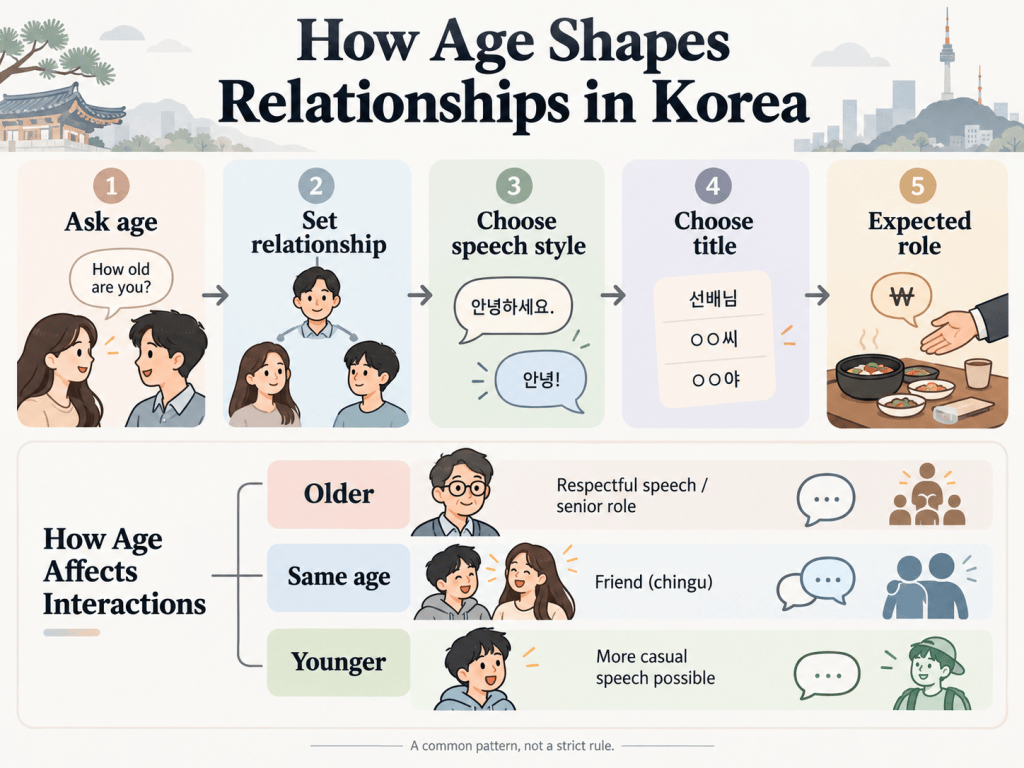
That can affect four things very quickly:
- how politely you speak,
- what title you use,
- whether you can treat each other as same-age friends,
- and sometimes what kind of role each person is expected to take.
Age Can Change the Way You Speak
Korean has polite speech (존댓말, jondaetmal) and casual speech (반말, banmal).
That is a simplified description—the language has more layers than just two—but for a foreign visitor, this distinction explains a lot.
If two Koreans have just met, polite speech is usually the safe starting point. If they become closer, they may later agree to switch to casual speech.
A common way to ask is, “Shall we speak casually?” (말 놓을까요?, mal noeulkkayo?)
Age often influences who suggests that change and how naturally it happens.
If you keep using polite speech, there is usually no major problem. In fact, if two people do not particularly want to define a closer relationship, they can simply stay polite and never make age very important.
But casual speech used at the wrong time can sound much harsher than a foreign learner may expect. It can make someone seem rude, badly mannered, or disrespectful—not just grammatically incorrect.
Age Can Also Change What You Call Someone
English speakers can use a first name for almost everyone.
Korean relationships often use more information.
Depending on the speaker’s gender and the older person’s gender, a close older friend may be called:
an older male friend or brother figure for a male speaker (형, hyeong), an older female friend or sister figure for a male speaker (누나, nuna), an older male friend or brother figure for a female speaker (오빠, oppa), or an older female friend or sister figure for a female speaker (언니, eonni).
People of the same age may more naturally become same-age friends (친구, chingu). In English, “friend” says nothing about age. In Korean social usage, age has traditionally been much more closely tied to that idea.
And age is not the only hierarchy.
A senior at school or work (선배, seonbae) can be younger than you. Workplace rank, school seniority, professional titles, intimacy, and context can all overlap with age.
So Korean relationships are not one simple ladder where the oldest person automatically controls everything.
Why Not Just Stay Polite Forever?
You can.
That is an important point foreigners often miss.
If neither person wants a more familiar relationship, there is no urgent need to ask age, change titles, or switch speech styles. Two adults can simply continue using polite speech.
Age becomes more useful when people are trying to move from “someone I know” toward a more defined relationship.
In that sense, asking age can be less about curiosity and more about social calibration.
With the Relationship Can Come Roles and Responsibilities
This is the part that is harder to translate.
Once people decide who is older, who is younger, who is a senior, or who is a same-age friend, the relationship can carry small expectations with it.
An older person may sometimes be expected to lead, look after the younger person, give advice, or pick up a bill. A younger person may be expected to show a little more deference.
Again, these are patterns, not laws.
My taxi conversation is a good example. The dinner joke was not a national rule about who must pay. What mattered was that the moment I realized he was older, I mentally moved him into a different relationship category—and my language changed with it.
The Downside: Age Can Turn Into Authority
The same system that can make relationships feel clear and warm also has a darker side.
Age can be used as power.
Sometimes the logic becomes: “I’m older, so you should listen to me.”
Or disagreement from a younger person is treated as a manners problem rather than simply a disagreement.
That is where age hierarchy can become frustrating. Being older does not automatically make someone wiser, kinder, or right.
This is why I would not explain Korean age culture as “older people are respected, younger people obey.” That is far too simple.
Age can create a useful social map. It can also become a weapon when someone turns that map into automatic authority.
What Should a Foreigner Do?
If a Korean asks your age, you do not have to assume they are being nosy or rude. They may simply be trying to understand how to speak to you and what kind of relationship you are building.
At the same time, you are not required to answer if you are uncomfortable.
If you speak Korean, the easiest rule is simple: start polite.
Stay with polite speech until the other person suggests something more casual. If you are unsure what title to use, ask.
You do not need to master the entire Korean social system on your first day in Seoul.
You just need to understand why the question may appear much earlier in a Korean conversation than you expect.
So Why Do Koreans Ask Your Age?
Because sometimes the real question is not simply:
“How old are you?”
It is:
“How should we relate to each other?”
Age can help choose speech style, titles, social distance, and sometimes responsibility. That can create warmth and clarity. It can also create hierarchy and pressure when people treat age as automatic authority.
So the more accurate explanation is not that Koreans are simply obsessed with age.
Age has long been one of the tools Koreans use to define relationships.
That is why a question that feels personal somewhere else can feel surprisingly practical here.
Have a question about Korea? Leave a comment below. If I know the answer, I’ll be happy to help.


Leave a comment