
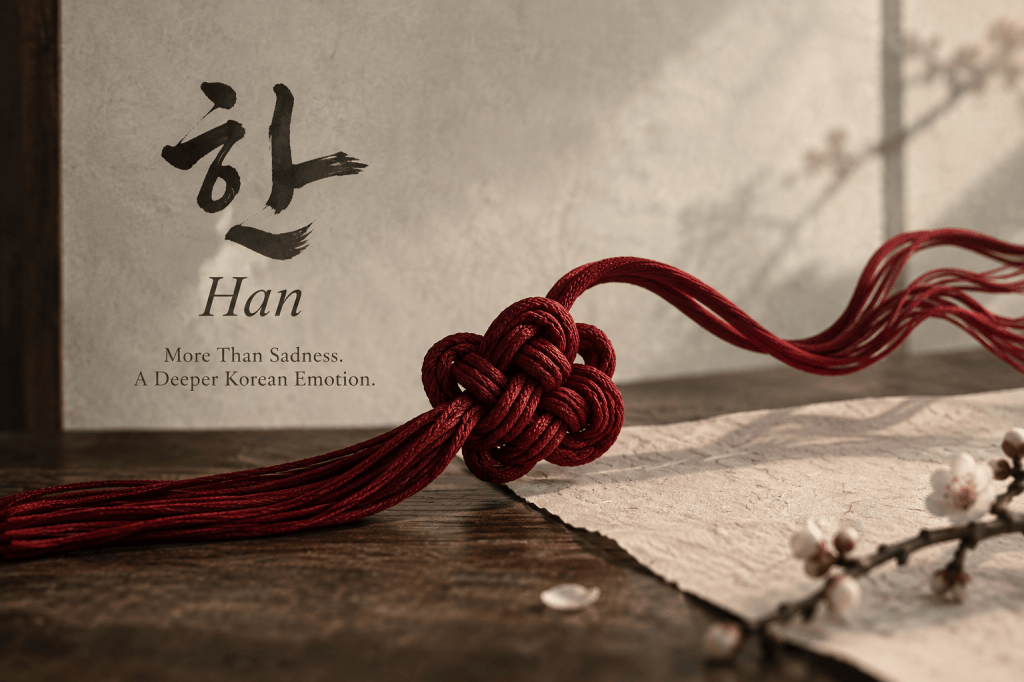
What Is Han (한)? The Korean Emotion That Is Hard to Translate
Han is often explained in English as a deep sadness that Koreans carry for generations.
As a Korean, that explanation has always felt a little too neat.
한 (han) can stay with someone for years.
But it can also be released surprisingly quickly.
It can weigh a person down.
But sometimes it does the opposite.
It can make someone endure, work harder, succeed just to prove a point — or even want to get even.
That is why words like sadness, grief, or resentment never seem quite enough.
Why “Sadness” Is Not Enough
Sadness can be part of han.
But sadness by itself is not han.
Imagine losing someone you love.
You may feel grief.
Imagine failing at something you desperately wanted.
You may feel disappointment.
But han often becomes more complicated when something feels unfinished, unresolved, unfair, or impossible to put right.
It is not simply:
“I am sad.”
There is often something behind the sadness.
Something that still feels unsettled.
Loss Can Become Han
Loss is one of the experiences that can lead to han.
That might mean losing a person.
Losing a relationship.
Losing an opportunity.
Or losing a life you thought you were going to have.
But not every loss automatically becomes han.
What matters is often what remains afterward.
A question that was never answered.
Words you never got to say.
A chance you never got back.
Something that ended, but somehow never felt completely over.
That unresolved feeling can become han.
Eogulham: “Why Did This Happen to Me?”
Another important feeling connected with han is 억울함 (eogulham).
This is another Korean word that does not translate perfectly into English.
The adjective is 억울하다 (eogulhada).
It can describe the feeling of being treated unfairly, blamed for something you did not do, misunderstood, or forced to suffer something you feel you did not deserve.
It is close to saying:
“Why did this happen to me when I did nothing wrong?”
But eogulham is not exactly the same thing as han either.
It is one feeling that can become part of a larger unresolved experience.
And when that feeling stays with someone, Koreans may describe it using expressions connected with han.
Han Can Make Someone Fiercely Determined
This is where I think many English explanations of han become too passive.
Han does not always make someone sit quietly and suffer.
Sometimes it makes a person 독하게 살다 (dokhage salda) — roughly, to live fiercely, toughen yourself, and keep going with determination.
Someone may think:
“I’ll show them.”
“I’m going to succeed no matter what.”
“One day they will see they were wrong about me.”
In that sense, han can become fuel.
A person may work harder because of it.
Become more ambitious because of it.
Try to restore their pride because of it.
In more extreme cases, han can even feed a desire to get even.
That does not mean han is revenge.
It means unresolved hurt can sometimes push a person toward revenge, just as it can push someone toward achievement or endurance.
Han is not always passive.
Sometimes it makes people frighteningly determined.
Koreans Also Talk About “Releasing” Han
Another reason I do not like explanations that describe han as something Koreans simply carry forever is that Korean itself contains the idea of releasing it.
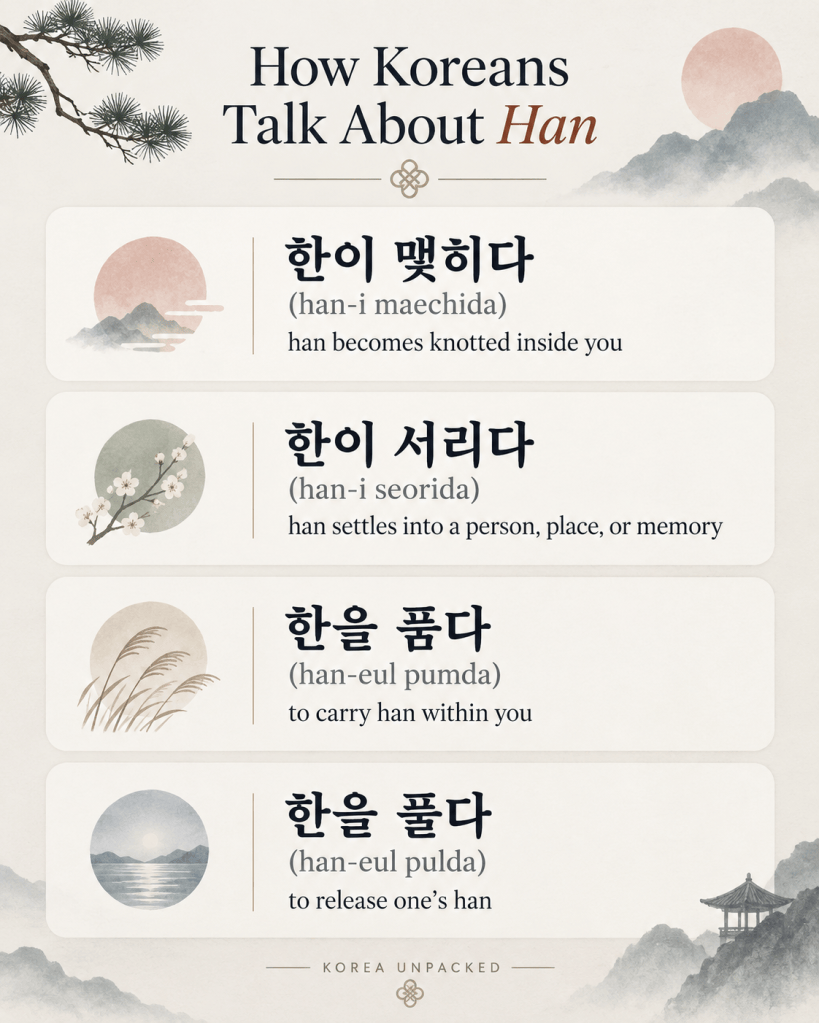
There are several common expressions:
한이 맺히다 (han-i maechida)
Han becomes knotted or lodged inside someone.
한이 서리다 (han-i seorida)
Han settles deeply into a person, place, memory, or experience.
한을 품다 (han-eul pumda)
To carry han within oneself.
And importantly:
한을 풀다 (han-eul pulda)
To release one’s han.
That last expression matters.
Because it means han does not necessarily have to remain forever.
Sometimes something happens that finally makes the unresolved experience feel complete.
An apology.
Recognition.
Success.
Justice.
Revenge, sometimes.
Or simply an ending that allows a person to say:
“Now it is over.”
And when that happens, Koreans may say that someone finally 풀었다 (pureotda) — released it.
So Why Is Han So Closely Associated With Korea?
This is where explanations can easily become exaggerated.
You will sometimes hear that Korea suffered invasions and hardship for thousands of years, and that this created han as a national emotion.
That explanation is too simple.
Korean history certainly contains many experiences of war, separation, political conflict, poverty, displacement, and loss.
Those experiences gave Koreans many stories in which feelings like grief, longing, and unresolved resentment became important.
But that does not mean every Korean is born carrying some ancient national sadness.
Modern discussions of han have also been shaped by literature, film, music, politics, and the way Koreans have interpreted their own history.
So I would be careful with statements like:
“Han is the emotion of the Korean people.”
Han is better understood as one way Koreans have learned to talk about certain kinds of unresolved experience.
Sometimes that experience is personal.
Sometimes it is shared by a family, community, or even a generation.
Han Is Not a Korean “Victim Mentality”
Han can involve suffering.
But that does not make it a celebration of suffering.
And it certainly does not mean Koreans enjoy thinking of themselves as victims.
In fact, han can produce the opposite reaction.
Someone who feels deeply wronged may become determined never to be weak again.
Someone who experienced poverty may become obsessed with succeeding.
Someone who was humiliated may spend years trying to prove everyone wrong.
Someone who lost something may refuse to accept that the story ends there.
That is why describing han only as sorrow misses so much of it.
There can be anger in it.
Pride.
Longing.
Regret.
Determination.
And sometimes a very strong desire for closure.
Han Does Not Have to Last a Lifetime
Han can last for decades.
In family stories, historical memories, or major personal loss, it may even be carried across generations through stories and memory.
But duration is not what defines han.
A person can carry han for years.
Or something can happen and suddenly allow them to release it.
What matters is not simply how long the feeling lasts.
What matters is that something feels unresolved.
And whether that unresolved feeling ever finds an ending.
Why Han Comes Up So Often When Koreans Talk About Arirang
If you read about 아리랑 (Arirang), you will eventually encounter the word han.
That makes sense.
Many versions of Arirang deal with separation, leaving, longing, or loss.
But I would not say:
Arirang = han.
Arirang is much broader than that.
It can contain han.
It can also contain 흥 (heung) — energy, rhythm, excitement, and the feeling of people being carried along together.
Han and heung are different things.
One does not automatically become the other.
But both can exist within the larger tradition of Arirang.
That is one reason Arirang is so difficult to reduce to a single mood.
And it is also part of why BTS choosing ARIRANG as an album title is more interesting than simply saying they chose an old Korean folk song.
→ Why BTS Called Their Album “ARIRANG” — and What the Name Means in Korea
So What Is Han?
Maybe the difficulty begins when we try too hard to force han into one English word.
Han can involve loss.
It can involve 억울함 (eogulham).
It can involve longing, regret, anger, or something that never reached the ending you wanted.
It can stay with someone for years.
It can be released.
It can make someone suffer.
Or it can make someone live harder, push further, prove something, and sometimes even seek revenge.
So instead of asking only:
“What emotion is han?”
it may be more useful to ask:
What happened?
What is still unresolved?
And what would have to happen for it to finally feel over?
For me, that gets much closer to han than any one-word translation ever could.
Have a question about Korea? Leave a comment below. If I know the answer, I’ll be happy to help when I can.


Leave a comment