
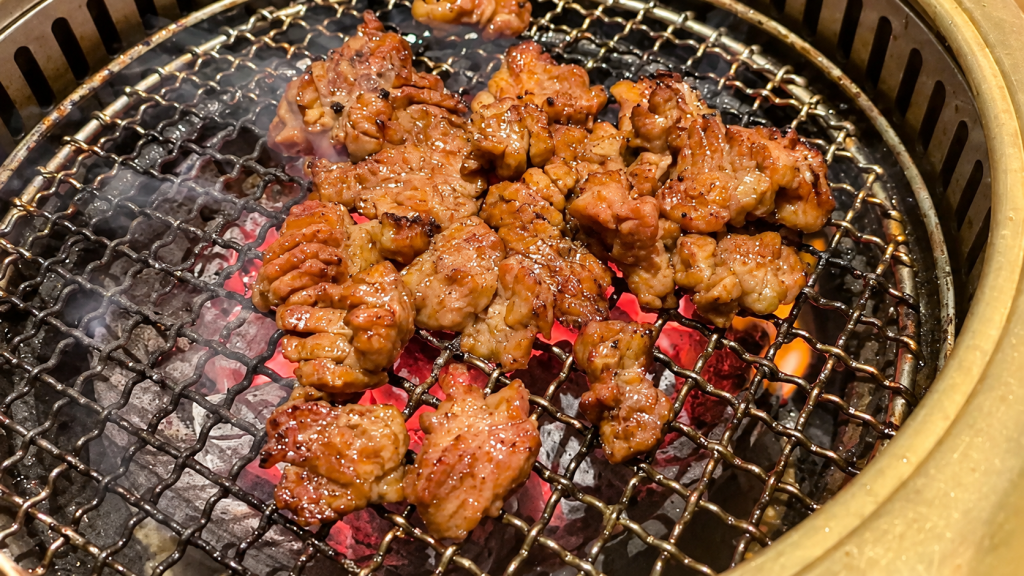
If a foreign friend asked me what Korean barbecue to try first, marinated pork ribs (돼지갈비, dwaeji-galbi) would be one of my easiest recommendations.
Pork belly (삼겹살, samgyeopsal) may be more famous internationally, but dwaeji-galbi is very easy to understand from the first bite.
It is sweet, savory, familiar, and hard to dislike.
Once the marinated pork hits a charcoal grill, the smell alone usually gets everyone’s attention.
But for me, eating dwaeji-galbi is not just about the meat.
The charcoal, the order in which I eat different cuts, the way I make a wrap, what I drink with it, and even the cold noodles at the end are all part of the meal.
Dwaeji-Galbi Usually Means Marinated Pork
When Koreans say, “Let’s go eat dwaeji-galbi,” they are usually talking about pork marinated in a sweet and savory sauce, often based on soy sauce.
Every restaurant does it a little differently.
Some marinades are noticeably sweeter. Others lean more heavily toward soy sauce and saltiness.
The cut and preparation can also vary from restaurant to restaurant, so two places serving “dwaeji-galbi” may taste surprisingly different.
Once the meat starts cooking over charcoal, the marinade caramelizes quickly.
That is one of the best things about it.
It is also one of the easiest ways to ruin it.
More on that later.
Saeng-Galbi Is Very Different From Samgyeopsal
Some pork rib restaurants also serve fresh, unmarinated pork ribs (생갈비, saeng-galbi).
If you have never tried them, you might assume saeng-galbi is simply dwaeji-galbi without the marinade.
I would not describe it that way.
It also feels quite different from samgyeopsal.
Samgyeopsal is the fattier option, and much of its appeal comes from that rich, fatty flavor.
Saeng-galbi is usually less fatty by comparison. What I notice more is the flavor of the meat itself, the juices, and the texture.
There is no sweet marinade covering anything up.
That is exactly why, when I try good saeng-galbi, I like to keep the first bite very simple.
Dip the first piece in just a little salt.
No dipping paste. No garlic. No lettuce wrap yet.
I want to taste the meat first.
After that, do whatever you like. Add garlic, dipping sauce, vegetables, or make a wrap.
But I think the first piece deserves a chance on its own.
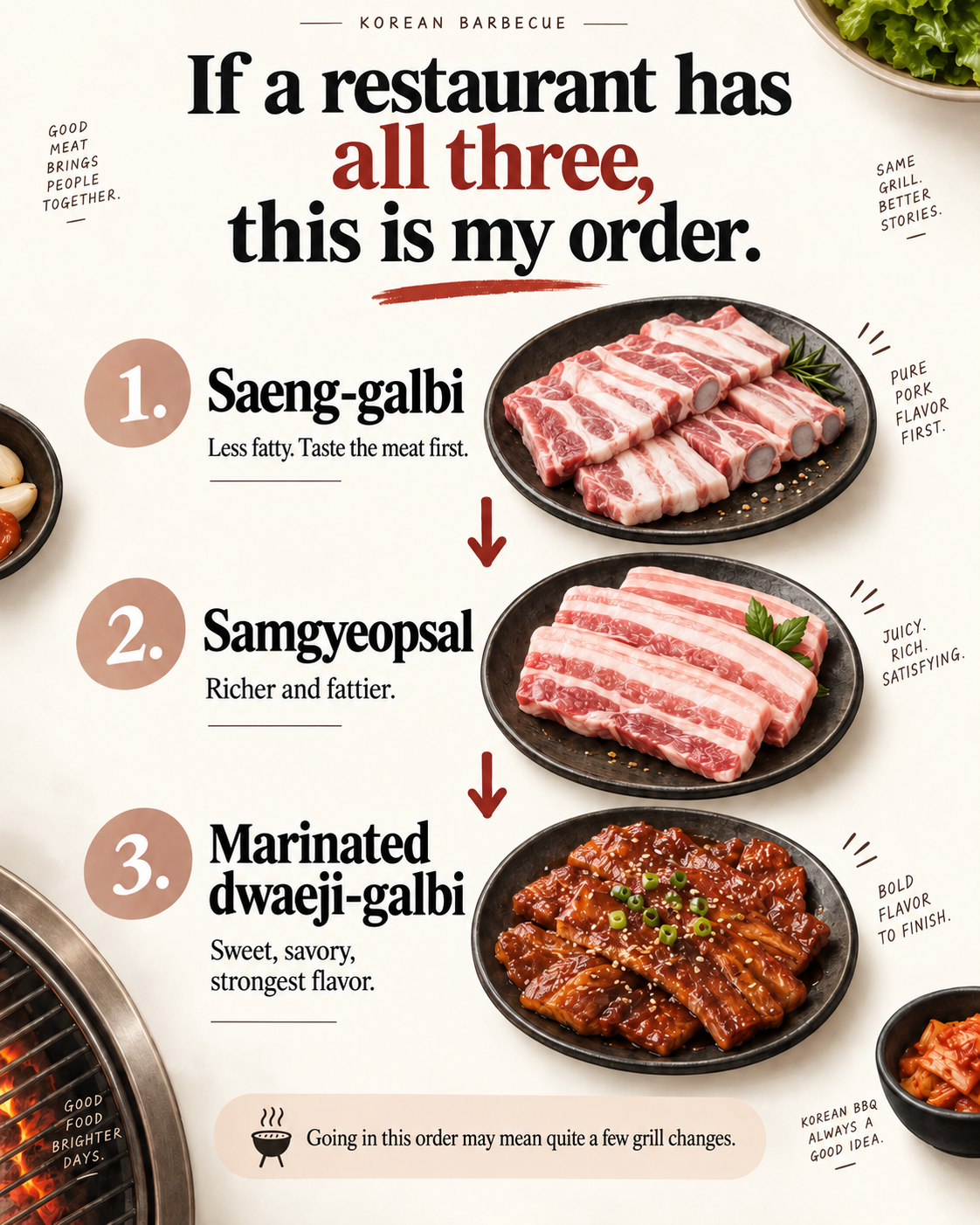
If a Restaurant Has All Three, This Is My Order
If a restaurant serves saeng-galbi, samgyeopsal, and marinated dwaeji-galbi, I usually eat them in this order:
Saeng-galbi → samgyeopsal → marinated dwaeji-galbi.
My reasoning is simple.
I go from the least fatty and most delicate flavor to something richer, then finish with the strongest seasoning.
Saeng-galbi comes first so I can taste the meat clearly.
Then comes samgyeopsal, with more fat and richness.
The sweet and savory marinated dwaeji-galbi comes last.
If I start with heavily marinated meat and then go back to saeng-galbi, the fresh pork can taste relatively mild.
There is one minor problem with my preferred order.
Depending on the restaurant, you may need quite a few grill changes along the way.
Your server may not love my system as much as I do.
For Me, Charcoal Is Part of the Dish
This is personal preference, but I strongly prefer both saeng-galbi and marinated dwaeji-galbi cooked over charcoal.
Charcoal is not just a heat source to me.
The heat, the fat dripping from the pork, the marinade hitting the grill, and the aroma coming up from the charcoal all become part of the flavor.
With saeng-galbi, I notice it even more because there is no marinade dominating the meat.
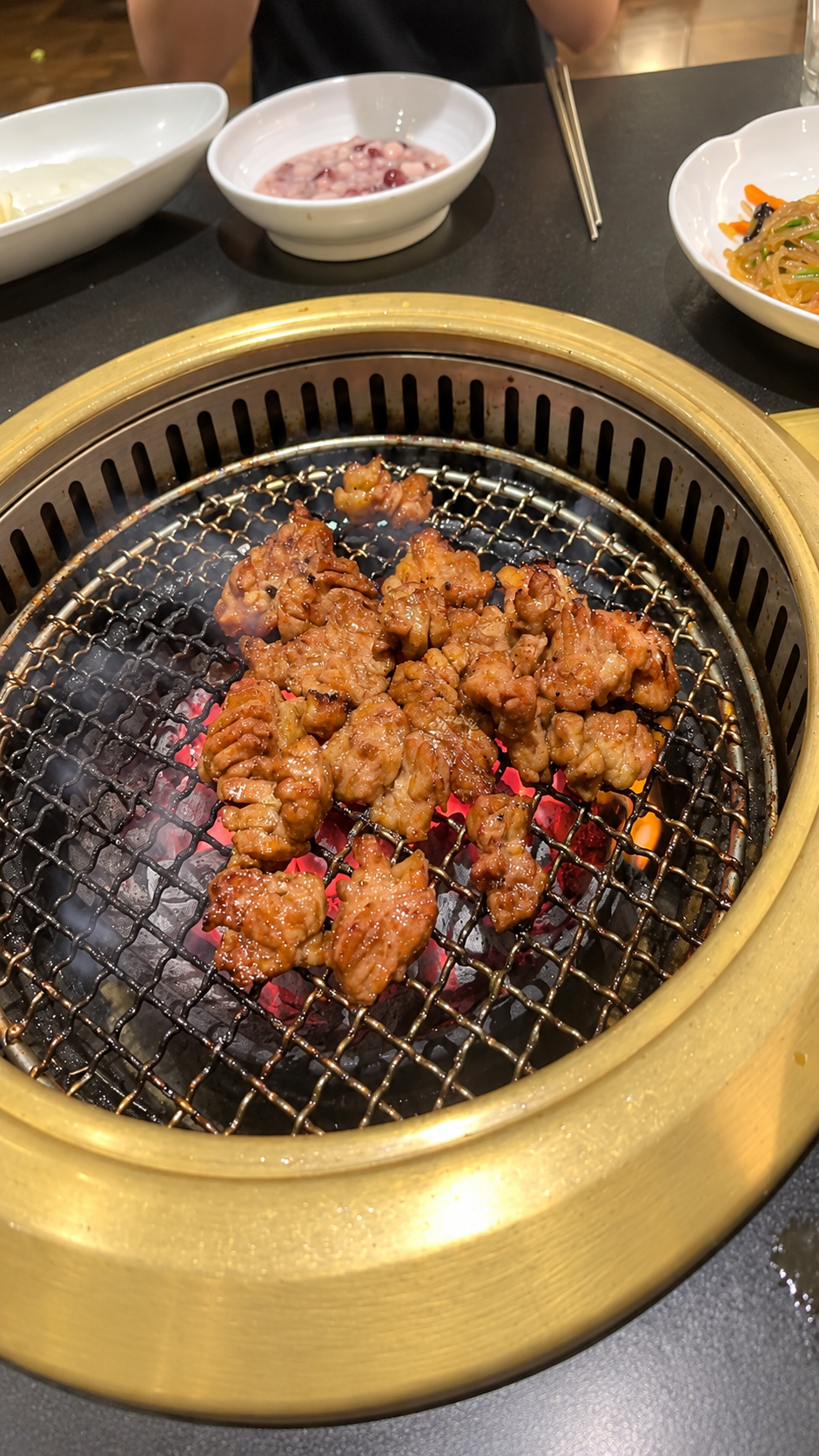
When I picture a proper dwaeji-galbi dinner, this is the scene I have in mind: meat sizzling over charcoal while everyone at the table keeps watching the grill.
And with marinated pork, somebody really does need to keep watching it.
Marinated Dwaeji-Galbi Burns Fast
If I could give someone grilling marinated dwaeji-galbi one piece of advice, it would be this:
Do not take your eyes off it.
Because of the marinade, the surface can burn surprisingly quickly.
I do not use the steak-style idea of leaving one side untouched for a long time and flipping it only once.
When I grill marinated dwaeji-galbi, I watch the fire and the surface of the meat and usually turn it quite often — sometimes around every 20 seconds.
That is not a scientific rule.
The heat of the charcoal, the thickness of the pork, and the type of grill all make a difference.
The point is simply not to leave a heavily marinated piece of pork sitting over strong heat for too long.
A little caramelization is delicious.
A black, bitter crust is not.
So I watch it. I turn it. Then I turn it again.
Keep Your Ssam Small
Both dwaeji-galbi and saeng-galbi work well in a Korean lettuce wrap (쌈, ssam).
You can start with lettuce or a perilla leaf (깻잎, kkaennip), add one piece of pork, a little Korean dipping paste (쌈장, ssamjang), maybe some garlic, and whatever else you like.
There is one mistake I see beginners make.
They put too much inside.
One piece of meat becomes two. Then garlic. Then kimchi. Then sauce. Then another side dish.
Soon the ssam is the size of a small hamburger.
I prefer the opposite.
Make it small. Wrap it tightly. Eat it in one bite.
If you build an enormous ssam and try to bite it in half, the filling tends to fall out everywhere.
This is not some strict rule of Korean etiquette.
It is simply a much easier way to eat it.
I could probably write an entire article just about ssam.
Koreans wrap far more things in leaves than many visitors realize.
One simple combination I would not skip is marinated dwaeji-galbi with plain white rice (흰쌀밥, huinssalbap). The sweet, salty marinade is strong enough that a bite of plain rice balances it beautifully. It is one of the simplest things on the table, but for me, dwaeji-galbi and hot white rice just belong together.
Soju Works. Somaek Works Too.
If I am eating dwaeji-galbi with friends, Korean distilled liquor (소주, soju) is an easy match.
The sweet, salty meat and a cold glass of soju are a very familiar Korean combination.
Another option is a soju-and-beer mix (소맥, somaek).
There is no single correct somaek ratio.
People have their own preferences.
One mixture I find relatively easy to drink is simple.
I fill a soju glass halfway with soju.
Then I use that same glass to measure two full glasses of beer.
Everything goes into the beer glass.
That works out to roughly one part soju to four parts beer.
Why use the soju glass as a measuring cup?
Because it is already sitting on the table.
No measuring jug. No milliliters. No mathematics.
Another method you may see is to pour one full shot of soju into a beer glass and then add beer until the glass is roughly 80 percent full.
But beer glasses are not all the same size, so I would not treat that as an exact formula either.
Somaek is less about following a recipe and more about finding the strength you like.

I Prefer Mul-Naengmyeon With Dwaeji-Galbi
Toward the end of a Korean barbecue meal, cold noodles often start looking very attractive.
My preference is very specific.
With samgyeopsal, I like spicy mixed cold noodles (비빔냉면, bibim-naengmyeon).
With marinated dwaeji-galbi, I prefer cold noodles in chilled broth (물냉면, mul-naengmyeon).
After eating sweet, salty, rich marinated pork for a while, the cold broth feels like it resets my mouth.
That contrast is part of why I like the combination so much.
Everyone has their own preference, of course.
But if you are trying dwaeji-galbi for the first time and see mul-naengmyeon on the menu, I would seriously consider ordering it at the end.
Dwaeji-Galbi Is Not Just Sweet Samgyeopsal
It is easy to group Korean pork barbecue together if you are new to it.
But samgyeopsal, saeng-galbi, and marinated dwaeji-galbi give me three very different experiences.
Samgyeopsal is richer and more driven by pork fat.
Saeng-galbi is cleaner, less fatty, and lets the flavor of the meat come through more directly.
Marinated dwaeji-galbi brings the strongest seasoning, especially when the sweet marinade meets charcoal.
They may all arrive at the table as pork and fire.
That does not make them the same meal.
The Full Dwaeji-Galbi Experience
If you have not noticed by now, I take Korean barbecue pretty seriously.
Charcoal.
The order of the meat.
Salt on the first bite of saeng-galbi.
Keeping the ssam small.
My preferred somaek ratio.
Mul-naengmyeon at the end.
To me, all of those small choices become part of the meal.
So if I were introducing dwaeji-galbi to a foreign friend, I would not just tell them what the meat tastes like.
I would show them how I eat it.
Because for me, Korean barbecue is not only about what you order.
It is also about how the meal unfolds around the grill.
Have a question about Korean barbecue or food in Korea? Leave a comment below. If I know the answer, I’ll be happy to help when I can.


Leave a comment