
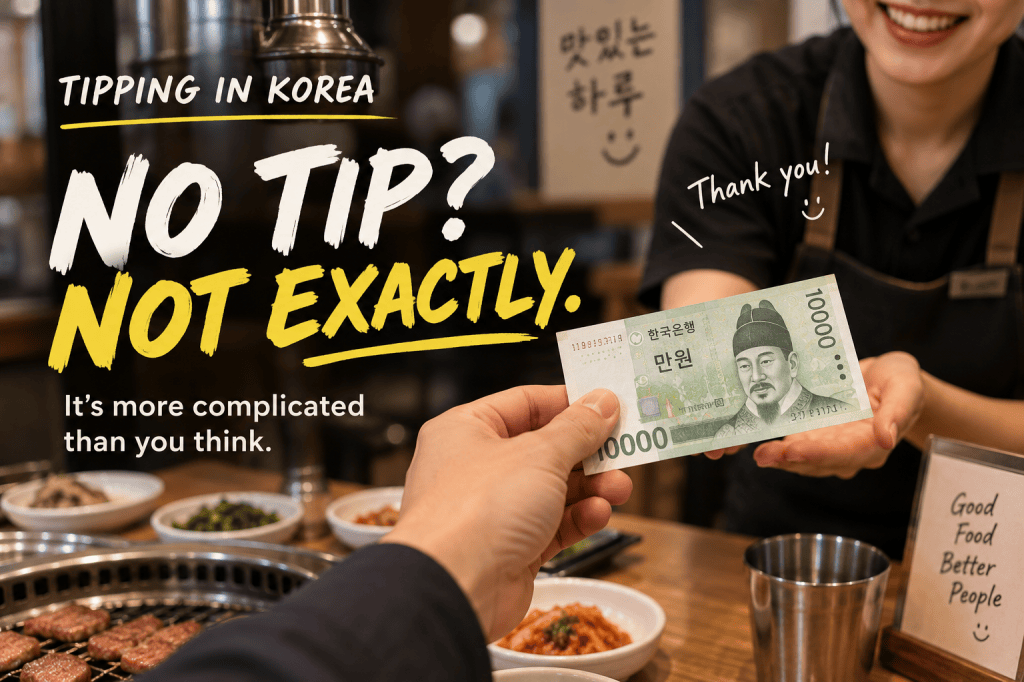
If you are visiting Korea for the first time, you may wonder:
Do I need to tip at restaurants? What about taxis? Should I leave cash for hotel housekeeping?
The short answer is no.
In most situations in Korea, you are not expected to tip. Paying exactly what is on the bill is completely normal.
But that does not mean tips never exist here.
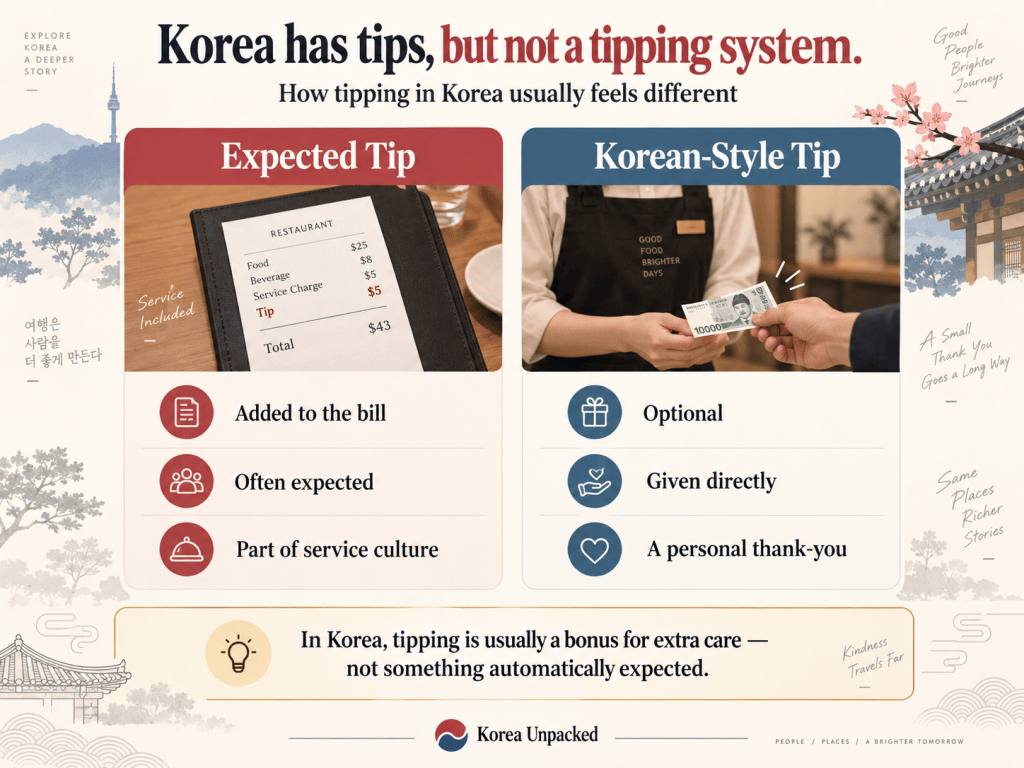
The way I see it, Korea has tips. It just does not have a tipping system.
In Korea, a Tip Is Usually a Thank-You, Not an Obligation
Official Korean tourism guidance is simple: tipping is not required or expected.
That matches everyday life. Korea does not have a fixed-percentage tipping culture where you are expected to add 15%, 18%, or 20% to a bill.
When extra money is given, it is usually because someone feels that a worker did something especially helpful or made the experience noticeably better.
A useful question is:
Did this person do something extra for me that they did not really have to do?
What I Saw When I Drove a Taxi in Seoul
I once worked as a taxi driver in Seoul.
Sometimes a passenger paying cash would simply leave the change.
For example, if the fare was ₩9,300, they might hand me ₩10,000 and say that the rest was fine.
I have done the same thing myself when taking a taxi and paying cash. If the change is only a few coins or a small amount, I sometimes just say I do not need it.
Technically, that is extra money. You could call it a tip.
But culturally it feels closer to saying, “Keep the change,” than participating in a formal tipping custom.
You do not need to tip taxi drivers in Korea.
You Do Not Normally Tip at Korean Restaurants
At an ordinary Korean restaurant, just pay the amount on the bill.
If the restaurant normally has staff grill the meat for customers, that is part of the restaurant’s normal service. You do not need to tip simply because someone cooked the meat at your table.
The situation feels different when someone goes beyond what that restaurant normally does.
It Feels Different When Someone Does More Than They Normally Have To
Imagine a restaurant where customers normally grill their own meat.
A foreign visitor is struggling with the grill, the scissors, and the timing. An employee notices, comes over, cooks and cuts the meat, explains what to do, and keeps checking the table even though that level of attention is not normally included.
The employee probably is not expecting a tip.
But if you genuinely appreciated the extra effort, giving something directly to that person can be a nice gesture.
High-End Sashimi and Tuna Restaurants Can Feel a Little Different
Personally, I am more likely to give extra money at a higher-end sashimi or tuna restaurant when one staff member has looked after our table for a long time.
In that kind of situation, I might give ₩10,000 or sometimes ₩20,000 as a personal thank-you.
That is my own habit, not a rule that Korean diners are expected to follow.
If You Want to Tip, Give It Directly to the Person Who Helped You
If I want to thank a particular employee, I prefer to give the money directly to that person rather than add something to the bill.
The point is not “I owe the restaurant more money.”
It is closer to: “Thank you for taking such good care of us.”
10,000 Won Can Already Be a Meaningful Gesture
You do not need to calculate a percentage.
From my experience, ₩10,000 can already feel like a clear and meaningful thank-you when someone has done something extra for you.
The amount matters less than the fact that it is voluntary and tied to a specific act of care.
If They Refuse Once, You Can Offer One More Time
There is another very Korean part of this situation: the first response may be a refusal.
Sometimes that is genuine. Sometimes it is politeness or awkwardness about accepting money directly.
If the staff member refuses at first, you can politely offer it once more.
If they clearly refuse again, do not insist further.
You Do Not Need to Leave Cash for Hotel Housekeeping
I do not normally tip at hotels in Korea.
You do not need to leave cash on the bed for housekeeping in a Korean hotel.
If a hotel bill includes taxes or a service charge, that is part of the hotel’s pricing. It is not the same thing as giving a personal tip to an employee.
Koreans Sometimes Give Extra Money in Other Situations Too
Designated Driving Service
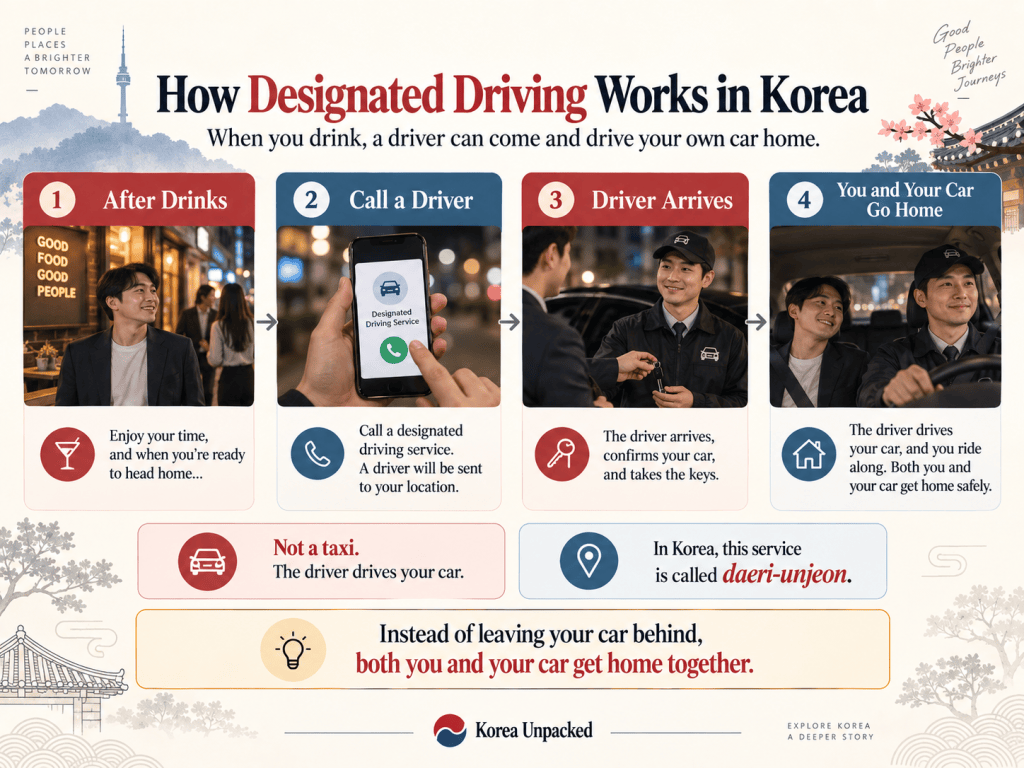
Korea has a common service called a designated driving service (대리운전, daeri-unjeon).
If you have been drinking, a driver comes to your location and drives your own car to your destination while you ride along.
So instead of leaving your car behind and taking a taxi home, both you and your car get home together.
I have sometimes given a little extra when the trip was late at night, the destination was far away, or the location made it difficult for the driver to get back afterward.
Again, the agreed fare is enough. The extra money is simply a way of saying, “Thanks for the trouble.”
Golf and the “Birdie Tip”
Korean golf also has a few situations where optional extra money appears.
The regular caddie fee is not a tip. It is part of the cost of the round.
But some golfers may give a small birdie tip (버디팁, beodi-tip) after making a birdie, simply because everyone is in a good mood.
A beginner may also give something at the start and say, in effect, “Please take good care of me today,” or give extra afterward for especially good service.
These are customs you may encounter, not mandatory rules.
Business Entertainment
I have also seen people give extra money directly to a staff member who is taking care of a private room or an important business dinner.
The meaning is often something like, “Please take good care of us tonight.”
This is situational, not something every Korean does.
So What Should Foreign Travelers Actually Do?
- Restaurants: No tip is normally needed.
- Taxis: No tip is needed. Leaving small cash change is optional.
- Hotels: No need to leave cash for housekeeping.
- Exceptional personal service: An optional direct thank-you can be appreciated.
- If someone refuses: Offer once more politely, then stop if they refuse again.
The most important thing is not to worry that you are being rude by failing to tip.
In Korea, paying the listed price is normal.
Korea Has Tips, but Not a Tipping System
That is the distinction I would remember.
Koreans sometimes give extra money. I have received it as a taxi driver, given it myself in restaurants, and seen it in other parts of Korean life.
But it is usually not an automatic percentage added because society expects you to pay more.
In Korea, a tip is usually a bonus for exceptional service — not part of someone’s expected wage.
Have a question about Korea? Leave a comment below. If I know the answer, I’ll be happy to help when I can.


Leave a comment