
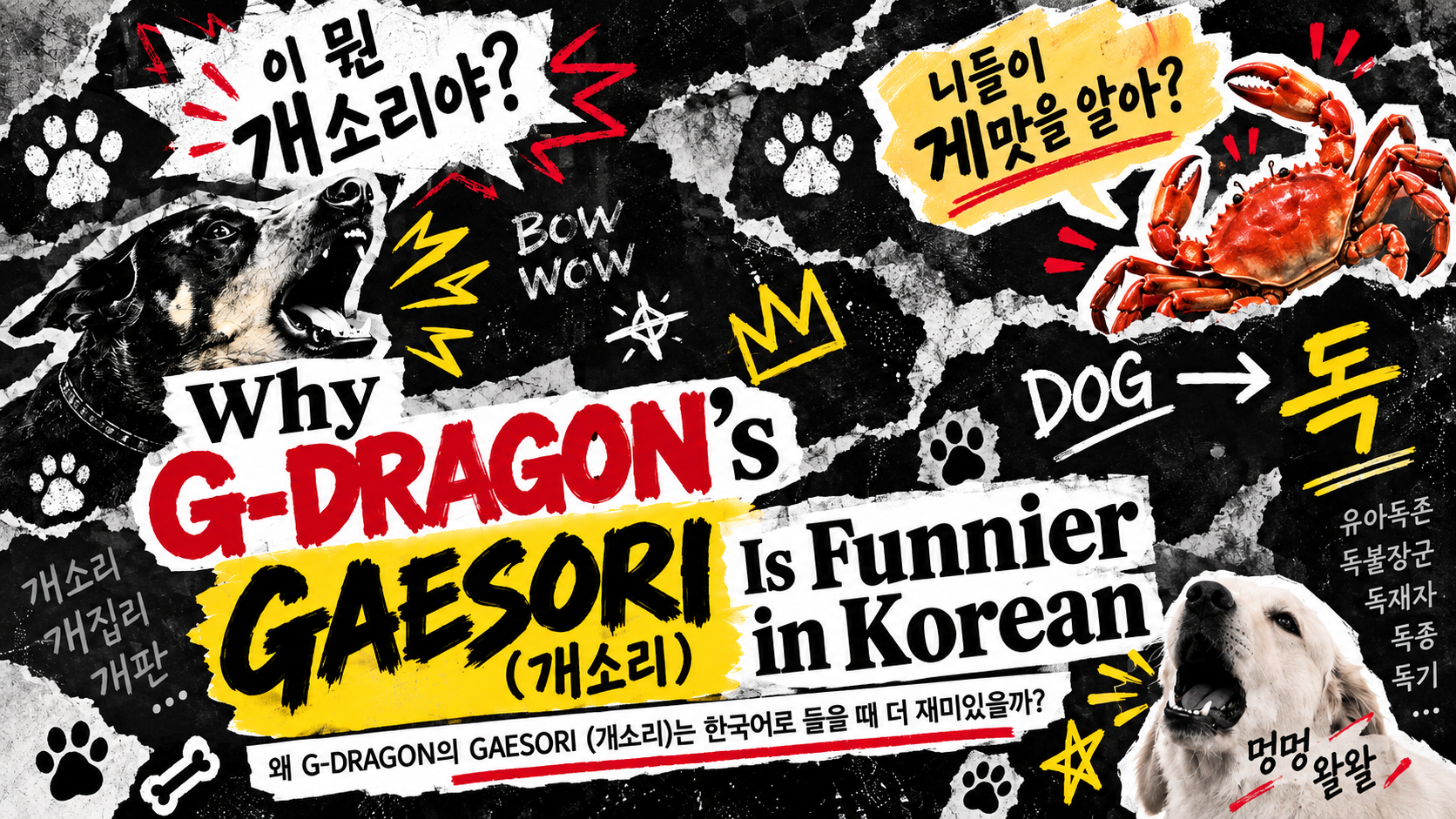
G-DRAGON’s “BULLSHIT” has a Korean title that literally looks much stranger: bullshit or nonsense (개소리, gaesori).
The English title is a good translation. In Korean, gaesori is what you might call ridiculous talk, nonsense, or—more bluntly—bullshit.
But there is a problem. The moment you translate it as “BULLSHIT,” part of the joke disappears.
Literally, gae (개) means “dog,” and sori (소리) means “sound.” So gaesori can also look like “dog sound.” G-DRAGON keeps playing with both ideas throughout the track.
“BULLSHIT” translates the meaning. It cannot translate everything a Korean listener hears.
The Whole Song Keeps Playing With 개 and DOG
The lyrics keep returning to dog-related Korean expressions: gaesori (개소리), doghouse (개집, gaejip), a total mess (개판, gaepan), and so on.
Then DOG, “Bow Wow,” Korean barking sounds such as meong-meong (멍멍), and more are layered over them.
The point is not simply that the song mentions dogs a lot. G-DRAGON keeps connecting the many ways gae appears in Korean with the English word DOG, and then pushes the sound play even further.
Two References Many Korean Listeners Recognize Immediately
“What Is This Bullshit?” Was Already a Famous Korean Meme
The repeated line “What is this bullshit?” (이 뭔 개소리야, i mwon gaesoriya) was already a familiar Korean internet meme before this song.
It comes from the 2007 MBC drama The Legend (Taewangsasingi), where actor Jang Hang-seon delivers the line as Heukgae. The delivery was so forceful that the clip later became a common reaction meme for absurd or ridiculous statements.
So for a Korean listener who knows the meme, the line can bring back more than its dictionary meaning. The voice and the cultural memory come with it.
“Do You Know the Taste of Dog?” Sounds Like a Famous Ad
Another line says, roughly, “Do you know the taste of dog?” (너희들이 개 맛을 알아, neohuideuri gae maseul ara).
For many Koreans, that immediately echoes one of the most famous Korean advertising lines of the early 2000s: “Do you know the taste of crab?” (니들이 게맛을 알아, nideuri ge-maseul ara), delivered by actor Shin Goo in a Lotteria commercial.
I have not found a statement from G-DRAGON confirming that he intended this specific reference. But as a Korean listener, the connection is hard not to hear: ge-mat (게맛, crab taste) becomes gae mat (개 맛, dog taste), while the famous sentence structure stays almost intact.
Wordplay That Translation Flattens
The song keeps doing this with smaller Korean jokes too.
Take “go ask” (가서 물어, gaseo mureo). The verb mureo can mean “ask,” but in another context the same form can mean “bite.” In a track obsessed with DOG, both meanings can sit in the listener’s head at once.
Then there is the Korean expression for ridiculous nonsense (개 풀 뜯어 먹는 소리, gae pul tteudeo meokneun sori). Literally, it sounds like “the sound of a dog grazing on grass.” That absurd literal image fits the dog theme perfectly, while the idiomatic meaning loops back to gaesori.
“RUN DOG RUN” also points toward Christopher Wool’s text-based work Untitled (1990), which uses the same phrase. It is another reference that fits neatly inside the track’s DOG obsession.
The Rhymes You Lose in Translation
Lyrics are not just text on a page. Rap is something you hear.
In Korean, line endings are repeatedly matched by sound. Two of the clearest examples are:
- dokjon / dokjong (독존 / 독종)
- pureo / pumeo (풀어 / 품어)
The words do not mean the same thing, but the final two-syllable sound shapes are very close. That is the rhyme.
The same thing happens in the non-Korean lines: Qué pasa / Mi Casa, FUNNY / MONEY, and HOMIE / OWE ME.
This matters because a literal English translation can preserve the meaning of dokjon, dokjong, pureo, and pumeo—but once they become unrelated English words, the original rhyme disappears.
The meaning survives. The rap changes.
From DOG to 독: The Wordplay Crosses Languages
This is the part I find most interesting.
The song spends so much time saying DOG in English that, semantically, a Korean listener is still hearing the same idea again and again: dog, dog, dog—개, 개, 개.
Then the sound seems to pivot into the Korean syllable dok (독).
Suddenly we get words such as yuadokjon (유아독존), dokbuljanggun (독불장군), dokjong (독종), and dokgi (독기).
DOG and dok are not identical pronunciations. And I have not found a statement from G-DRAGON explicitly saying this was his intention.
But to my Korean ear, the transition is hard to miss. First the song links Korean gae with English DOG by meaning. Then DOG seems to hand the rhyme over to Korean dok by sound.
개 → DOG → 독.
And inside that run, dokjon / dokjong creates another rhyme.
Translate all of those words into English and the meanings can survive, but the sound chain vanishes.
개- Does Not Always Mean “Dog” in Korean
One more thing helps explain why this track works.
Gae (개) is, of course, the Korean noun for “dog.” But in modern casual Korean, gae- can also appear as a rough intensifier.
You may hear expressions such as “really hilarious” (개웃겨, gae-utgyeo) or “I really love it” (개좋아, gae-joa).
Depending on context, it can feel closer to “really,” “damn,” “freaking,” or something stronger. It is casual and rough, and it deserves a separate article of its own.
For this song, the important point is simple: when a Korean hears gae, “dog” is not the only possible layer.
“BULLSHIT” Is Accurate. It Just Cannot Carry Everything.
Calling gaesori “BULLSHIT” is not a bad translation. It is probably one of the best short translations available.
But a Korean listener may also hear an old drama meme, remember a famous hamburger commercial, catch the rhyme in dokjon / dokjong and pureo / pumeo, and hear English DOG slide toward Korean dok.
That is why translating this track line by line is not enough.
You can translate what the lyrics mean. You cannot translate everything a Korean listener hears.
Have you heard another Korean word in a K-pop song or drama that made no sense when translated literally? Leave a comment below. If I know the answer, I’ll be happy to help when I have time.
Leave a Reply